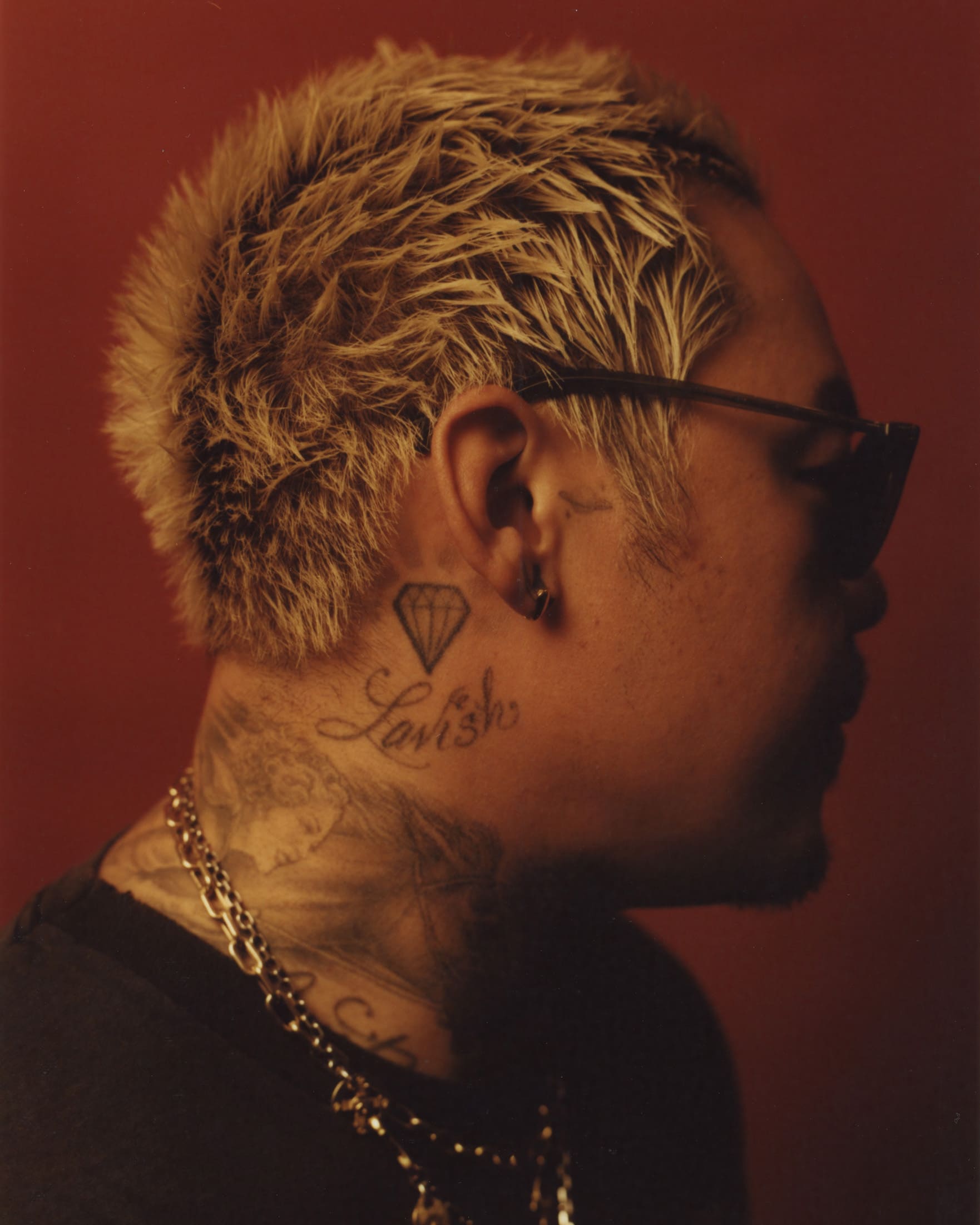
DR. WOO
- Words Marianne Eloise
- Photography Justin Chung
Meet the tattoo artist who's inked LA.
- Words Marianne Eloise
- Photography Justin Chung
- Photo Assistant Julien Sage

The making of a celebrity tattoo artist is difficult to trace. They are not always more talented or visionary than their peers, or more aggressive in their pursuit of the spotlight. The shift to fame can happen seemingly overnight: One day they are toiling away in someone else’s studio, the next day musicians and actors are lining up to be inked by them. So it was for Dr. Woo. Now in his 40s, the LA-based artist’s work first exploded in popularity in 2016, and today his celebrity clients include Frank Ocean, Justin and Hailey Bieber, Kid Cudi, Miley Cyrus and Zoë Kravitz.
Some aspects of Woo’s lore are exaggerated: The story that he called himself Dr. Woo to please an overbearing parent is something he let run because it’s “funny.” (In reality, he says, his parents are just happy that he’s given them two grandchildren.) He doesn’t really have a two-year waiting list; it would be suffocating to book that far ahead. He doesn’t have much of an ego, either. Introducing himself as Brian on the phone, he is clear, humble and in love with his practice. He talks about his compositions in exacting detail, like he’s conducting an orchestra.
Once you know what you’re looking for, Woo’s work—and its imitators—are recognizable anywhere: small, intricate, single-needle designs in gray tones. Taking cues from Los Angeles culture, his signature pieces include palm trees, animals and geometric patterns. This style took a while to develop. He started getting tattooed at 11 with his friends (sewing needles and Indian ink) and at 14 got his first real tattoo at a studio off Melrose Avenue. “I remember it was Thanksgiving because the artist was on the phone asking where to get a turkey last minute. He told me, ‘If your parents ask you where you got this tattoo, you gotta tell them you went to Mexico,’” says Woo. “He knew I was young, but he didn’t care enough not to do it.” The piece, a small dragon on his ankle, moved as he grew and is now somewhere around the middle of his calf.
As an 18-year-old at the turn of the millennium, he started to collect tattoos by well-regarded artists. Among them was Mark Mahoney, the proprietor of Shamrock Social Club in Hollywood, who was a “god” to him and his friends. But Woo had no intention of becoming a tattoo artist himself. He tried college, then worked as an assistant buyer for a skate shop. He was also running his own clothing brand, but it never went very far: “I got bogged down, and it was hard to get backers and people interested.” During that time, he was hanging out at Mahoney’s shop, getting a lot of tattoos and competing with his friends to be the most covered.
When Woo was in his early 20s, Mahoney asked if he had ever considered becoming a tattoo artist. Woo felt that he was the antithesis of the guys he was getting tattooed by: A first-generation immigrant born to Taiwanese parents, he looked and felt different from the men in the industry. “I was intimidated because everyone in the shop looked like they were born a tattoo artist, and I wasn’t. I was born into a very conservative Asian family. It was scary!” But it felt right. The story goes that he quit his job the next day. (Actually, he says now, there’s some myth in there: He did both jobs for a week or two before going “all in.”)
For a few years, Woo apprenticed without even touching a machine. He was the first to arrive at the shop and the last to leave, helping to set up for the day, clean equipment and take care of any administrative work that needed doing. “I wanted to be completely organic and do it the right way,” he says. When he finally got behind a machine, he was learning from Mahoney, who he describes as one of the first “champions” of single-needle tattooing. “I learned my technique and style from Mark. He was doing it in a very old-school way in terms of the subject matter and the style, but he made it his own.”


In 2021, Woo collaborated with Swiss watchmaker Roger Dubuis to create a new timepiece.
“The fewer lines
there were, the more
impact it held.”
At the time, most well-known tattoo artists were pushing designs that were big and bold: dragons, tribal tattoos, skulls, naked women, maybe a little blood here and there. But tastes were changing and evolving technology made delicate, hyper-detailed tattoos possible. Woo developed his own spin on Mahoney’s style, something he credits in part to the input of his early clients. “A lot of them were artists and creatives, so the ideas started getting really cool. They found the strength and density in minimalism where the fewer lines there were, the more impact it held.” This put him onto the idea of “telling small, detailed stories that you could hide and that could be a little bit anonymous on the skin.”
There is uncertainty in Woo’s voice when he discusses what happened next. It was difficult, he says, when he became more successful than his peers and mentors. While still at Shamrock, he had started to share his work on Instagram: “It got crazy. There was a lot of attention and demand, but it was tough because I was the lowest on the totem pole in the shop,” Woo says. He felt like the success was undeserved compared to his colleagues who had been toiling away for years. It made for complicated workplace politics. “I had to respect my fellow artists and my boss while growing. I felt shame about the success because I didn’t want to feel like I was overstepping my boundaries or competing with these other guys.”
He attributes his success not to being better, but to his delicate style becoming popular. In fact, when he became so overbooked that he couldn’t see everyone, his colleagues adopted it. “I was bringing a lot of business into the shop, but it was bittersweet. It was good for the shop but bad for my relationships.” Looking back, he feels some sadness over those complex workplace dynamics, but he mostly feels proud. “Mark created this shop where all these fine line tattoos were coming from. It took me a long time to understand that it’s not not being humble to recognize your position and your work.”
Woo now works out of a private studio, which adds to the mystique—you only find out the location when you secure a coveted booking. But what remains the same is that he’s in LA, the city he grew up in and the only one he can imagine living in. “This is all I’ve ever known. . . . There’s something special about this city, we’re different cultures living on top of each other. There’s no racial divide.” He sees it, rather optimistically, as a center for opportunity, a place where you can show up with two bucks and figure it out. As well as tattooing, Woo has launched a skincare line (with a focus on products that will be gentle to freshly inked skin), the coffee table book Everything is Permanent and collaborations with brands including Sacai, Roger Dubuis and Jean Paul Gaultier.
No matter who the artist is—and how hyped they are—tattooing is simple. It’s about driving ink into skin. It’s about making a permanent decision that you may regret, but if you have the right relationship with the right artist, you might not. Rapport can outlive a session; part of what Woo’s clients are paying for is membership in his club. So, what of that mythical two-year waitlist? Woo shuts it down. “If you’re that booked out, you are lucky to be successful in business, but it’s almost like handcuffs,” he says. Woo has a flexible schedule wherein if he’s home and working, his assistant gets people in. Even after almost a decade of success, he is superstitious about saying his books are full: “It’s like saying ‘Bloody Mary’ in the mirror. If I vocalize it, I’m going to curse it. I feel blessed to even be booked at all.”