© Louis Monier / Bridgeman Images
Jacques Cousteau
The man who taught a generation to love—and protect—the oceans.

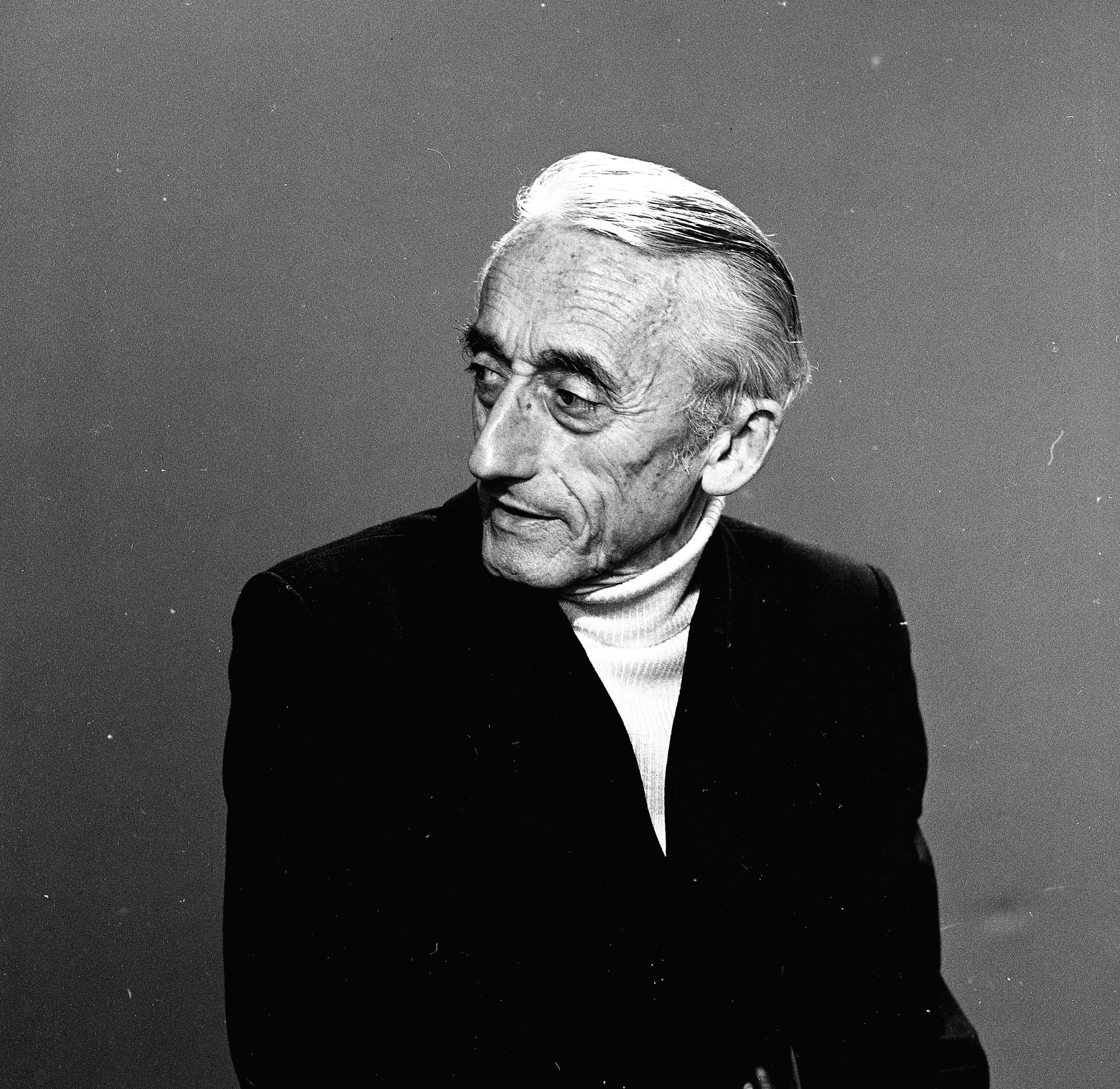
Photograph: Yousuf Karsh, Camera Press London.
In The Undersea World of Jacques Cousteau, the explorer uses inventive and often foolhardy techniques to film animals in close proximity, including approaching hippos by hiding inside a hippo-shaped stalking horse.
In the autumn of 1977, Jacques Cousteau was on a six-week tour of the US to raise funds for filming his much-loved documentary series that was airing on American television at the time. The lectures sold out in each city he visited, attracting crowds bigger than many rock bands. During a stop in Seattle, a group of local schoolchildren came to meet him before the event. Handing him a drawing of a colorful underwater world, one child shyly asked what it was really like deep down in the sea. “It’s fantastic underwater,” Cousteau answered with a dazzling smile. “It feels like floating in space.”
With his red hat, long wiry face and instantly recognizable French accent, the then 67-year-old oceanographer had become a subject of fascination the world over for opening humans up to a previously unknown part of the planet: oceans. Sailing around the world on the Calypso, his ship and floating lab, Cousteau dedicated his life to exploring the sea and all forms of underwater life, and shared his adventures with millions of television viewers in hit series such as The Undersea World of Jacques Cousteau and The Cousteau Odyssey. “He was an extremely charismatic person and a master showman: He knew how to explain the ocean environment to people in ways that didn’t necessarily involve hard science,” Brad Matsen, the author of the biography Jacques Cousteau: The Sea King, tells me on the phone. “We knew so little about it that the idea of him roaming around and filming underwater was immediately attractive. He showed us places we could only imagine going.”
Funnily enough, despite his contagious, almost childlike enthusiasm, being a maritime explorer never figured in the young Cousteau’s dreams. Born to an upper-middle-class family near Bordeaux in 1910, he had three career ambitions as a boy: to become a pilot, a film director, or a medical doctor. Though he learned to dive before his 10th birthday, he was determined to pursue the goals he had set out, saving up his pocket money to buy an early Pathé movie camera at age 13 and later entering the École Navale to train in naval aviation. But his life changed its course drastically when one foggy evening he crashed his father’s sports car and broke both his arms. The accident forced Cousteau to rethink his professional choice of flying airplanes, and so he turned to the ocean instead, starting to shoot underwater films with his friends from naval college in the early 1940s and experimenting with breathing equipment to be able to dive for longer.
If Cousteau is today known for having co-invented, among others, the Aqua-Lung scuba regulator, the world probably owes the contraptions he came up with to his insatiable quest for the best footage. “As madcap as they may seem, the inventions of Cousteau were in fact extremely pragmatic,” Matsen explains. “He created the Aqua-Lung because he wanted to make [his 1943 film] Épaves. The first ocean dive he did with its prototype was to harvest lobster. He was an opportunist; he was driven not so much by his advocacy of science, but by his desire to do exactly what he wanted to do.” For example, when World War II prevented him from finding blank reels of film for making Épaves, he ended up splicing together hundreds of small reels designed for a brand of children’s camera.
“The sea’s most monstrous force doesn’t live in Loch Ness. It lives in us.”
In The Undersea World of Jacques Cousteau, the explorer uses inventive and often foolhardy techniques to film animals in close proximity, including approaching hippos by hiding inside a hippo-shaped stalking horse.

Photograph: Popperfoto/Getty Images.

Photograph: © AGIP / Bridgeman Images.
“Man has only to sink beneath the surface and he is free. Under water, man becomes an archangel.”
Later, for his 1956 documentary The Silent World—which won the Palme d’Or and an Academy Award—he shot over 15 miles of film, of which only one-tenth were used in the final version.
In everything he did, Cousteau was guided by his unquenchable curiosity. Since floating underwater was the closest he could get to his childhood dream of flying, he pushed boundaries to chase the freedom of the deep sea and capture it for generations to come.
Cousteau once wrote: “From birth, man carries the weight of gravity on his shoulders. He is bolted to the Earth. But man has only to sink beneath the surface and he is free. Buoyed by water, he can fly in any direction—up, down, sideways—by merely flipping his hand. Under water, man becomes an archangel.”
To keep pursuing his passion, he thought outside existing systems. In the 1960s, Cousteau and his team built a series of pressurized underwater habitats in which they could live and work directly on the seafloor. Large windows with unblocked views of the real-life aquarium enabled them to study the ocean environment in more depth. When the crew reappeared after 30 days continuously spent underwater, they had set a new world record that only Cousteau’s grandson, the aquanaut Fabien Cousteau, would break 51 years later.
While the first half of Cousteau’s life was dominated by exploring and filming the undersea world, he would spend the years until his death in 1997 advocating for its preservation. Over four decades of expeditions, he began to notice that this once rich and biodiverse realm was becoming the victim of pollution. The waters of his youth were increasingly robbed of their crystalline quality by heavy metals and other toxins, leading him to conclude that “the sea’s most monstrous force doesn’t live in Loch Ness. It lives in us.”
To educate people about the alarming state of the oceans, he founded the still-active Cousteau Society in 1973. Around that time, he also started dedicating entire episodes of The Cousteau Odyssey television series to environmental disaster, contrasting old footage of colorful marine life with shots of today’s bleak reality. “The concept of ecology simply didn’t exist in most households until Cousteau came on television,” Matsen insists. “People started to understand that we have got to change our ways or otherwise we will extinguish ourselves. He surely wasn’t the first to popularize the environmental movement, but he was its first mass hero.”
Despite uncovering more of the underwater world than anyone before him, Cousteau remained an outsider to the scientific establishment. While some oceanographers doubted the importance of his research, others accused him of hypocrisy, especially when it came to his ecological commitments. They questioned how someone who had his first missions sponsored by the likes of British Petroleum could suddenly be a champion of marine conservation. Many also accused him of capturing dolphins to get the best wildlife shots for his films. To Cousteau’s admirers, however, he was aware of his own failings and his preservation efforts were an honest attempt to reverse some of the ills he had committed in the 1950s.
What matters today is that his work not only laid the foundation for generations’ worth of research, but shared the importance of protecting the oceans with the world. “We owe a lot of our dreams and our sense of curiosity to him,” Fabien Cousteau says of his grandfather’s legacy. “His work inspired people to make better decisions in their daily lives, so that hopefully, in the future, we can live with the ocean as our life support system, rather than eating away at it.”