Karin Mamma Andersson

  • Words Emily Nathan
  • Photography Staffan Sundström
  • Styling Naomi Itkes

Inside the moody, mysterious world of Sweden’s preeminent painter.

Issue 49

, Scandinavia

,
  • Words Emily Nathan
  • Photography Staffan Sundström
  • Styling Naomi Itkes

Andersson at her studio in Stockholm's SoFo neighborhood, with works under production for a new exhibition at David Zwirner Gallery in Paris opening in October 2023.

The Swedish painter Karin “Mamma” Andersson is reluctant to recount how she got her name. “Everybody always asks me about that, so it’s boring to me now,” she says, and launches into the tale, making me promise that I’ll keep it to myself. It’s a good story, and it takes us back to her art-school days as a bright-eyed fugitive from the country’s dark north—a lonely girl who found her place in the big, cold city. At the heart of the story is a kernel of amiable perversity, a mischievous refusal to do what’s proper or what’s expected, and it’s there that I discover a foundational truth about her, an essential characteristic that can be found blossoming throughout her saturated, soulful canvases: Mamma Andersson is an outlaw. 

You’d never know it, by looking at her. In a vintage blouse and leather lace-ups, her hair parted neatly in the middle and twinkling eyes framed by large plastic rims, she appears wholesome rather than contrarian; bookish rather than bold. But she speaks with surprising frankness, betraying her insecurities in an offhand, lighthearted kind of way, and peppers her narratives with anecdotes of subtle resistance.

When I arrive at her Stockholm studio on a sunny day in April, Andersson is not wearing pants, despite a photographer and his assistants huddled behind the lens of a camera on a tripod. “Sorry,” she says with a roll of her eyes, pulling on a pair of wrinkled jeans. “I’ll be decent now. You wouldn’t believe what they brought me for this photo shoot—oversize jackets in crazy colors, what all the Stockholm ladies are wearing. I don’t like how they all look the same. But I did recently see the film Tar, and I had a big problem after because I felt, Oh, I’m so masculine! I must do something to be more feminine.” Having completed the thought out loud, she buries her face in her hands.

Andersson is arguably Sweden’s most famous contemporary artist. Since breaking into the American market with a show at David Zwirner Gallery in New York, she has conquered the international landscape, winning the Carnegie Art Award, representing Scandinavia at the Venice Biennale, and joining the permanent collections of such hallowed institutions as New York’s MoMA, the Centre Pompidou in Paris, MOCA in LA and Stockholm’s Moderna Museet. 

For the past 13 years, she has worked in this airy atelier occupying the bottom floor of a lemon-yellow building between a kindergarten and a park in the Swedish capital. Flanked by windows, the space overflows with books, which are stacked and piled on ceiling-high bookshelves or spread open on the paint-splattered floor. There are easels against walls, easels under windows and tables dripping with pigment: oil paints in thick, creamy chunks; a rainbow of acrylic tubes, crudely arranged. A collector, Andersson has staged altars around the room, modest vignettes of meaningful objects that provide both atmosphere and inspiration. 

Andersson's latest paintings have been inspired by large 18th-century mirrors.

( 1 ) In Frieze, the writer Ronald Jones wrote that About a Girl was arguably Andersson’s “masterpiece.” He mooted that the painting reflects similar themes to a Kurt Cobain song of the same name in which the singer resists the commitment that would save a wobbling relationship.

“If you work with art, you take the water from your own well.”

What makes her work remarkable is the color, the vision, the downright painterliness of it all; her large, heavy canvases pulse with texture in dreamlike figurations that evoke the great painters of the past. But her similarity with her predecessors stops there. While she might be described as an expressive impressionist, teasing gestures from books or paintings into domestic tableaux and panoramic landscapes that reflect the world around her, Andersson’s paintings do not celebrate or idealize. There is no romance in her rich compositions, and though they do seem to integrate some fantastical dream state with familiar motifs from a catalogue of shared cultural references, they always provoke the unsettling feeling that something is awry. Her skies are shaded an eerie, apocalyptic pink that tingles with storm; the light is glaring, without shadow; her lakes are bottomless. Hauntingly beautiful, her paintings are suffused with darkness. 

Andersson was born in 1962 in Norrland—the northernmost and least populated of Sweden’s territories. In the Western imagination, this remote Nordic region represents desolation, a vast accumulation of sprawling tundras and mysterious folklore where the endless days of summer melt into the eternal darkness of winter. With its dramatic seasons and infinite space, this landscape was the backdrop for what she describes as a “very ordinary” childhood, one lacking in the textbook turmoil that might make somebody “interesting.” But just consider what it’s produced: Her paintings beg for psychoanalysis. 

“If you’re scared of something, you’re also curious, fascinated by it—and I have been scared of the dark my whole life,” Andersson reflects, chronicling a youth complete with all the trappings of health and happiness: supportive, creative parents; a sister; a summerhouse; friends and activities. It’s safe to hazard that in the absence of circumstantial struggles, Andersson has created her own ghosts, fleeing the easy, complacent brightness of her upbringing and seeking the anxiety of the unknown. “In a way, I think I have always been listening with an adult’s eyes and ears,” she says, “even when I was too young. My parents gave me a lot of freedom, but I felt that it was just lonely space. And they never understood why I ran away.”

Her preoccupation with the dark side of things is evident in all of her paintings, throbbing beneath their gorgeous surfaces like a heartbeat. Take the canvas About a Girl, from 2005, an ostensibly benign snapshot of eight young women—her schoolmates—sitting together around a coffee table. This canvas, Andersson confesses, has brought more than one child to tears. And it is truly nightmarish: Staring blankly out from empty eyes, irises so blue that they bleed into the white, the girls evoke witches, their faces twisted into enigmatic smiles, their hair pierced by thick strokes of black. Behind them, through the window, a putrid green landscape crawls with shadows.1 

The title promises a picture of a pretty Swede, but the image delivers a visualization of something broken, something lost. “In a group of girls, you can feel the hierarchy between them, and it’s a very fragile balance,” Andersson explains. “I remember being there at that table with my friends, and the feeling of utter isolation. They’re together but they’re alone, all of them.” 

( 1 ) In Frieze, the writer Ronald Jones wrote that About a Girl was arguably Andersson’s “masterpiece.” He mooted that the painting reflects similar themes to a Kurt Cobain song of the same name in which the singer resists the commitment that would save a wobbling relationship.

and the stylist's own archive.

When arriving in Stockholm by plane, the bones and silhouettes of Andersson’s paintings reveal themselves like fossils: aerial views of lakes snaking between hillsides, red farmhouses surrounded by mahogany-tipped brush, and stands of trees, their shadows jutting into the water. Trains disappear under craggy rock and emerge again into ochre stretches of ground; pines mingle with the brown spindles of bare trunks. There is forest, too, thick and deep—even the airport is fringed by forest. For a country so civilized, there is something wild about it: The sheer scale of the landscape is overwhelming. 

“If you work with art, you take the water from your own well,” Andersson tells me, when I ask why she has described every painting as a self-portrait. “And of course, you can borrow water from other people’s well, but the main source is coming from yourself. I’m often asked if I have a plan for my paintings, but I don’t. I walk in and see the rug I painted yesterday and I think, Okay, I need a floor under the rug. Or, that rabbit must have fur—it’s too flat. Or, these colors are not so good together. I see what’s there, and I respond to it. It’s an intuitive thing, but to be intuitive, you have to trust yourself. And that takes time.”

These days, her studio is filled with canvases she’s creating for an upcoming show at David Zwirner Gallery in Paris. “Ah, the empty rooms,” she sighs. Indeed, the paintings depict moody, grand spaces, interiors and exteriors, reflected in surfaces that echo to infinity—all of them devoid of life. She says that she’s recently been fascinated by large, 18th-century mirrors whose size required the junction of two panes, producing a distorting seam in the middle, and that they continue to make an appearance in her art. “These rooms and these warped reflections just seem to be what’s coming out right now,” she adds, gesturing toward a collage of reference images on the wall: a Japanese block print of a geisha; wallpaper patterns. “And it’s a metaphor, probably. I’m just letting the process tell me where to go.” 

At lunchtime, we make our way across the park to Post Bar, a neighborhood diner where Andersson eats three times a week. She greets the waitresses warmly, and we’re seated in a booth. Over steamed fish and potatoes, she orders a beer and speaks wistfully about motherhood, her parents, her sons, until a game of tag between a bird and a rat on a pile of dirt outside the window ensorcells her. “Magpies are very smart, you know; the bird is taunting the rat on purpose!” she says, and stops to watch them as we leave, her eyes gleaming with approval. 

Back at the studio, she invites me to join her on the couch for a slice of cardamom cake. “I think my way of working has really changed,” she says, unprompted. “I do much more by hand, and don’t use so much reference—it makes you secure in one way, but insecure in another. You lean on the picture, but it’s better to lean on yourself.” A magpie of sorts, Andersson has spent her life establishing a homemade archive of found photographs that she has historically used as inspiration, copying an element from an image and using it as “the entrance into a painting.” But in recent years, she tells me, she prefers to rely on her own interior aesthetic world, and has become confident enough to trust her instincts—no matter what shape they might take on the canvas. 

“Many of the artists I appreciate most, like Guston or Van Gogh, didn’t care if it looked right or not,” Andersson says, gazing at a series of black-and-white photographs on the wall. They are portraits of the artists who mean the most to her: Paul Gaugin, the writer Gustaf Hellström, Edvard Munch, Paul Matisse, Picasso—and the Marx Brothers. “It’s something very beautiful and simple when you are not correct. You can have much more experience than painting precisely after a photograph, making porcelain so real you could touch it. That can be very nice, but it can also be very uninteresting, because the reality is always there in front of us. I think what we need, what we really need, is the fantasy.”

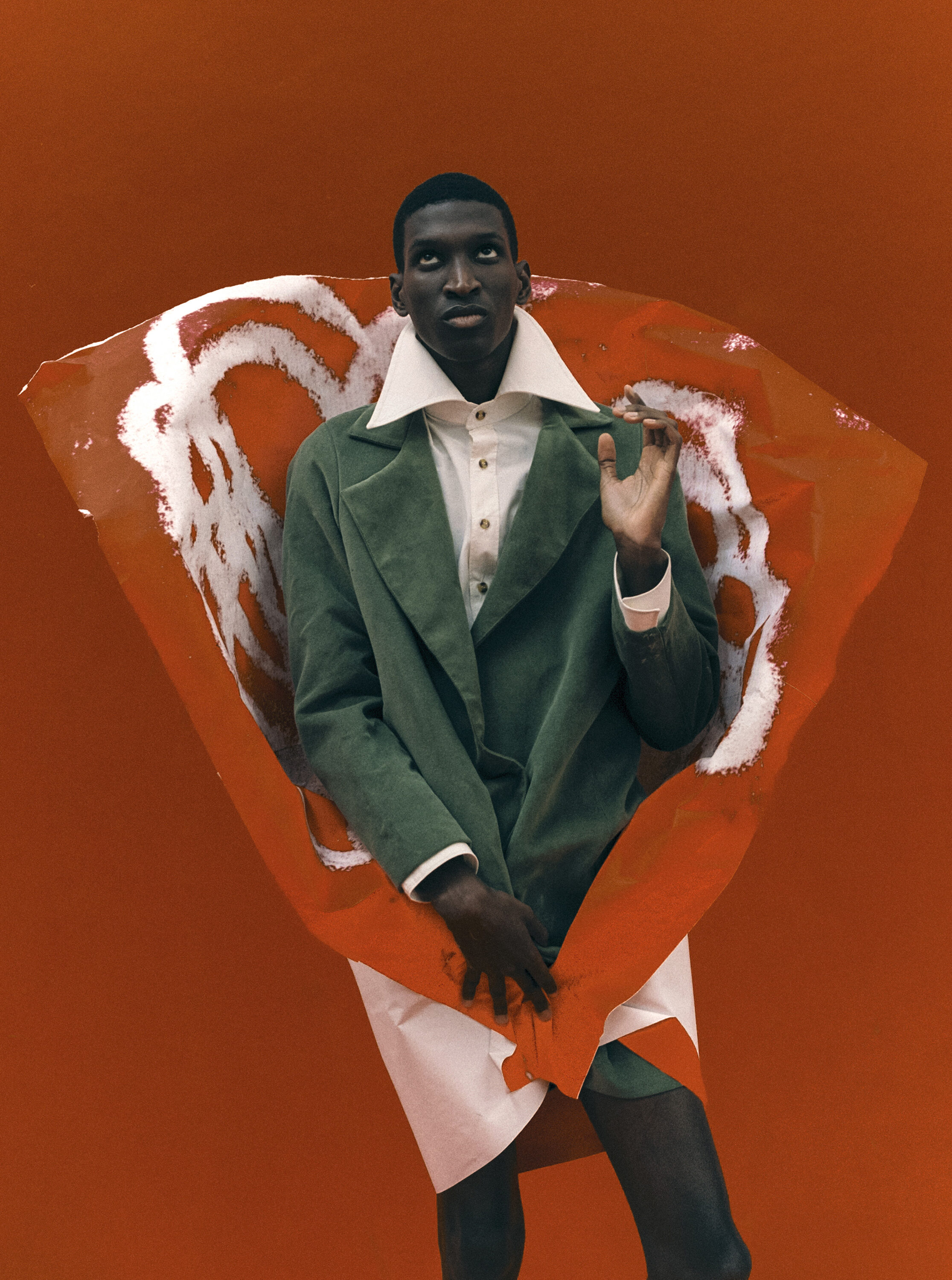
Andersson wears a suit jacket from TEURN STUDIOS, a tie from STENSTRÖMS and slippers from ALAÏA, plus pieces from her own wardrobe

FREE PREVIEW

Take a look inside Issue Sixty

You are reading a complimentary story from Issue 49

Want to enjoy full access? Subscribe Now

Subscribe Discover unlimited access to Kinfolk

  • Four print issues of Kinfolk magazine per year, delivered to your door, with twelve-months’ access to the entire Kinfolk.com archive and all web exclusives.

  • Receive twelve-months of all access to the entire Kinfolk.com archive and all web exclusives.

Learn More

Already a Subscriber? Login

Your cart is empty

Your Cart (0)