Peer Review Curator Alya Al-Mulla shares the legacy of Algerian artist Baya Mahieddine.
( 1 ) Earlier this year, Al-Mulla and Suheyla Takesh co-curated an exhibition on Baya Mahieddine at the Sharjah Art Museum in the United Arab Emirates. Al-Mulla’s favorite work in the show is Musiciennes from 1975, which shows women playing musical instruments. “Baya was very much inspired by her surroundings, and in 1953 she got married to a musician. After that, we notice she started to include musical instruments in her works. It’s a happy and cheerful painting with a lot of vibrance and, once you go into that room, you can visualize the surroundings and feel the ambience. You can almost hear the music,” says Al-Mulla.
In Baya Mahieddine’s works, the woman is always the focal point. There aren’t any male figures in her paintings. There are some works where you have a female with an infant. But then again, that’s an extension of the woman herself.
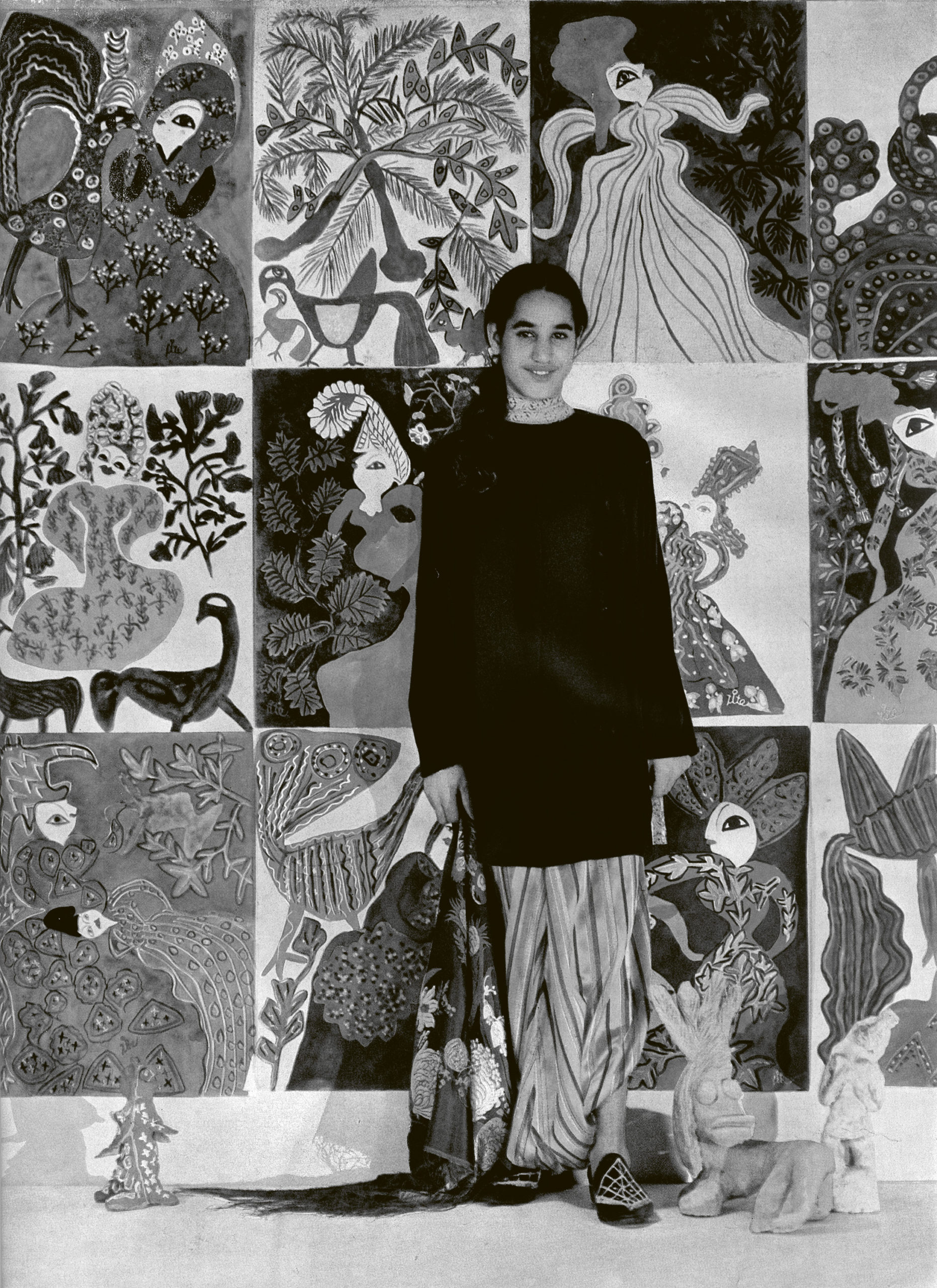
Baya was born in 1931 and orphaned when she was around five or six years old. She was then raised by her grandmother. Later on, she was adopted by the French intellectual Marguerite Camina Benhoura. It was after seeing Baya drawing and painting in the mud, and making clay figures while her grandmother was working in the garden, that Benhoura adopted her and nurtured that talent. Benhoura had a huge impact on Baya’s life. She was a painter herself, and she had a big collection of works in her house which was frequented by many collectors and people in the art world. So that female presence—her mother, her grandmother and her adoptive mother—had a huge influence on her.
Baya’s works are extremely playful: very colorful and vivid, very childlike and joyful. She said in an interview that when she paints, that’s her happy place. That’s where she goes to escape. She lived through the Algerian War and the struggle for independence, but none of that sadness shows in her works.
While curating the exhibition, we didn’t want to present her from a Western point of view.1 When people talk about Baya Mahieddine, it’s mostly through the viewpoint of her solo exhibition in Paris which was held at Galerie Maeght. The narrative would normally be that she was this exotic female artist from Algeria who exhibited in France and was discovered by André Breton and Picasso. We tried to move away from that and present her from an Arab art history perspective. So we didn’t want to add any extra text panels and contextualize the individual works: You have the introduction, then you walk into the rooms. It’s up to the visitor how they perceive what they’re looking at. We have some quotes from artists and people who encountered her, and one of them is from Breton. But it’s not the main focus of the exhibition. The other quotes are from Arab art historians, other points of view. We respected her as an artist who didn’t want to be categorized.
( 1 ) Earlier this year, Al-Mulla and Suheyla Takesh co-curated an exhibition on Baya Mahieddine at the Sharjah Art Museum in the United Arab Emirates. Al-Mulla’s favorite work in the show is Musiciennes from 1975, which shows women playing musical instruments. “Baya was very much inspired by her surroundings, and in 1953 she got married to a musician. After that, we notice she started to include musical instruments in her works. It’s a happy and cheerful painting with a lot of vibrance and, once you go into that room, you can visualize the surroundings and feel the ambience. You can almost hear the music,” says Al-Mulla.