At Work With: Liz Kleinrock
Meet the elementary school teacher on a mission to improve diversity and anti-bias training.
- Words Robert Ito
- Photography Emman Montalvan
- Styling Patricia Lagmay

She wears a sweater and sweater dress by Pari Desai and trousers by Shaina Mote.
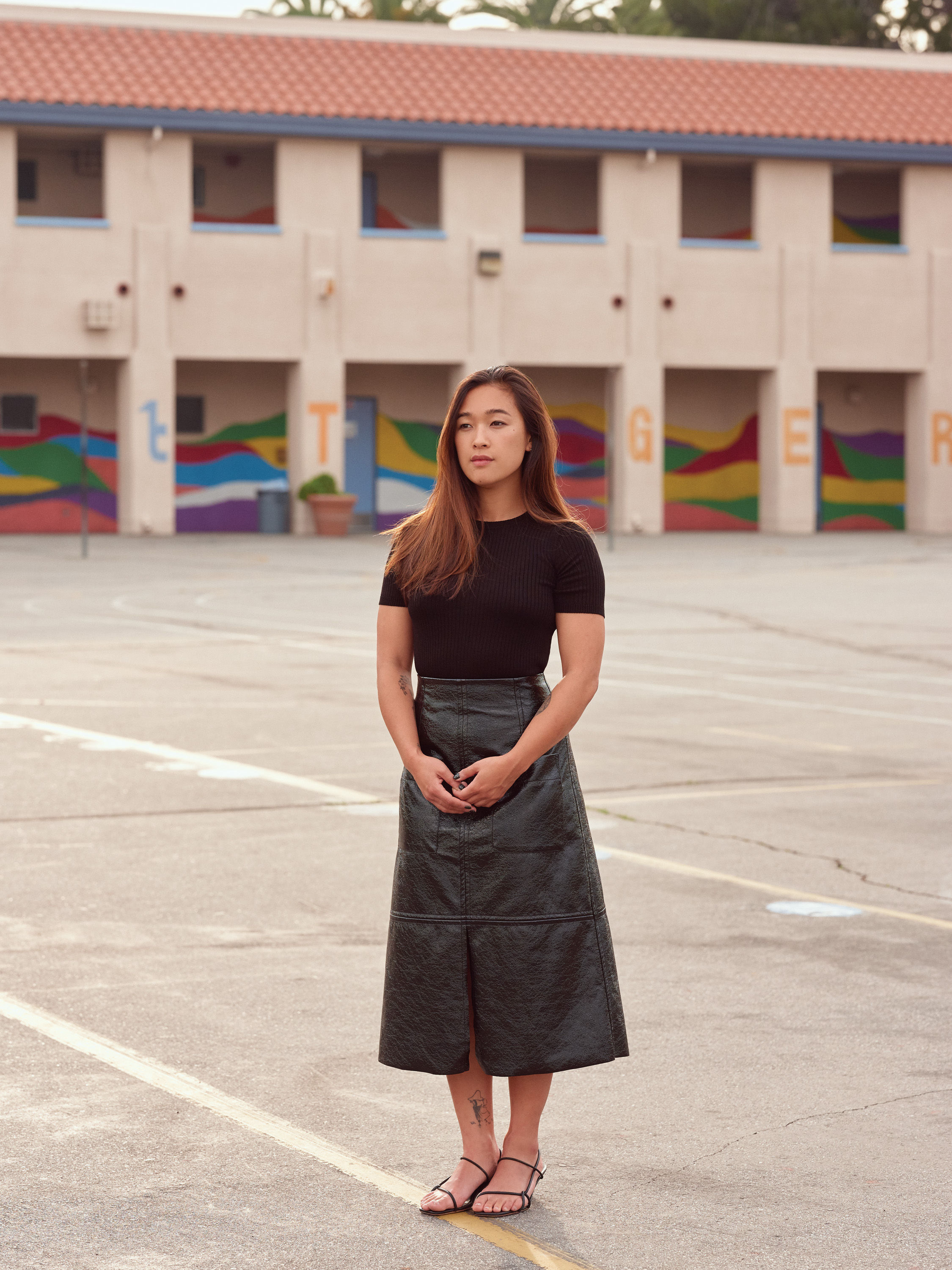
Kleinrock wears a top by Une Heures, a skirt by Mijeong Park and sandals by COS.
For the past eight years, Liz Kleinrock, a grade school teacher in Los Angeles, has discussed all manner of topics with her students. Conversations range from the serious (the homelessness crisis) to the whimsical (“If you woke up tomorrow as a 30-year-old, what would you do?”). In 2017, she began posting some of her favorite classroom discussions on Instagram, in the hopes of sharing and connecting with other like-minded teachers. “When I got my first 10 followers who didn’t know me, I was like, ‘Oh, this is really cool!’” she says, speaking at a coffee shop in Larchmont Village. “I’m meeting people.”
But when Kleinrock shared a lesson plan on consent—what it means, why we need to ask for it—the post quickly went viral. Soon, newcomers to her page were discovering older posts about everything from food deserts and housing discrimination to how to pump yourself up when you’re feeling down. Since then, Kleinrock, who was born in South Korea and raised in Washington, D.C., has received a teaching award from Teaching Tolerance, an offshoot of the Southern Poverty Law Center, delivered a TED Talk entitled “How to Teach Kids to Talk About Taboo Topics” and signed a book deal—which she’s taking time out from teaching to work on.
Still, she remains humble about the post that, in many ways, started it all. “These are conversations that most teachers in elementary school are having with their kids anyway,” she says. “Don’t put your hands on people. Ask with your words, not with your hands. I was just giving them the adult vocabulary to go with it.”
You spend a lot of time with kids. What were you like growing up?
My kindergarten teacher wrote a comment about how I was the kid who didn’t want to come to the circle when it was circle time. I believe her quote was “Elizabeth can be found sitting in a corner reading or talking to herself.” I read a lot.
Were you a good student?
Academically, I was pretty average, if not below average. I went to Sidwell Friends in D.C., which is a really elite private school. It’s where the Obama girls went. Chelsea Clinton went there. I think I spent most of my childhood just feeling like I wasn’t as smart as the person sitting next to me.
Did those experiences affect how you approach your own students?
It’s really helped me think about how I discuss and define success in the classroom. I want my students to feel recognized for what they can bring to the table, instead of being defined by what they can’t do (which, unfortunately, is how things tend to go in public education). We label students as “English language learners” instead of praising them for being emerging bilingual students. I would love to be completely fluent in another language!
Did you have a sense early on that things were not fair in the world?
I think if you ask my parents they would probably say yes. My school emphasized philanthropy at a young age. I remember being exposed to reminders of how privileged I was very early and not really understanding why everybody couldn’t have access to what they needed. It’s something that I love about working with young kids. All little kids are really just socialists. They want to give everything to everybody.
“Everybody has biases—kids have biases—but they’re not as jaded as adults.”

In her TED Talk, Kleinrock explains that she started teaching her fourth graders about equality on the spot after one of them made an ignorant comment about race.

She wears a dress by LVIR and a turtle-neck by Nanushka.

She wears a dress by Nanushka and boots by Labucq.
Tell me about how your consent lesson came about.
I was watching some truly heartbreaking testimony of a woman reliving her trauma from her youth, and watching the general public skewer her. And it wasn’t just that one incident, it was every article that highlighted a case of sexual assault or abuse on college campuses or in the workplace, and just thinking that this is a cycle that’s never going to stop unless we get to people early. I wondered what those people who committed those acts were told as kids, or if they were ever introduced to the concept of boundaries. What kind of foundation can we lay down for kids so they grow up to be better? I feel like that’s the basis for all of this work. How can we make kids better than us?
What was it like when the post went viral?
Really exciting and great for two or three days. And then overwhelming, and I wanted it all to go away.
Were there things you had to learn the hard way about social media?
You can’t please everybody, and it’s unrealistic to think that you can. I got a lot of hate mail. I went out for Peking duck with my family after my TED Talk in New York, and I posted a celebratory picture on my Instagram story, and someone responded, “It’s really disappointing and irresponsible that you would be using your platform to promote eating meat.” I’ve had people criticize the food that I feed my bunny.
And yet are there a lot of positives, too?
I think so. It has already started to connect teachers who feel isolated and disconnected. There are some really cool conferences that take place online, so teachers from all over the country can attend virtually. And there’s the community part, too. I know that there are teachers out there who I talk to more frequently than I talk to some of my really close friends. There are teachers I have met through Instagram who are real-life friends, which is awesome.
When I was teaching at UCLA, a lot of my undergrad students hadn’t really thought about many of the topics you discuss with your third and fourth grade kids. What do you tell people who say that grade schoolers are too young to be talking about these issues?
More often than not, the unwillingness to engage kids in these kinds of conversations comes from adults not knowing how to navigate those topics themselves. And they assume that if they can’t as adults, then therefore kids probably can’t either. But I find it to be completely the opposite. Everybody has biases—kids have biases—but they’re not as jaded as adults. And when they get the inkling that somebody’s inviting them into a conversation about a topic that’s usually reserved for grownups, they just get so much more excited about it.
You’ve also done a lot of work on racial issues in your classroom. When did you first become conscious of race?
I can’t remember ever not being conscious of it. I knew that the yellow Power Ranger on TV was the only character who looked like me, and therefore whenever we played games outside, that’s who I wanted to be. There was one Korean boy in my class, and I remember in kindergarten or first grade, somehow being convinced that, “Oh, I have to marry him, because he’s the only one who looks like me.”
In a perfect world, what would schools look like, and how would kids move through them?
In a perfect world, schools would be much more student-centered. I think a lot of schools say that they’re student-centered, but they’re really not. In a perfect world, teachers are the facilitators in the classroom, but the students are the leaders. I would love to see students out of the classroom, or out of school more often, going into their communities to learn about what people are doing, or building or creating. And I want their curiosity to be honored. I think a lot of teachers view the kid who’s always asking “Why this?” “Why that?” as a hindrance. I love my kids who are always asking why.