Mac CollinsFour questions for an emerging designer.
Mac CollinsFour questions for an emerging designer.
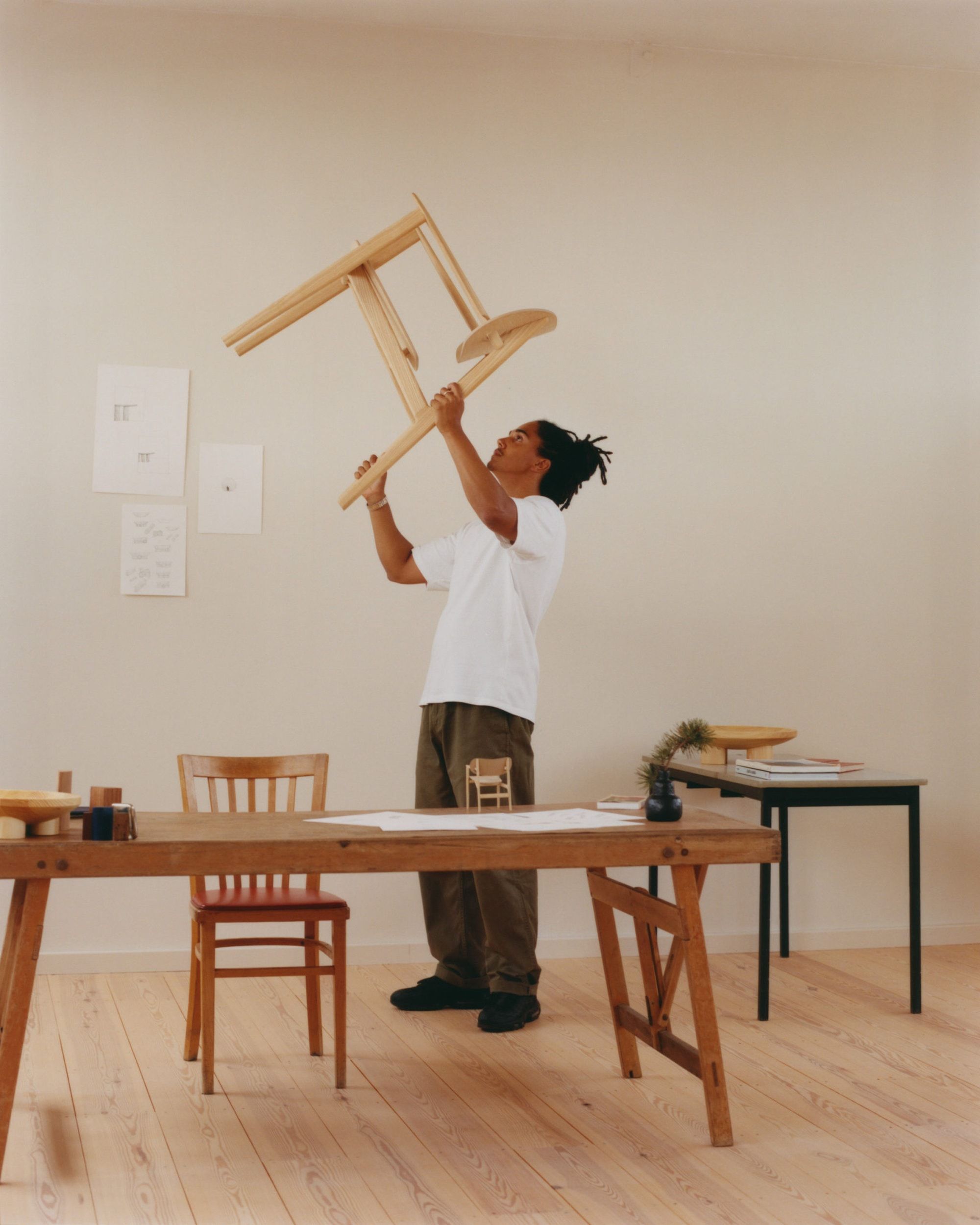
Mac Collins is a young designer whose work is characterized by strong narratives and a rich material culture. Based in the north of England, he is the first recipient of the Ralph Saltzman Prize awarded by the Design Museum in London. His furniture pieces, most notably the Iklwa chair, are bold, intuitive and a joyful celebration of typically peripheral stories.
Nana Biamah-Ofosu: Your research at Harewood House in West Yorkshire earlier this year explored the relationship between objects, furniture, Empire and transatlantic slavery. Can you tell us about this project?
Mac Collins: The house has a difficult history which, while not hidden, is not entirely visible. I was interested in the Chippendale mahogany furniture collection in the games room which was made from timber sourced from woodlands that were felled to clear land for plantations in 18th-century Jamaica. The piece that I made at Harewood House—a table for playing dominoes, a game that is now synonymous with British Caribbean culture—is intended to be visually obtrusive and heavy in contrast to the intricateness of the Chippendale furniture pieces. The black color which comes from the stained oak suggests the permanence and prominence of the Caribbean influence within British identity.
NBO: You’re of Jamaican and English heritage and grew up in Nottingham. How has this shaped your work and practice?
MC: My dual heritage has allowed me to observe society perhaps more broadly and critically. Nottingham has a large Black and minority population. It was one of the major cities for settling Caribbean communities during the Windrush generation [1948–1971] and in the years since then. It also has a significant South Asian diaspora population. My interactions with these communities have surely influenced my opinions about design and inform the way that I determine value in objects, which in turn influences the way that I understand my own contribution to material culture.
NBO: You’ve described your work as part of a social movement. What does that mean?
MC: We underestimate the power of material culture in influencing our attitudes, behaviors and social beliefs. We are beginning to question how the objects that we encounter frame a time in history and our future. Commercial product design and art can change perceptions and challenge ideas that have been uncritically ingrained within our psyche.
NBO: You’re becoming a prominent designer and you’ve received several awards. What does this mean for your future practice and aspirations?
MC: It seems like two paths are emerging—a conceptual practice and a more commercial route. The conceptual practice holds a sense of exclusivity where people might be able to experience my work but not necessarily own it and engage with it every day. Having a presence in commercial design would allow me to contribute more directly to material culture. It is an opportunity to leave a legacy that speaks to how people understand their lives and objects in them. The recognition has offered me the space, options and freedom to move in the holistic direction I want for my practice. I intend to find my own space and path.