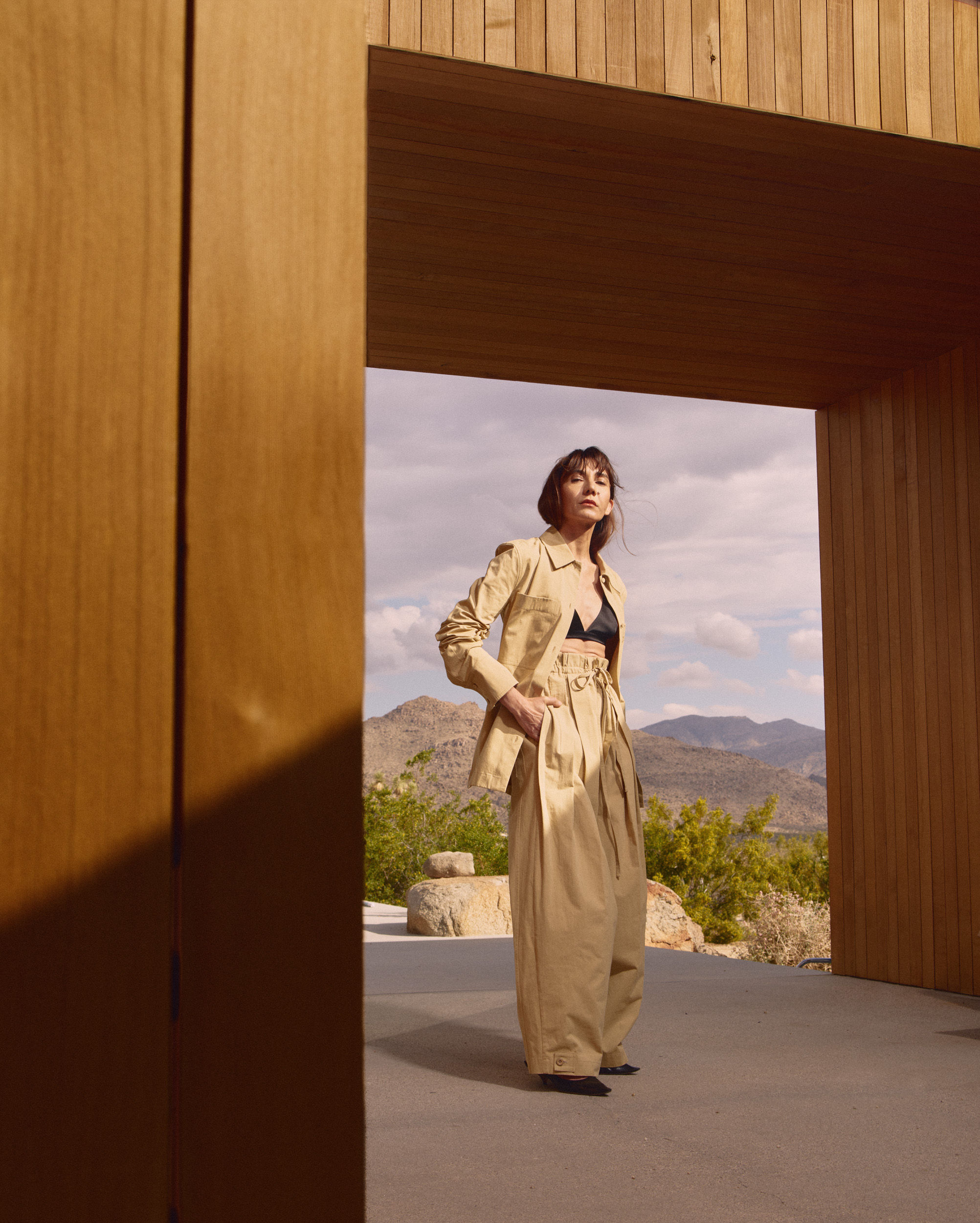
Moshfegh wears a jacket and trousers by JIL SANDER, a bra by FLEUR DU MAL and shoes by THE ROW.

OTTESSA MOSHFEGH

  • Words Natasha Stallard
  • Photos Luke Lovell
  • Styling Heather Rest

The prolific writer’s state of grace.

Issue 57

, Features

,
  • Words Natasha Stallard
  • Photos Luke Lovell
  • Styling Heather Rest
  • Hair & Makeup Hayley Farrington
  • Tailor Logan Neitzel

Moshfegh wears a shirt by JIL SANDER.

( 1 ) Moshfegh learned to read music before she could read words, beginning piano lessons at the age of four. She gave it up in her teens, but considers her early musical training fundamental to her writing. “Writing, to me, is more musical than I think it is literary a lot of the time,” she told The New Yorker in 2018, “the way that a voice can sound and the way that it leads the reader in a sort of virtual reality, a journey through its own consciousness.”

The characters in Ottessa Moshfegh’s novels are often misfits, loners and outsiders. There’s the volatile alcoholic sailor (McGlue); the abused, laxative-consuming daughter (Eileen); and the rich girl who wishes to escape society through a year of medicated sleep (My Year of Rest and Relaxation). Her excellent short story collection, Homesick for Another World, is a study of unhappy girlfriends, depressed widowers, bulimics, dropouts and creeps who, no matter how much they try to escape their lives, only find themselves more trapped.

The story of Moshfegh’s life, or at least the version told to the public, has not seemed so different from her fictional outcasts—except that her own character arc has led to success and acclaim. The origin story is this: Born and raised in New England, the daughter of classical musicians, she once quit a job as an assistant to literary editor and patron Jean Stein after contracting cat scratch fever—although it was through Stein’s introduction that Moshfegh was later published in The Paris Review.1 A fairy godmother moment, maybe, but Moshfegh is a determined workaholic. She does not care to conform to the niceties of the literary marketplace and this can lead to controversy. She used to be an alcoholic. She used to sell vintage clothing. She is one of those artists who I find most enviable—the kind who could never work in an office and therefore doesn’t. And that’s okay, because she doesn’t need to.

“If I’m not writing or doing something that is enriching to my life then I feel I’m wasting my time.”

To encounter Moshfegh is to enter this mythology. When I ask about her reputation as a workaholic, she smiles. The evidence may speak for itself—she has published four novels, a novella and a short story collection in the space of 10 years—but she sees her productivity differently: “If I’m not either writing or doing something that is enriching to my life then I feel I’m wasting my time. It’s not so much about what writing I produce, but if I’m living a meaningful existence or not.”

She is speaking over Zoom from her house in the desert outside Palm Springs, where she lives with her husband, the writer Luke Goebel, and their five dogs. The family is living there temporarily after their neighborhood in Pasadena was evacuated in February due to a mudslide during the LA fires. It’s windy today and she warns the internet might cut out at any moment. She is casually dressed and wears a hoodie with a zipper, which she occasionally pulls up and down mid-thought. Behind her, the foliage in the garden blows around at high speed, creating a sinister and turbulent atmosphere that could be described as “Moshfeghian.” 

( 1 ) Moshfegh learned to read music before she could read words, beginning piano lessons at the age of four. She gave it up in her teens, but considers her early musical training fundamental to her writing. “Writing, to me, is more musical than I think it is literary a lot of the time,” she told The New Yorker in 2018, “the way that a voice can sound and the way that it leads the reader in a sort of virtual reality, a journey through its own consciousness.”

She wears a top by RACHEL COMEY and tights by WOLFORD.

Moshfegh wears a sweater by JIL SANDER, a top by ISSEY MIYAKE and tights by WOLFORD.

( 2 ) The British director Mike Leigh has never set any of his films in Brighton. It’s possible Moshfegh was thinking instead of Ben Wheatley’s Down Terrace, which The Hollywood Reporter describes as “a darkly comedic approach to the British working-class social realism inhabited by Mike Leigh.”

( 3 ) Substack is a newsletter platform founded in 2017 that allows writers to offer paid subscriptions directly to readers. Touted as a viable alternative to traditional media amid its ongoing decline, the platform initially attracted a wave of prominent journalists. However, many later departed, citing concerns over Substack’s “lightweight” content moderation policies.

With the exception of the weather, it’s a domestic setting that seems remarkably different from the insular, comfortless worlds of her fiction, but it becomes clear that Moshfegh—who is about to turn 44 years old—considers the life she has built for herself in California with a sense of wonder and mild dismay. When talking about her “cliché and annoying” maternal-like love for her dog Walter, she remembers what her life was like before him and says: “I never want to go back there.”

Every day, she writes a to-do list for herself (“dishes, laundry, dog, make my bed”). Ticking off these tasks is also a way to ground herself so that “weird stuff can arise.” “I am a person of habit, and I find I need that stability in order to feel like I can go crazy—you know, in other ways,” she says with the delivery of someone who is intimately familiar with what can happen when a woman becomes disordered and feral. 

“If I’ve done everything that’s, like, ‘Here’s what a person does’—the minimum to sustain one’s survival, like buy toilet paper—if I’m nailing that, then I can understand that the space and time I’ve given myself for the creative part is well spent.”

At the moment, that includes a transition into Hollywood. She and Goebel have formed a screenwriting partnership and together the couple wrote Causeway, the story of a brain-damaged Iraq veteran starring Jennifer Lawrence, and adapted her novel Eileen for a film directed by William Oldroyd and starring Thomasin McKenzie and Anne Hathaway. Moshfegh’s current list of projects includes a screenplay adaptation of Rachel Kushner’s novel The Mars Room, another screenwriting project that “I guess I shouldn’t talk about,” and a short story for The New Yorker written in response to Harold Brodkey’s 1954 story “The State of Grace” which, she says, she has read at least a hundred times. She sounds wistful about how long it’s been since she’s written a short story, and how she forgot the deep immersion it requires from her. There’s also her fifth novel, which she is conscious she has been ignoring.

“Oh my god!” Moshfegh says, as she counts the six, seven, eight months since she last worked on the draft. “I feel like I’ve been very cold to a close relative or something. I miss it.” Much of the novel has been written by instinct, following a hunch that its setting should be inspired by the British seaside resort of Brighton, where she had never been but remembered the quality of the light from a film set there. (“Sorry, brain aneurysm,” she says while trying to remember the director’s name, settling on Mike Leigh.)2 A trip to the city later confirmed her suspicion that there was a “great weirdness about the place.” “It was just a day and a half, and half of it was spent in the basement of this store emporium where there was a post office, because I had to ship home all the stuff I was lugging around. But it was really satisfying and creepy, because it was exactly what I had hoped it would be,” she says.

Moshfegh has since taken two more “incredibly lonely” solo trips to Brighton, staying in Airbnbs she insisted must have a view of the sea (essential to access the mood of the novel), often at the expense of her comfort: In one rental, the ceiling crashed in due to a leak. She has bought a copy of Graham Greene’s Brighton Rock but refuses to read it, in case its atmosphere “seeps through.”

Back at home in California, she has found she is unable to work on the novel. “I have to be away from the world that I’ve built for myself to really see this other one clearly,” she says, with a startling intensity. Talking about the novel—still a first draft—her descriptions are fragmented but fully charged. You can sense how thoroughly it occupies her mind; she returns to it often throughout our conversation. The protagonist is an 18-year-old boy, and she hints at themes of skin and self-harm. “As a younger person, I had no tools with which to cope with feeling things—like feeling anything. That is pretty much what the novel is about—how to feel things or not feel things.”

Moshfegh has been deliberately reconnecting with her teenage self to prepare for the next period of writing. In 2024 she started a Substack newsletter, It’s Ottessa, bitch, which has the lo-fi, adolescent look of an early noughties Myspace.3 She has scanned her high school notebooks, shared a neuropsychology evaluation from her 20s, and narrated a dream from 15 years ago with shoppable eBay links to objects that appeared in it (kindergarten finger paintings, white cotton underwear, a 1988 wood Zenith television). In another series of posts, she reviews every movie mentioned in My Year of Rest and Relaxation, most of them from the 1980s and 1990s (and many of which she has not watched), such as Tin Cup, Showgirls and I’ll Be Home for Christmas

( 2 ) The British director Mike Leigh has never set any of his films in Brighton. It’s possible Moshfegh was thinking instead of Ben Wheatley’s Down Terrace, which The Hollywood Reporter describes as “a darkly comedic approach to the British working-class social realism inhabited by Mike Leigh.”

( 3 ) Substack is a newsletter platform founded in 2017 that allows writers to offer paid subscriptions directly to readers. Touted as a viable alternative to traditional media amid its ongoing decline, the platform initially attracted a wave of prominent journalists. However, many later departed, citing concerns over Substack’s “lightweight” content moderation policies.

Moshfegh wears a look by RACHEL COMEY.

She wears a top and skirt by JIL SANDER and rings by LARA SONMEZ.

She wears a top and skirt by KAMPERETT.

( 4 ) German-American writer Charles Bukowski—the “laureate of American lowlife”—has been a favorite of Raymond Carver, Irvine Welsh and Harry Styles, who, in 2014, paused a One Direction concert to read from his poetry collection You Get So Alone at Times That It Just Makes Sense.

( 5 ) Moshfegh and Goebel met in 2016, after Goebel reached out to interview her for the Los Angeles Review of Books. The interview was never published.

( 6 ) The artist Agnes Martin was also drawn to the expansive landscape of Taos, its simplicity inspiring her minimal style. “I saw the plains driving out of New Mexico and I thought that the plain had it, just the plane…” she wrote in 1972 of her move toward complete abstraction. “Anything can be painted without representation.”

( 7 ) Shrek was the subject of Investigating Shrek: Power, Identity, and Ideology (2011), a scholarly volume that examined the film through a range of theoretical lenses, including Kantian cosmopolitanism, evolutionary psychology and neo-Marxist critique.

“I was like, let me interview my high school crush and let me interview this person about what they were like in high school. I was still working on the novel, but reuniting that part of myself with who I am now. Being a teenager is so fucking intense. I don’t miss it, you know. I remember how stressful it was. I think I was also a real stress case.”

The newsletter also features a writing advice column, where Moshfegh responds to questions from subscribers such as “Is misanthropy ever a useful base to work from or do you just end up becoming Charles Bukowski?” and “How do you know if your writing sucks?”4 A post featuring interviews with LA-based novelists Emma Cline, Bret Easton Ellis and Rachel Kushner comes to the conclusion that yes, LA has a “writer social scene” but it is best for a writer to stay at home and not participate. Another post is an attack on Johanna Thomas-Corr, the chief literary critic for the London Times, for comparing Moshfegh’s last published novel, Lapvona—set in a medieval fiefdom—to the animated movie Shrek.

“I can understand when actors say they never watch themselves. It’s sort of like if you could watch a thousand people reading your book at the same time.”

Moshfegh appears on Goebel’s Substack too, in posts such as “My BACKBREAKING WORK Documenting Ottessa’s Dishwashing”—the transcript of a documentary of the novelist loading the dishwasher while sick.5 Moshfegh wishes she had a better answer when asked about the collaborative aspect of the couple’s use of the platform. Instead, she emphasizes how it has been a useful tool for her as a novelist, and as a person.

“It pushes me to be more aware and creative of the smaller moments in my life. I’m going to be 44 in a month and it’s very different; the scope of my existence has shifted so much. I know I’m missing so many things in my own experience because I can only really focus and process a few a day.”

These glimpses into her home life mark a shift for a writer whose work has often explored isolation. It’s a shift that dovetails with a more collaborative era for Moshfegh. “I think I’m learning how to bring myself, my peculiar interests and even a style to screenwriting,” she says when asked how her new projects compare to writing novels. “I also have to show up and talk about it with people and have meetings and meet deadlines.” She describes the adaptation of Eileen as a “miraculous project,” despite the horrifying experience of attending the premiere at the Sundance Film Festival. “I can understand when actors say they never watch themselves. It’s sort of like if you could watch a thousand people reading your book at the same time, you know? With synchronized page-turning.”

Her screenwriting projects have also made her view stories differently. “I love plot now,” she says, likening a script to a set of instructions. “I feel like I have even more integrity. I am not trying to merely provide an aesthetic experience of beautiful language or evocative imagery. I’m trying to build an entire experience.” 

The New Englander seems suited to life in California. She likes the encounters with nature, such as the coyote across the street or the bear she videos that lives in her neighborhood. “It makes total sense that this is where American cinema really became a force,” Moshfegh says. “There’s something about the sunsets, the imagination and the charge of the place—there’s a strangeness and a falseness.” When I ask if she’s planning to return to LA, she laughs. “Yeah, I think so. I don’t have any plans to leave right now. We’ll see what happens. Maybe they’ll kick me out. Just wind up in South America somewhere.”

For now, she is preparing for a trip to Taos, New Mexico, to finish the first draft of the novel, which she says is about two-thirds complete. “Finishing a book is when all the spirits circle around. Taos has a certain energy… I find it to be something cosmic, open, kind of intangible and unexpected.6 And it is similar to the sea in that there’s a wide expanse of flatness, that I need to be seated in front of. And also I can drive there and bring a few of my dogs.”

This approach makes sense. Moshfegh’s workaholic nature is also an act of devotion. As she enters midlife, she says she has started to see symmetries between her life and work that feel close to divine intervention, and throughout our conversation, she routinely flits between jokey, teen-like angst and intense spiritual insights—a maneuver that readers of her novels will be familiar with. To read her is to enter a trancelike state, and so it fits that in order to write she requires seclusion, obsession and the type of self-surrender associated with marines and Buddhist monks. Even a bad review becomes reframed—she says the comparison of Lapvona to Shrek has only refueled her for the next radical step.7 “Now I give myself total permission to be a punk. To be angry and horrible, to be devout, to be anything,” she says, with the righteous attitude of someone who knows they are one of the most interesting novelists writing today.

“ I love plot now. I am not trying to merely provide an aesthetic experience of beautiful language or evocative imagery. I’m trying to build an entire experience.”

( 4 ) German-American writer Charles Bukowski—the “laureate of American lowlife”—has been a favorite of Raymond Carver, Irvine Welsh and Harry Styles, who, in 2014, paused a One Direction concert to read from his poetry collection You Get So Alone at Times That It Just Makes Sense.

( 5 ) Moshfegh and Goebel met in 2016, after Goebel reached out to interview her for the Los Angeles Review of Books. The interview was never published.

( 6 ) The artist Agnes Martin was also drawn to the expansive landscape of Taos, its simplicity inspiring her minimal style. “I saw the plains driving out of New Mexico and I thought that the plain had it, just the plane…” she wrote in 1972 of her move toward complete abstraction. “Anything can be painted without representation.”

( 7 ) Shrek was the subject of Investigating Shrek: Power, Identity, and Ideology (2011), a scholarly volume that examined the film through a range of theoretical lenses, including Kantian cosmopolitanism, evolutionary psychology and neo-Marxist critique.

FREE PREVIEW

Take a look inside Issue Fifty-Seven.

You are reading a complimentary story from Issue 57

Want to enjoy full access? Subscribe Now

Subscribe Discover unlimited access to Kinfolk

  • Four print issues of Kinfolk magazine per year, delivered to your door, with twelve-months’ access to the entire Kinfolk.com archive and all web exclusives.

  • Receive twelve-months of all access to the entire Kinfolk.com archive and all web exclusives.

Learn More

Already a Subscriber? Login

Your Cart (1)