HOME TOUR ALEKOS FASSIANOS
- Words George Papam
- Photos Bill Stamatopoulos
Inside the artist’s atelier on the Greek island of Kea.
Two large fish on a plate, served on a table beside a single chair, seem to await a lone guest on a checkerboard tiled terrace. Drawn with playful watercolor strokes of red, green and blue, on a scrap of paper that the artist likely had to hand, the scene has a disarming simplicity. At the top, in the artist’s handwriting, it reads: “Good fish of Kea.” It welcomes you as you step over the threshold of Alekos Fassianos’ house: A homage to the Greek island it sits on—and its fish—that captures the unpretentious spirit of the artist.
Perched high on the northern hillside of Kea’s capital, Ioulida, the house was Fassianos’ summer retreat and studio for over 50 years. The artist—who is celebrated in Greece for weaving folk traditions and the dreamlike quality of Greek mythology with the everyday—had studied painting and lithography in Athens and Paris, and was practicing between the two cities when he first visited the island in the mid-1960s. He was deeply impressed.
Kea, also known as Tzia, is the westernmost of the Cyclades islands in the Aegean Sea, and the one closest to Athens. To this day—and in contrast to many of the better-known islands nearby—Kea has not been overwhelmed by tourism and maintains some of its industrial identity—something that appealed to Fassianos at the time. Back then, the island sustained a lively farming sector and was home to tanneries and a large enamel homeware factory.
The island of Hydra was the established haven for writers and artists in 1960s Greece, but Fassianos did not appreciate the number of foreigners and intellectuals that were drawn to it. He preferred a quieter and more grounded place, away from the bustle of the art scene and, most importantly, somewhere with several accessible beaches where he could fish. He bought the house in 1967 and returned there every summer, taking welcome breaks from busy Athens and rainy Paris, until 2021, the year before he passed away. Every summer since, following the pattern of the artist’s visits, the Fassianos estate has opened the studio to the public.

Google Maps is of little use as you approach the house through Ioulida’s labyrinthine alleys but traces of the painter begin to appear along the way: One of his signature profiles carved in stone relief at the school’s wall; a fading six-winged figure with Fassianos’ characteristic brushstrokes on a green door; a dragon of black metal standing guard on the house’s courtyard gate. Fassianos wished to be known as an artist of the people and shared his art with fellow villagers: When the priest asked for the six-winged icon, or when the butcher and a neighbor asked for a mural on their wall, Fassianos was glad to spend hours painting in the town’s alleys. He befriended and worked alongside local craftsmen, lingered in conversation at the town’s coffee shops and even persuaded some of his Athens friends, such as the painters Nikos Stefanou and Vassilis Sperantzas, to join him on the island. In short order, he formed a deep bond with Kea and its people.


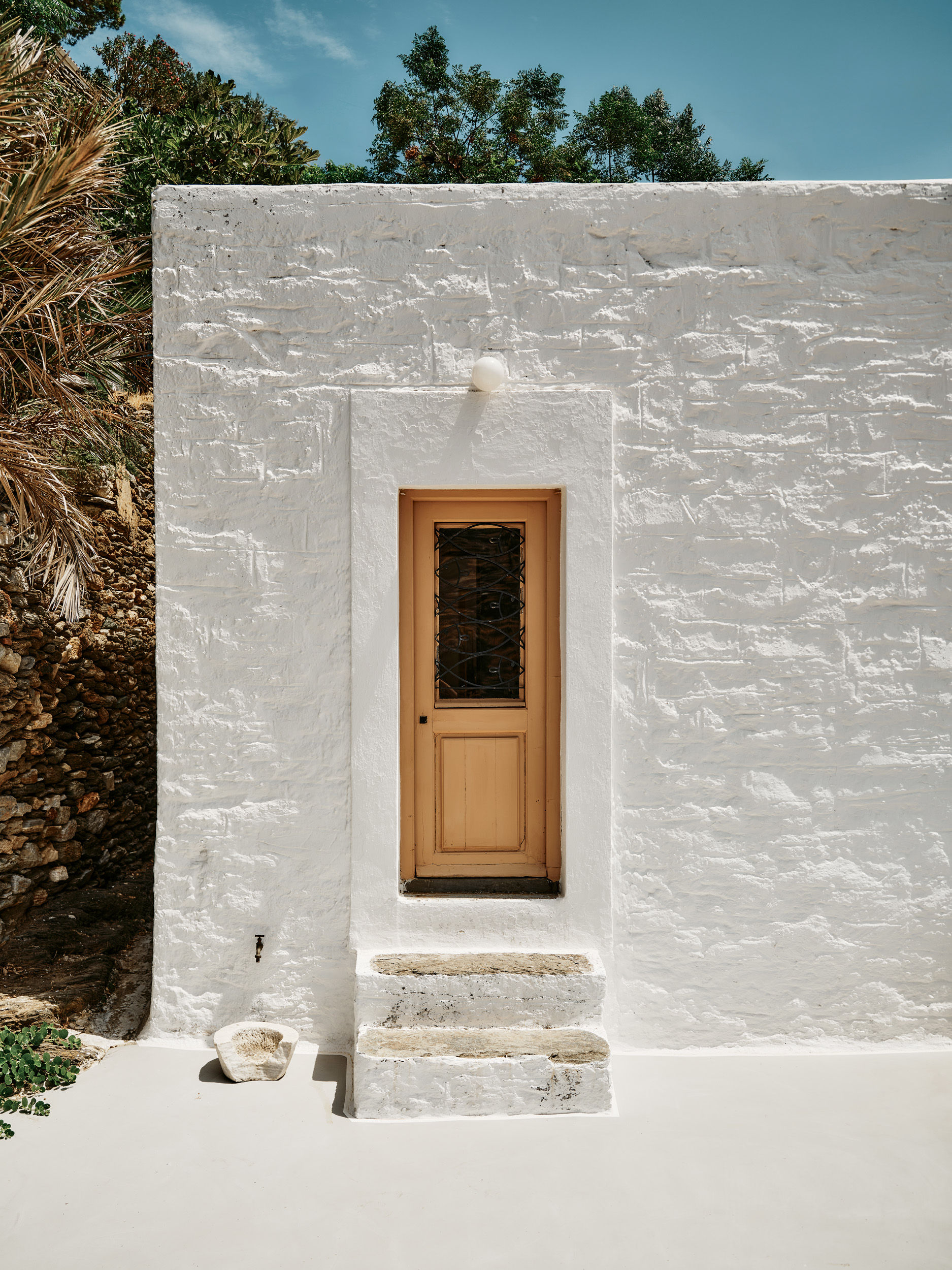
A shadow-theater dragon hangs by the door, which Fassianos painted ocher in tribute to the colors of Kea. The dragon motif was recently reimagined as a brass table lamp by Swedish design house Svenskt Tenn, part of a collection of homewares honoring Fassianos titled Beneath the Same Sky.
( 1 ) Perhaps one of Fassianos’ best-known, if not most-seen, works can be found at Metaxourgio Station on the Athens Metro. In 2000, he was invited to paint two large-scale murals, which he titled The Myth of My Neighborhood. One depicts an outdoor cinema, a passing cyclist and a folk singer; the other shows a fruit market, with a grocer weighing vegetables on a scale.
Although he soon acquired a second house in the coastal village of Ksyla for his fishing excursions, and later another property in Ioulida for his family, his main home on the island remained his first house and atelier. Viktoria Fassianou, the artist’s daughter, has spent every summer on the island since early childhood and remembers how her father preferred to pass the nights alone, working in the house, even when his family was visiting.
The building, in its form and layout, is typical of the modest houses in Ioulida, which evolved from the forms of rural houses on the island. In the 19th and 20th centuries it was typical for Kean farmers to raise a modest dwelling in the main village, as a place to gather on Sundays and feast days—a kind of vacation home, though with the relationship between town and countryside inverted.
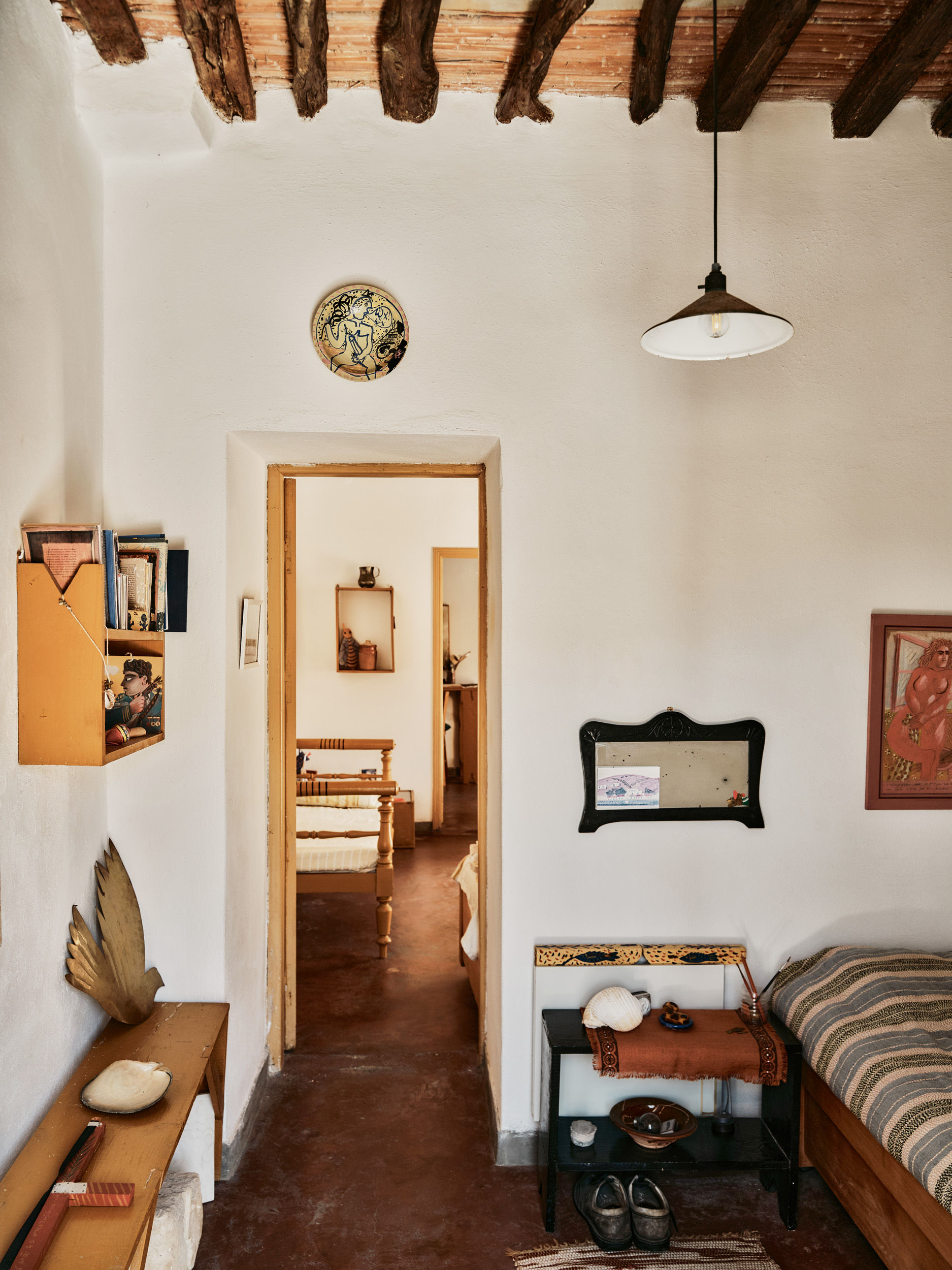
The entrance opens to a small living room that divides the house in two: On one side there is a bedroom and on the other a working space, which in turn opens to a small kitchen. None of the four rooms are large—between 50 and 100 square feet—but outside, the terraces more than double the footprint of the house and embed it in the network of levels, stairs and verandas that comprise the settlement of Ioulida. Facing south and west, they overlook Ioulida and the hills opposite, and allow the gaze to reach as far as the sea. Fassianos, who loved to paint on the ground, could often be seen out here, working on larger pieces.
Over the decades, Fassianos kept interventions to a minimum, wanting to maintain the identity and simplicity of the house’s architecture. He resisted the addition of roof tiles, a feature foreign to the island but adopted by many as a convenient substitute for the traditional flat roofs built of wood and earth. The matrix of branches and reed that still line the ceiling only add to the house’s character. It was with equal fervor he searched for and applied traditional colors on doorframes and shutters, and he took care to maintain the original flooring.
His determination has meant that a remarkable example of Kea’s traditional architecture has been preserved and yet, plain and unassuming, the house offers a quiet backdrop for the countless works and artifacts that populate it to this day. As Theodora Patiti, an artist from Kea who works for the Fassianos estate, explains, nothing in the house was curated to create a particular narrative after his death. Instead, most items have remained exactly where Fassianos left them: the painted desk, where he drew; the notes to friends, scrawled on planks because the house had no telephone line—acts of fidelity more than conservation.
Other than a few items made by local friends or guests—such as a plate drawn and gifted to Fassianos by Yannis Tsarouchis, or some drawings by the local folk artist Delapitsas—everything that can be seen today was either created by Fassianos or carries, in some way, his presence. The artist’s paintings can be found on nearly every wall, but it is the small things that catch the eye: everyday objects, toys, improvised creations, various hand-decorated pieces. The sofa, the desk, the night table and the cupboards have all been adorned with flower motifs and fish; vases and ceramics are embellished with the faces with flowing hair that he was known for. A self-made speargun lies next to a makeshift toy windmill improvised from cans, and shadow-theater dragons of varying sizes and materials are hung here and there.

“Most items have remained exactly where Fassianos left them.”
This domestic practice was central to Fassianos’ conception of both art and life. In a 2002 interview, recalling the ascetic room where the poet Odysseas Elytis once wrote, Fassianos summarized his view plainly: “The greatest wealth is the little room, your desk, your bed, the objects you have behind and in front of you. And so I paint the little nightstand beside my bed; my chair; the things I know. And the greatest wealth is this: To create your world, to enclose yourself around it, and then to radiate outwards.”
Tellingly, many of the small works clustered around the rooms are studies of Kea itself: paintings of the houses in Ioulida, or of the island’s landscape and sea—subjects he would later repeat in many of his better-known works.1 But there are also countless meticulous observations of the island’s minute nature: its birds, bugs and insects, its fish, fruits and herbs. He even gathered these drawings into three books dedicated to the island: The Small Things of Kea, The Antiquities of Kea and The Fish of Kea. These drawings and artifacts, crafted with curiosity and affection, seem to be trying to bring all of Kea into the house and, conversely, to make the house a part of Kea.
( 1 ) Perhaps one of Fassianos’ best-known, if not most-seen, works can be found at Metaxourgio Station on the Athens Metro. In 2000, he was invited to paint two large-scale murals, which he titled The Myth of My Neighborhood. One depicts an outdoor cinema, a passing cyclist and a folk singer; the other shows a fruit market, with a grocer weighing vegetables on a scale.