At Work With: Dr. Bronner’s Magic Soaps
- Words Robert Ito
- Photos Luke Lovell
One soap, 18 uses and endless philosophic ramblings—a look inside the eccentric, psychedelic world of the iconic all-in-one cleaner.
Emanuel Bronner, the founder of Dr. Bronner’s Magic Soaps, hailed from a long line of German Jewish soap makers. The family business stretched back to 1858 and it was a tradition Bronner carried forward. He was good at soapmaking—according to family lore, his soaps were stocked on zeppelins—but he wanted to forge his own path and so, in 1929, when he was just 21 years old, he left for the US.

He quickly found work as a consultant to American soap companies but, after a series of heartrending tragedies (the murder of his parents in Nazi concentration camps; the death of his wife, Paula, in 1944), he had an epiphany: In a world seemingly on the brink of extinction, he determined that if we didn’t all pull together and recognize that we were one big human family, emanating from the same divine source, we were done for. In 1948, Bronner founded his company and began touring the country preaching his message of peace—“All-One or None!”—giving away his natural, biodegradable soaps after his lectures.
I’m hearing this story from Emanuel’s grandson, David Bronner, a Harvard graduate, former mental health counselor and now CEO (“Cosmic Engagement Officer”) of Dr. Bronner’s Magic Soaps. “The word spread,” he says, “but people were just coming for the soap and not to hear what my granddad had to say. So he put his philosophy on the label and the next time you went to the bathroom and forgot a magazine, you know, he had you.”
If you’ve ever used one of Dr. Bronner’s soaps or sanitizers, toothpastes or lip balms, you remember the labels: comically text-heavy with messages about—among other things—the climate crisis, regenerative agriculture and the evils of factory farming, all printed in the tiniest of fonts. “Fungi is family!” one diminutive line exclaims. “Each day, like a bird, perfect thyself first, to have courage & smile my friend,” commands another. There are also, in addition to the list of ingredients, quotes from luminaries like Abraham Lincoln and Rudyard Kipling.
“When my granddad was in full throttle, there were probably 3,000 words on the quart bottle,” David says. The company, which is based in Vista, California, decided years ago to remove a birth control home remedy (basically, a lemon douche followed up with some of Dr. Bronner’s soap) and recently added icons to improve readability. But otherwise, the labels have changed little.
This includes one of the more intriguing claims of Dr. Bronner’s castile soaps: that you can use them to do 18 different things. They can be used to wash dishes, shave your face and legs, do laundry, mop floors, clean toilets and even brush your teeth. Given the wide variety and range of possibilities, the number 18 seems oddly specific. “I think we just kind of chose 18,” says David. You also have to wonder about how much you’d want to use a toilet cleaner to brush your teeth, say, or toothpaste to shave your legs. “It’s an all-purpose soap, so you can use it for everything,” he continues, “but yeah, it’s really optimized for the hands and body, for sure.”


Wirecutter named the unscented Dr. Bronner’s bar as one of its best bar soaps of 2025. It uses only 10 ingredients, with most of its cleansing power provided by organic coconut oil. Unlike the brand’s more assertive scents—such as tea tree or eucalyptus, which can create a noticeable tingle—the fragrance-free version is gentle on skin.
Over the decades, the soaps grew in popularity, particularly with the rise of the counterculture in the 1960s and increasing fears over the ecological damage humans were doing to the planet. “Here’s this generation that’s trying to live a simpler life, closer to the Earth, trying to stop the war in Vietnam,” says David. “My granddad’s soap really intersected perfectly with the ethos of the time. It was concentrated, biodegradable, you could wash your hair, your dog, your dishes by the side of the river and not worry about it, and it had a groovy message of peace on the label.”
But just like Bronner’s earlier customers, these later generations connected more with the soap than with the ideas behind it. It was a hard pill for Emanuel to swallow. “For him, the message was everything,” David says. “He obviously loved the soap, but that was just the vehicle for the message. For most products, the labels are a vehicle for the product. But in this case, the label was the point. For my granddad, it was all about uniting Spaceship Earth.”
Much like his grandfather, David had little interest in joining the family business and in 1991 he went to Harvard, where he played on the football and rugby teams and majored in biology. “I had some notion I’d be a doctor,” he says. “But then I had a really big psychedelic experience after college. I basically experienced ego death and died into the love and light at the heart of existence. I immediately realized that my granddad is right: All the faith traditions at their best are pointing at this transcendent love, when they’re not making idols out of their beliefs and demonizing each other.”
After a stay in Amsterdam, where he considered becoming a cannabis entrepreneur, and a year and a half as a mental health counselor, David came upon Natural Capitalism, an economics book co-authored by the Northern California–based author and entrepreneur Paul Hawken. “It was all about how business can be a force for social and ecological good in the world,” David says. “It doesn’t have to be this regressive force fighting every single responsible labor or environmental regulation.”
“You could wash your hair, your dog, your dishes by the side of the river and not worry about it, and it had a groovy message of peace on the label.”
Wirecutter named the unscented Dr. Bronner’s bar as one of its best bar soaps of 2025. It uses only 10 ingredients, with most of its cleansing power provided by organic coconut oil. Unlike the brand’s more assertive scents—such as tea tree or eucalyptus, which can create a noticeable tingle—the fragrance-free version is gentle on skin.

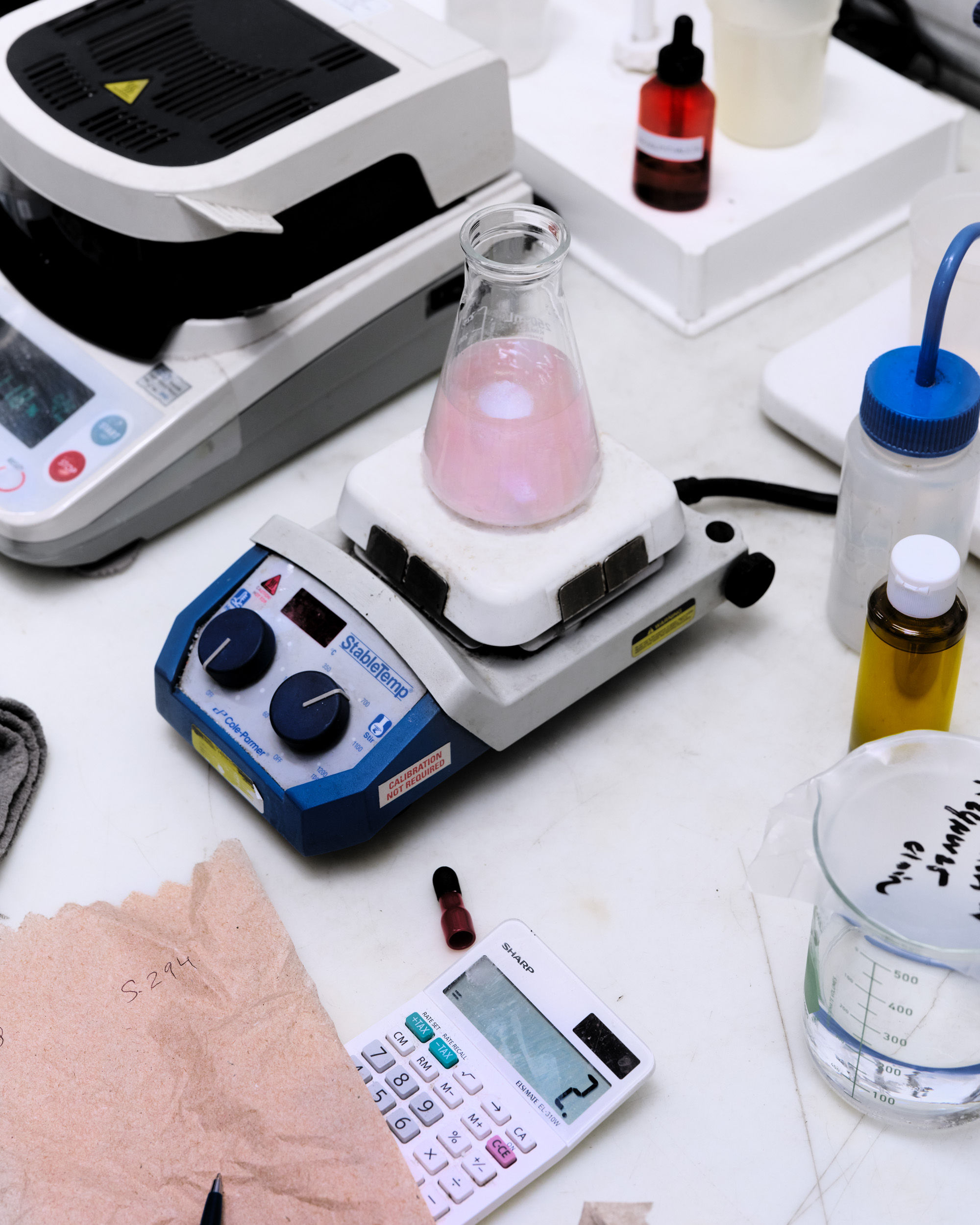
Castile soap is created through saponification, a centuries-old technique for turning oils into soap. For Dr. Bronner’s formulas, a mix of coconut, palm, olive and hemp oils is heated, clarified and combined with lye. As the alkaline lye reacts with the oils, it loses its caustic quality and transforms the mixture into soap, leaving naturally occurring glycerin behind.
Dr. Bronner’s packages its soaps in bottles made from 100% post-consumer recycled PET, relying on “bottle-to-bottle” processing and sourcing much of the resin locally in California.
Reading the book inspired him to join the family business and work toward his grandfather’s vision of unity and world peace. “In some ways, we’re more pragmatic now about finding how exactly we’re going to unify Earth and live in sustainable relationship,” David says.
In 1998, not long after David joined the company, his parents donated 1,000 acres of land in San Diego—“a third of our whole worth”—to the Boys & Girls Clubs of San Diego. “That really set the tone for me and my brother, Mike, our company president, about what kind of company we’re going to run,” David says. Since then, Dr. Bronner’s Magic Soaps has donated millions of dollars to support a range of causes, from animal rights and fair-trade sourcing to regenerative organic agriculture and drug policy reform. “We’ve given about 100 million away in the last 20 years,” he says.
Within the company itself, the Bronners have attempted to address the increasing problem of income inequality, paying a living wage to their workers and instituting a five-to-one salary cap—capping compensation so that company leaders like David can’t earn more than five times their least-compensated employee.
Of all the company’s causes, David’s pet project is psychedelics. Dr. Bronner’s has become one of the country’s biggest supporters of research into psychedelics, promoting their use in treating a host of ills, including PTSD, addiction, anxiety and depression, and advocating for their decriminalization. David himself partakes in wachuma, a mescaline-containing cactus native to Peru, about every three months. “I’ve got a bunch in my backyard,” he says.
Pro-psychedelic messages can be found on the company’s iconic labels: “Support Psychedelic-Assisted Therapies to Heal the Soul!”, one reads. Over the years, the labels themselves have been shamelessly mimicked, despite the fact that, as David says, his grandfather “violated every rule of marketing with them.” “Some companies copy that text-graphic-y thing, but without the same soul and passion and authenticity,” he says. “It’s more about marketing, whereas for my granddad, that was the furthest thing from his mind.”
Indeed, those unmistakable labels, with their thousands of words and entreaties and exclamation points (“Dilute! Dilute! OK!”), were much more a happy accident than a branding exercise. “My granddad went blind in the early ’70s,” David says. “So our label was designed by a blind man. I don’t think he even understood just how tiny the font was getting! But he was standing by the message.”

“Our label was designed by a blind man. I don’t think he even understood just how tiny the font was.”
Castile soap is created through saponification, a centuries-old technique for turning oils into soap. For Dr. Bronner’s formulas, a mix of coconut, palm, olive and hemp oils is heated, clarified and combined with lye. As the alkaline lye reacts with the oils, it loses its caustic quality and transforms the mixture into soap, leaving naturally occurring glycerin behind.
Dr. Bronner’s packages its soaps in bottles made from 100% post-consumer recycled PET, relying on “bottle-to-bottle” processing and sourcing much of the resin locally in California.