STUDIO VISIT: Yoko KubrickIn the studio with a sculptor of monuments and mythologies.

STUDIO VISIT: Yoko KubrickIn the studio with a sculptor of monuments and mythologies.

Issue 46

, Features

,
  • Words Emma Silvers
  • Photography Kourtney Kyung Smith

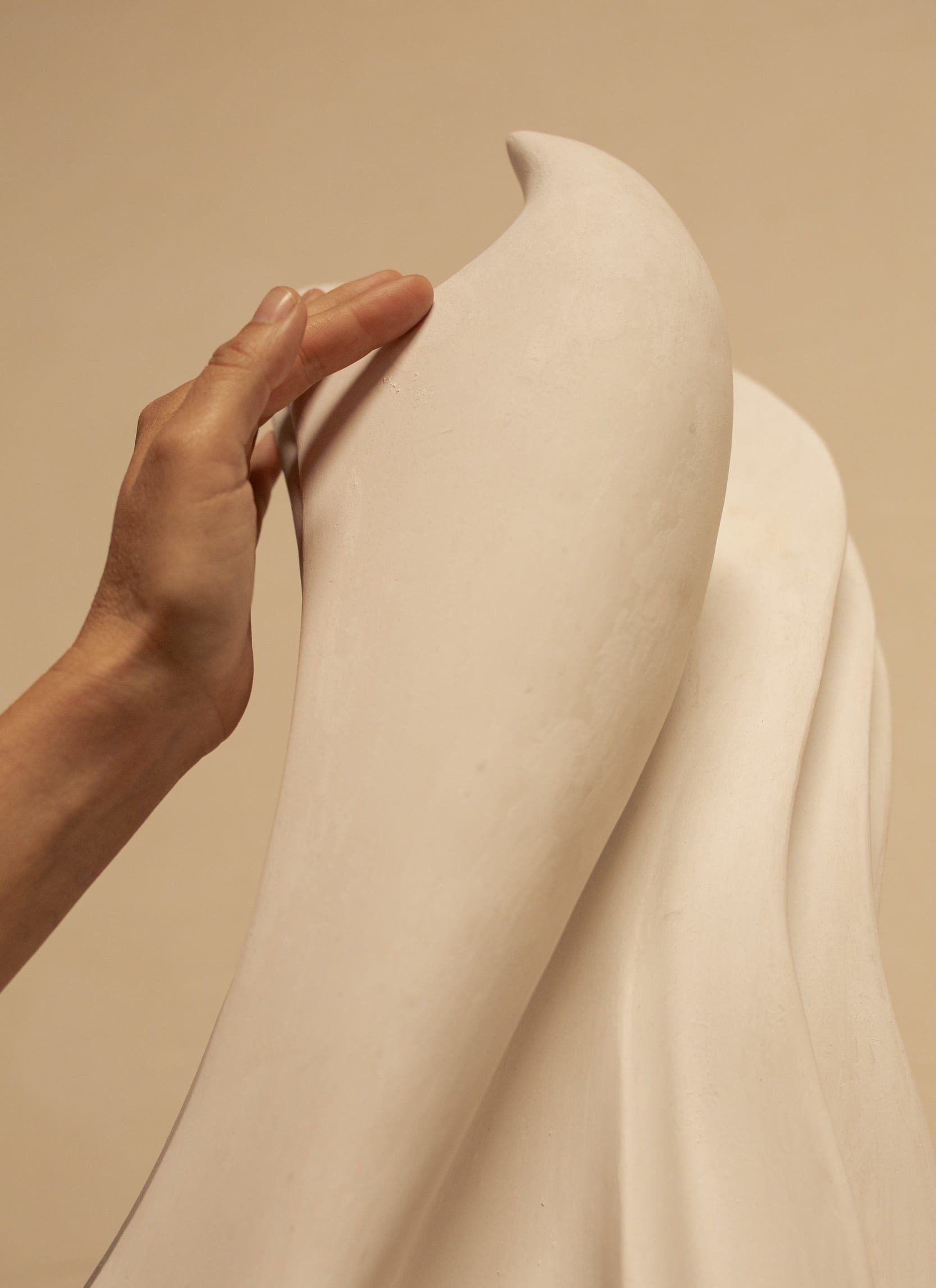
From an industrial park in Silicon Valley, Yoko Kubrick is summoning gods and monsters. When the door of her large, nondescript unit is rolled up, a world of beauty reveals itself: The sculptor makes monumental bronze and marble works—nine-foot-tall sculptures full of quiet surprises and subtle, erotic references to plant life and the ocean.

Born to a Japanese mother and Czechoslovakian father in the US territory of Guam, Kubrick grew up moving between Guam, Hawaii and San Francisco, spending summers with her grandparents in what is now Czechia. Sitting in a workspace overflowing with carving tools, small plaster studies and stacks of art and philosophy books, she credits her early inspiration to Hawaii: “There’s Indigenous sculpture everywhere, and the way the teachers in school talked about the mythology behind them was to tell these stories like they were real,” she says.

Storytelling is now central to Kubrick’s practice, with ideas for her work sparked sometimes by myths about ancient gods and goddesses and, at other times, soap operas. “Across cultures, when you boil it down, there are these common stories,” she says. “If you look at Will Smith and what happened with that slap? That’s what a lot of Greek mythology reads like: gossipy dramas between people. Rage, jealousy, revenge, not being able to control our emotions. They’re stories about human nature.”

Emma Silvers: From 2016 to 2019, you lived in Tuscany, where you learned to carve marble from third- and fourth-generation sculptors. What role does tradition play in your work? 

Yoko Kubrick: I love traditional materials. I lived in Pietrasanta, which has the highest population per capita of sculptors anywhere in the world. Some foundries go back multiple generations and so much of the sacred sculpture around the world is from there. These sculptors were so specialized—when they made angels, they would have one guy who did faces, one guy who did wings and feathers and another guy who just did the flowers. I actually met one of the last flower carvers in Pietrasanta. They stopped training them that way, because it doesn’t make sense economically; they all became generalists. I think it’s kind of sad that’s being lost. This guy, Franco Lombardi, you give him an air hammer and a chisel and he could carve roses blindfolded.

ES: Did that experience affect how you think about American art?

YK: Well, while I was doing my apprenticeship I also met sculptors from all over the world—Venezuela, Japan, the Czech Republic. I was the only American. We would sit and have these dinners and get into debates and it would often turn into an attack on Americans, like, “You guys don’t have any art history.” I would sit there and listen to this, until something dawned on me one day and I started pushing back: Maybe it’s a good thing we aren’t so tied to our history and culture the way Italians are. Most contemporary Italian artists are figurative; they’re very rooted in their tradition, and even when they do try to break away from it, it’s very difficult for them. I think that’s why a lot of the early abstract expressionists were children of immigrants—like Mark Rothko. They’re breaking away and starting new. Similar to how, in the Bay Area, because we’re not married to so much tradition, somebody can say, “I’m going to start an app where I rent out my air mattress, okay?” And we’re like, “Great!” 

Kubrick trained in Pietrasanta, a small Tuscan town known for its 50-plus marble workshops. Sculptors including Henry Moore, Isamu Noguchi, Joan Miró and Fernando Botero also spent time perfecting their craft there.

A fragment of a mushroom coral skeleton (center) and a handmade rasp, the coarse file used by marble carvers.

The stone a sculptor chooses to work with will affect the look and feel of the final piece. The sculpture in the foreground is carved from statuary marble, which has a smooth aspect, whereas the one behind it is carved in titanium travertine, which retains a matte finish.

( 1 ) The Medici family, owners of the most powerful bank in 15th-century Europe, is seen as responsible for ushering in the Renaissance in Florence because they commissioned the city’s artists and built a host of buildings through which to disseminate culture. None of this was altruistic; the family saw the arts as a means of gaining popularity and cementing its rule.

ES: You have a master’s degree in psychology and art therapy, and previously worked at a psychiatric facility as an art therapist. Does that background inform your work?

YK: It has to do with how I fell in love with abstract art. I think the gap between reality and that abstract shape opens your mind—almost like a Rorschach, where you can project your own interpretation onto it. Carl Jung said that we have this collective unconscious, so certain shapes and forms are preprogrammed in our minds to elicit a response. If you show even a very young child the shape of a spider, there’s a fear or revulsion response, right? I think about why humans love flowers so much. And if you think about it, a flower is the sex organ of a plant. In a lot of my sculptures, I might take some shape out of a plant, some shape out of a woman, and just try to touch that pleasure or curiosity point in the mind. 

ES: You’re currently creating pieces for an exhibition in the gardens at Filoli [a nearby historic estate-turned-museum] based on Ovid’s Metamorphoses. What drew you to that work?

YK: If you look at Renaissance art, even Shakespeare, so much of it comes out of this one epic book of poetry and fables. But the thing that I found fascinating was scholars think it was the first time in written literature that the woman was portrayed as the protagonist. So these pieces will be interpretations of female heroines. And part of my proposal was that, in the gardens, with this large-scale work, the art becomes a place of refuge and the audience really becomes part of those stories.

ES: Some of your work is installed in public places, like the University of San Francisco campus. How do you think about making public art versus sculptures that wind up in private collections?

YK: If I could get enough commissions, I would actually love to only do public art. Having studied art therapy, I think all hospitals should have therapeutic gardens. And I just think about art in terms of urban design, town centers, piazzas. Growing up in San Francisco’s Japantown, Ruth Asawa’s sculptures were everywhere. I used to play in that fountain at Peace Plaza when I was a kid. I remember sitting out there with my dad when he was talking to his friends—just that open space with the artwork as the focal point. Art becomes a marker where memories are made.

I also think, in terms of accessibility—especially when so much of the world’s wealth is concentrated in Silicon Valley—why don’t we have more public art? People here can afford it. I’ve thought about this a lot. In Italy, Florence is a center of so much opera, sculpture, architecture. None of that would have happened without the Medici family, who were incredibly important patrons of Renaissance art.1 I think the way to go about it with the Mark Zuckerberg types is to make it a social responsibility to support visual art, music—comedy, even. To get them to realize that they have, potentially, a very important historic role, to be the patrons of the next generation of culture and art. If all we have is Google, what do we really have?

Kubrick often takes inspiration from classical mythology when naming her sculptures. Panta Rhei translates as “everything flows"—an aphorism of Heraclitus that expresses the fact that the universe is in a state of constant flux.

( 1 ) The Medici family, owners of the most powerful bank in 15th-century Europe, is seen as responsible for ushering in the Renaissance in Florence because they commissioned the city’s artists and built a host of buildings through which to disseminate culture. None of this was altruistic; the family saw the arts as a means of gaining popularity and cementing its rule.

You are reading a complimentary story from Issue 46

Want to enjoy full access? Subscribe Now

Subscribe Discover unlimited access to Kinfolk

  • Four print issues of Kinfolk magazine per year, delivered to your door, with twelve-months’ access to the entire Kinfolk.com archive and all web exclusives.

  • Receive twelve-months of all access to the entire Kinfolk.com archive and all web exclusives.

Learn More

Already a Subscriber? Login

Your cart is empty

Your Cart (0)