Photograph: Brigitte Lacombe.
Archive: Jean SteinAnnick Weber chronicles the life of one of New York’s great storytellers.

Photograph: © Inge Morath / Magnum Photos / Scanpix.
Jean Stein brought the world to her Upper West Side apartment, then transformed her guests’ party anecdotes into stirring oral histories of the American dream. Annick Weber chronicles the life of of New York’s great storytellers.
Jean Stein brought the world to her Upper West Side apartment, then transformed her guests’ party anecdotes into stirring oral histories of the American dream. <i>Annick Weber</i> chronicles the life of of New York’s great storytellers.
The first thing that many people noticed about Jean Stein was the tape recorder. Though clunky and somewhat old-fashioned-looking, it served her well on decades’ worth of trips across America, during which she interviewed subjects as varied as the topics she covered. Stein was not an ordinary writer for whom a notepad and pen would likely have sufficed; she was a master of the oral history form, and the tape recorder was essential in fully capturing and collecting her interviewees’ firsthand accounts of modern American life.
“She found the métier she loved in conducting interviews,” Stein’s daughter, Katrina vanden Heuvel, says, speaking on the phone from New York City. “She seemed quiet and vulnerable with her shy, fluttery voice, but she was fearless with the tape recorder. She was a relentless interviewer and a beautiful listener, who would wait until she got exactly what she wanted to hear from her subjects.” The cassette recordings, combined with Stein’s restless curiosity, laid the foundations for comprehensive oral histories about the assassinated US attorney general Robert F. Kennedy (American Journey, published in 1970), the Andy Warhol muse Edie Sedgwick (Edie, published in 1982) and a group of Angelenos who shaped the face of their city (West of Eden, published in 2016). Her oeuvre spanned politics to the underground art scene, both of which she was involved in, but never fully a part of. “She was able to see milieus that she wouldn’t have seen, had she not had that tape recorder,” vanden Heuvel tells me. “Essentially, it was a way of getting out of where she was born.”
A daughter of Hollywood royalty, Stein grew up in a bubble. When she was three, in 1937, her family moved from Chicago to a sprawling mansion in Beverly Hills. The relocation allowed her father, Jules—a conservative Republican and ophthalmologist-turned-entertainment magnate—to be closer to the glitz and glamor of Hollywood, where the new headquarters of his music booking agency, MCA, was based. The family mansion quickly became legendary for its parties, where Los Angeles’ film, music and theater set gathered to pay court to the powerful patriarch. Stein liked to describe her childhood home as a “fantasy,” remembering with regret how she and her sister were “brought down to curtsy like little dolls in our dressing gowns” before being tucked into bed by their nannies. Life in La-La Land could have given her all the wealth and security she wanted, but Stein—a fervent Democrat—chose to venture out and see more of the world.
“She was able to see milieus that she wouldn’t have seen, had she not had that tape recorder. Essentially, it was a way of getting out of where she was born.”

Photograph: Brigitte Lacombe.

Photograph: Brigitte Lacombe.
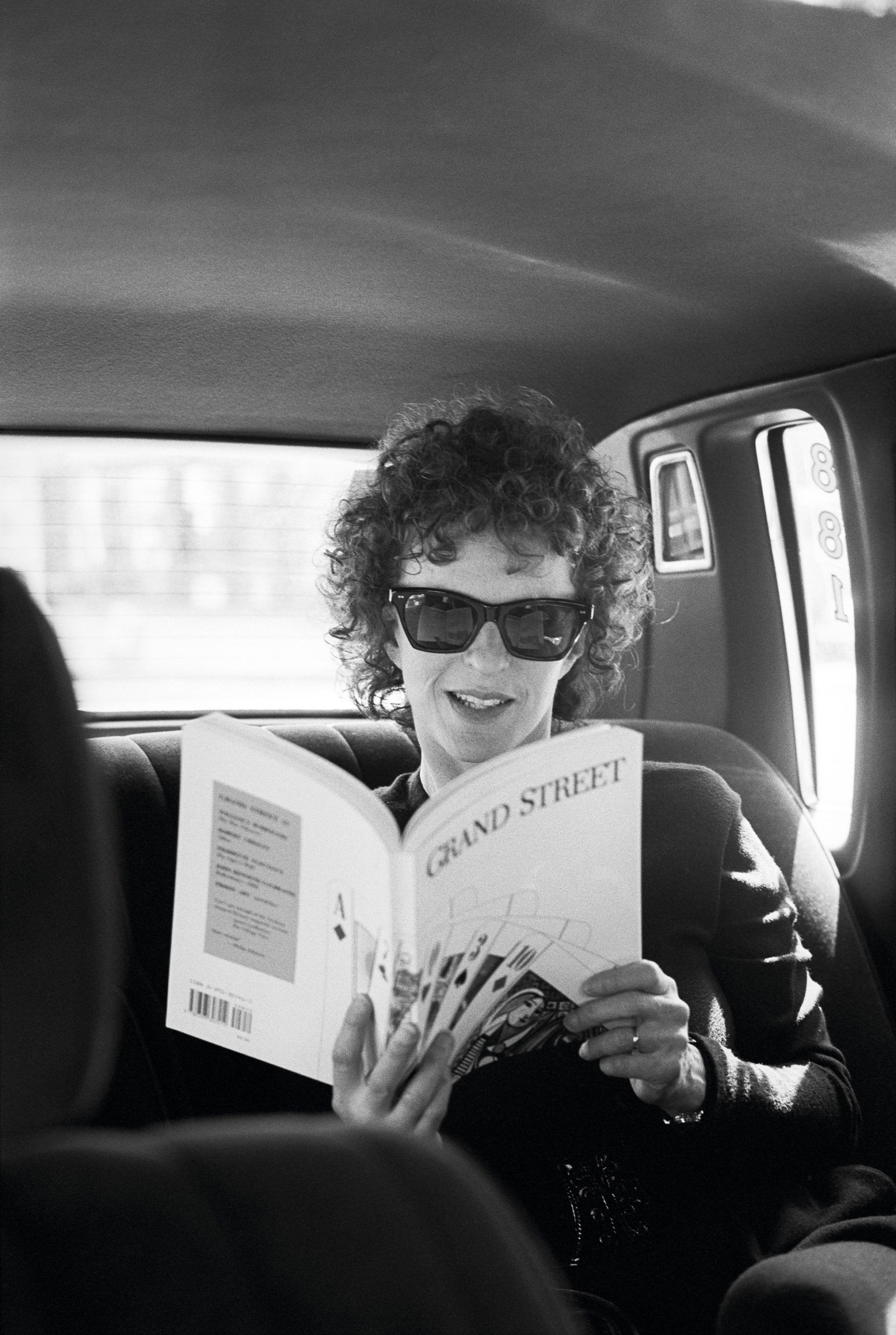
From a young age, Stein attended schools in San Francisco, Switzerland, New York and Massachusetts, before enrolling at Paris’ Sorbonne university in the mid-1950s. It was in the French capital that she made her initial forays not only into the art of interviewing, but also the world’s intellectual circles. The first major commission she landed was an interview for The Paris Review with William Faulkner, with whom she was having an affair. Impressed by her direct, even blunt interview style, the literary magazine kept her on as an assistant to the founding editor, George Plimpton, a role she held for several years before moving back to New York. (Plimpton remained a close friend of Stein’s and went on to edit her books American Journey and Edie.) “She made her great mark at The Paris Review, which informed her later on when she was working on Grand Street,” vanden Heuvel says, referring to the literary and visual arts magazine Stein edited from 1990 to 2004. “She was a great editor, always looking for the new, the vibrant, the interesting. That too was almost oral history; Grand Street was a place where she could make various voices heard.”
In her personal life, Stein enjoyed doing what she did professionally as an editor and an oral historian: bringing together a mix of people from all sorts of backgrounds. She was a passionate host with an eclectic group of friends. As she told the Los Angeles Times in 1990: “I am very interested in these different worlds coming together. In a way, I’ve lived my life in New York that way.” At the parties held starting in the early 1960s at her Upper West Side apartment, one was as likely to run into Nobel laureates and diplomats as civil rights activists, dissident poets and avant-garde artists.
Among the invitees were Jackie Kennedy Onassis and members of the Black Panther party, Andy Warhol in the company of his Factory pals, and Norman Mailer exchanging punches with Gore Vidal. And in the midst of it all was Stein, observing, orchestrating and connecting her guests with effortless ability. “She was the ringmaster,” the Pulitzer Prize–winning cartoonist Jules Feiffer said in The New York Times’ obituary for Stein. “Her demeanor was quiet, but she was noticeable in a room. She was the centerpiece without commanding attention.” It was this lack of pretense that her friends admired the most in her. Stein invited people not for their fame, but because they were unafraid to live life on their own terms.
Out of the three oral histories she wrote, the one she was most fond of was Edie. Edie Sedgwick, unsurprisingly, was a friend of Stein’s. Aware of Sedgwick’s anorexia and drug abuse years before her death from an overdose in 1971, Stein put her up in her daughter Wendy’s bedroom in 1967 after Sedgwick accidentally set fire to her room at the Chelsea Hotel. The sisterly devotion with which Stein looked after Sedgwick stemmed to some extent from her own familiarity with the perils of high society: Like Stein, Sedgwick was born into great wealth as the daughter of New England patricians.
Edie allowed Stein to explore what drove her protagonist’s downfall from aristocratic heiress to doomed superstar. She spent multiple years interviewing and reinterviewing Sedgwick’s family and friends to paint a full picture of her subject’s short life, but also of a 1960s America fascinated with youth, beauty and stardom. The illusory nature of the American dream was a recurring topic in Stein’s work, becoming the basis for her final book, West of Eden, in which she recorded the nation’s “trickster promise” through interviews with five of Los Angeles’ most influential families, including her own, compiled over more than 20 years.
Stein died by suicide on April 30, 2017 at the age of 83, leaving behind countless unpublished oral histories, including records of the 1992 Los Angeles riots and Havana on the eve of the Cuban revolution. With age, her social circles had become increasingly smaller. “She had a hard time because so many of her friends passed away,” vanden Heuvel tells me of her mother’s death. “She stopped having parties and instead started seeing people one-on-one. But she missed it.” In her breakthrough 1955 interview with Faulkner, Stein asked him what he thought the best environment for a writer was. Had he asked the question back to her, she would surely have said that for an oral historian like her, it was a room full of voices—voices of otherwise forgotten chapters in American history, culture and society.

Photograph: Frank Leonardo / New York Post Archives / © NYP Holdings Inc. / Getty Images