CAIRO CALM The Hassan Fathy masterpiece that a costume collector calls home.

CAIRO CALM The Hassan Fathy masterpiece that a costume collector calls home.

Issue 46

, Interiors

,
  • Words Rowan El Shimi
  • Photography Ämr Ezzeldinn

The apartment makes the most of its positioning on the top floor of the building with an open-air courtyard and a skylight in the bathroom.

Mehrez has spent a lifetime archiving the regionally specific dress of Egyptian women. Her 500-plus costumes aren't stored in her penthouse, but it is full of antique textiles and books on Egyptian history.

The Cairo skyline is a maze of satellite dishes, rebar, minarets and pigeon lofts. Many of its rooftops hold informal housing, often for underprivileged immigrants from the countryside.

One rooftop stands out: the apartment of 78-year-old Shahira Mehrez, which tops a six-story building in the upmarket neighborhood of al-Dokki on the west bank of the Nile. Built in 1971 by renowned Egyptian architect Hassan Fathy, who pioneered the use of ecological materials and traditional building design in contemporary settings, the penthouse has been Mehrez’s home for the past 52 years. 

Mehrez is a designer, scholar and collector of traditional Egyptian costumes. With her French education and roots as a Muslim in Egypt, Mehrez always felt hinged between two worlds. “For the Egyptians, I was French and for the French, I was Egyptian. I was nowhere,” she explains, relaxing in the open courtyard of her apartment. After hearing about Fathy and his work in the mid-1960s, she sought him out and started visiting his home and studio in 1967. Meeting Fathy completely changed her perspective on her duality: “He told me I was very lucky that I had the opportunity to belong to two cultures and could take from each what suited me best,” she says.

From there came the project for the apartment, which was added to a building already owned by Mehrez’s family, and completed in 1971. Fathy brought his signature approach of environmentally conscious building and traditional motifs. 

Upon entering the rooftop via the elevator, one is met with a magaz, a wooden structure that protects the privacy of the owner, followed by a hallway that leads to an open-air courtyard with built-in marble couches, marble floors and a traditional fountain in its center. Fathy designed the space to maximize airflow to counter the hot summer climate, and this is where Mehrez spends most of her time, enjoying the breeze.

Mehrez told Fathy that she wanted her interior space to be a “small, big room.” It’s made up of two levels: On the lower level, there’s a workspace and hosting area and on the upper level, closed off behind colorful sequined curtains, is her bedroom—all under a tall wooden traditional structure with windows on every side. There’s also a marble bathroom with a vanity, built-in couch and traditional tub on the upper level.

“When I have people over, I can use the whole space with people outside in the courtyard, in the lower space of my bedroom or even in the bathroom, where I would often have ice in the tub for drinks and people could sit and enjoy their beverages on the marble sofa,” she says. “Now that I’m older, I have more high tables to eat and to write at,” she continues, counting six workstations in the three rooms where she sits and writes her book when she’s not working on one of her sofas outside.

Mehrez explains that Fathy did not consider himself an architect for the rich. “He would say, ‘You’re not my client; my clients are the millions due for premature death because of bad habitat. I build for the poor,’” she recalls. Fathy’s flagship project was New Gourna, a village on the west bank of the Nile built between 1945 and 1948 to house those displaced by the booming tourist trade at the famous temples on the east bank. Despite Fathy’s vision, his use of sustainable materials and his involvement of the community in the design process, the project ultimately failed; only a fraction of the local population moved there. Fathy detailed the story of New Gourna in his book Architecture for the Poor.

In a way, Mehrez and Fathy have both lived by the belief that Egypt lost its way in the 20th century when it dropped its traditions for a more Western approach. Mehrez is currently writing Costumes of Egypt: The Lost Legacies, a four-volume book documenting Egypt’s costume tradition, and a culmination of her life’s work. “[Fathy’s] work was much more important, as you can’t avoid architecture, as he would say,” she explains. “But in a way, we both failed. He was trying to preserve tradition that was more environmentally conscientious and build with ecological materials and I was trying to push Egyptian society to at least preserve their clothing and traditional costumes by wearing them. I failed . . . I’m the only one wearing them!”

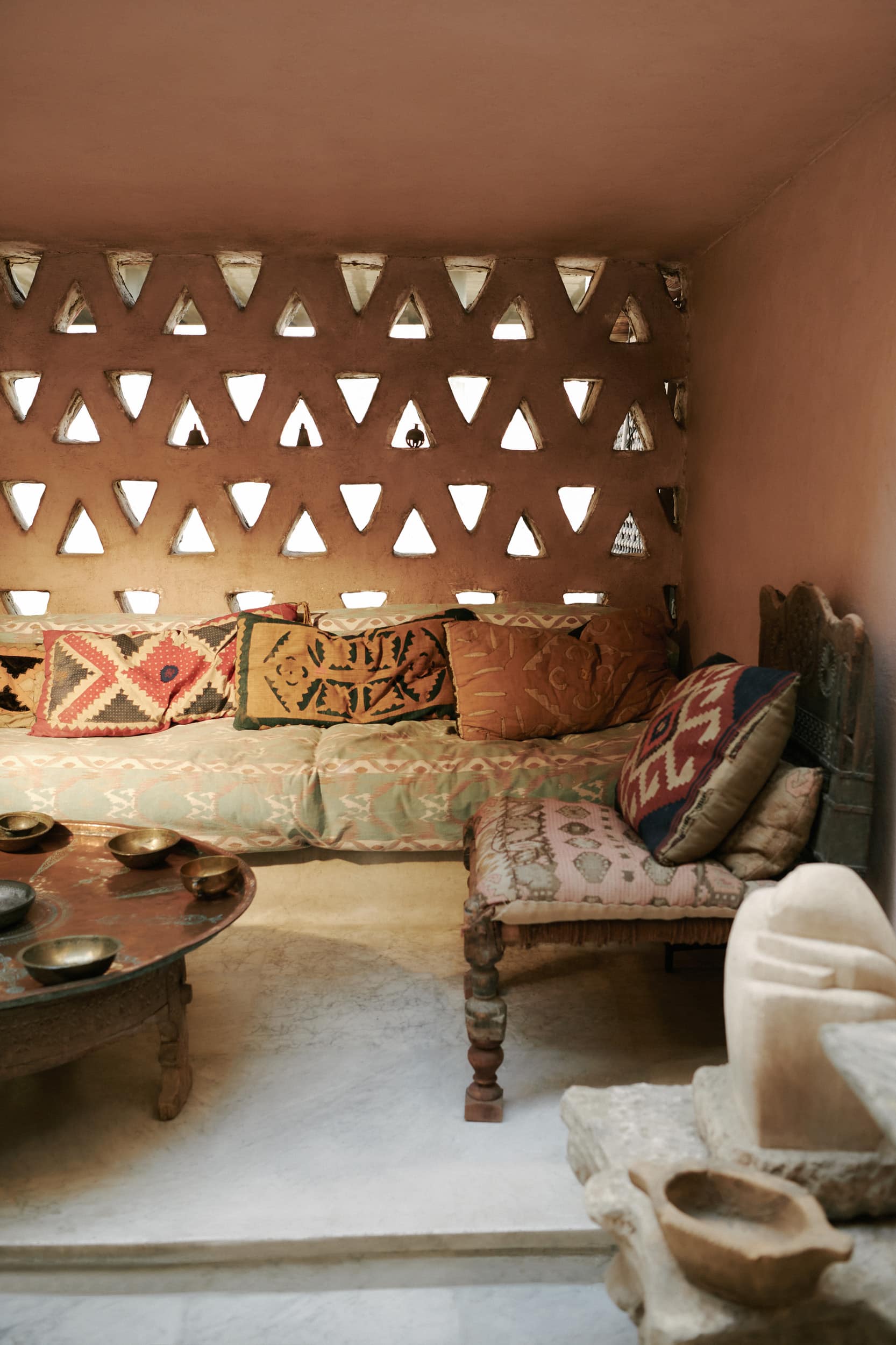
A traditional majlis (the Arabic word for sitting room) designed by Fathy, featuring long, low sofas on three sides.

You are reading a complimentary story from Issue 46

Want to enjoy full access? Subscribe Now

Subscribe Discover unlimited access to Kinfolk

  • Four print issues of Kinfolk magazine per year, delivered to your door, with twelve-months’ access to the entire Kinfolk.com archive and all web exclusives.

  • Receive twelve-months of all access to the entire Kinfolk.com archive and all web exclusives.

Learn More

Already a Subscriber? Login

Your cart is empty

Your Cart (0)