Cult RoomsSpying on the house of Anaïs Nin.
Cult RoomsSpying on the house of Anaïs Nin.
The story behind the Los Angeles home of the celebrated writer and eroticist Anaïs Nin (1903-1977) begins in 1947, when Nin met the actor and forest ranger Rupert Pole. Nin had been splitting her time between New York and California and so Pole, who would later become Nin’s husband, commissioned a home in Silver Lake to anchor her on the West Coast.
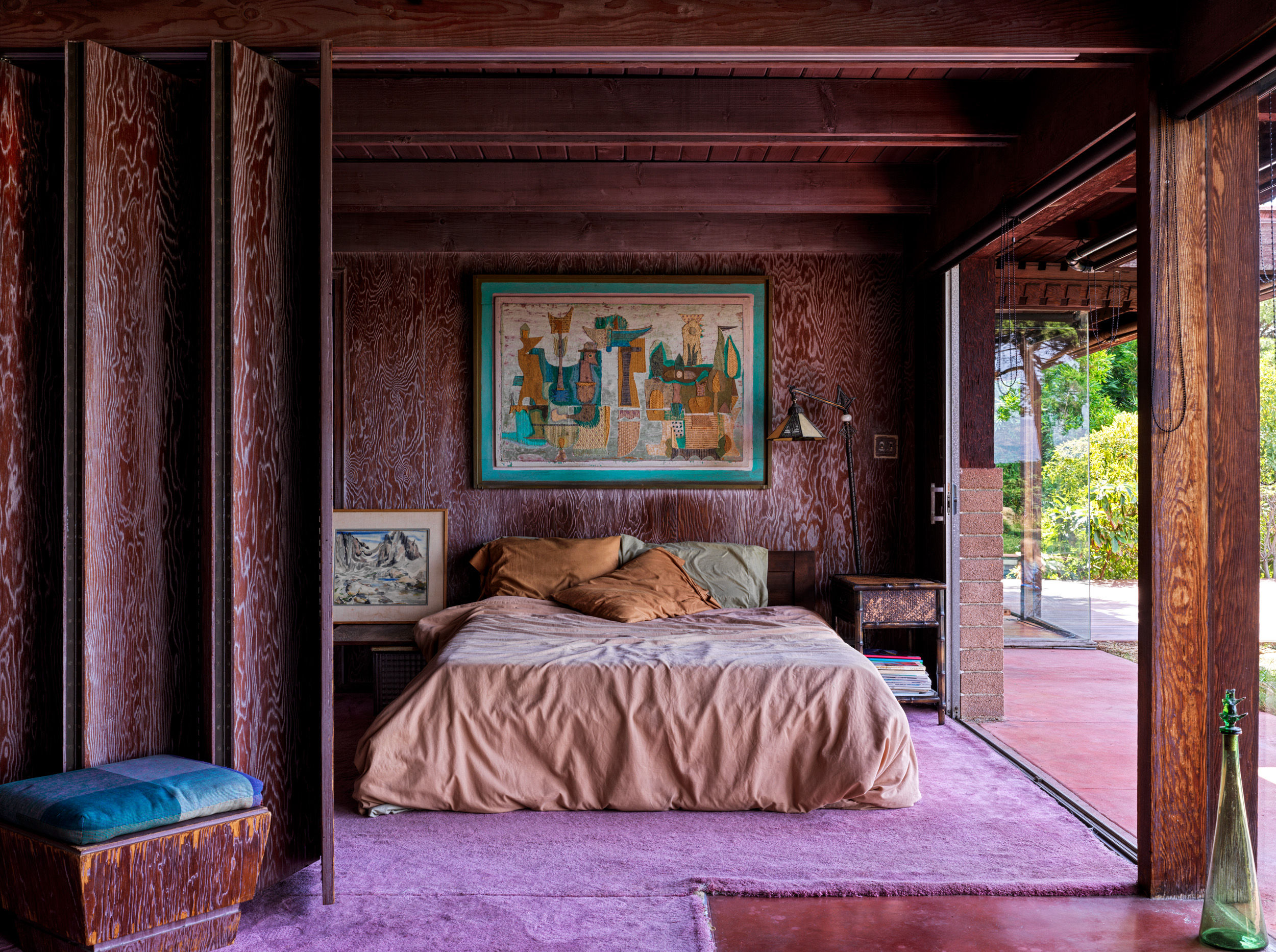
Designed by Pole’s half brother, Eric Lloyd Wright, the home expresses the philosophy of organic architecture that had been conceived by Lloyd Wright’s pioneering grandfather, Frank—an approach that seeks to balance buildings with the environment, prioritizing natural materials, such as the stained redwood used at Nin and Pole’s home, and sustainable design.
The Nin-Pole house, which was completed in 1962, is noted as much for its interior design as for its architecture, however, and is defined throughout by a prominent use of purple. There are mauve carpets and the walls are clad in wire-brushed purplish-brown plywood, a material that is also used for a folding divider that opens the living room onto the bedroom. The west wall has vast floor-to-ceiling windows opening onto a small pool with views over Silver Lake Reservoir, causing—as Tree Wright, the secretary of the Anais Nin Foundation, says—the entire space to be “warmed [by] the mauve interior [at] sunset.”
Little has changed at the house since Nin and Pole lived there. Following Pole’s death in 2006, Tree moved in with her husband, Devon, Lloyd Wright’s son, and had the house designated as a historic-cultural monument. They sold the house in 2020, but as Tree remembers, “We spent hours watching incredible fires in the large fireplace, with the pool reflecting dancing light onto the interior walls and ceiling; the sky entering from the unobstructed picture windows, along with the abundant lush landscape planted by Rupert.”