Cult RoomsWalden 7—the pop icon of public housing.
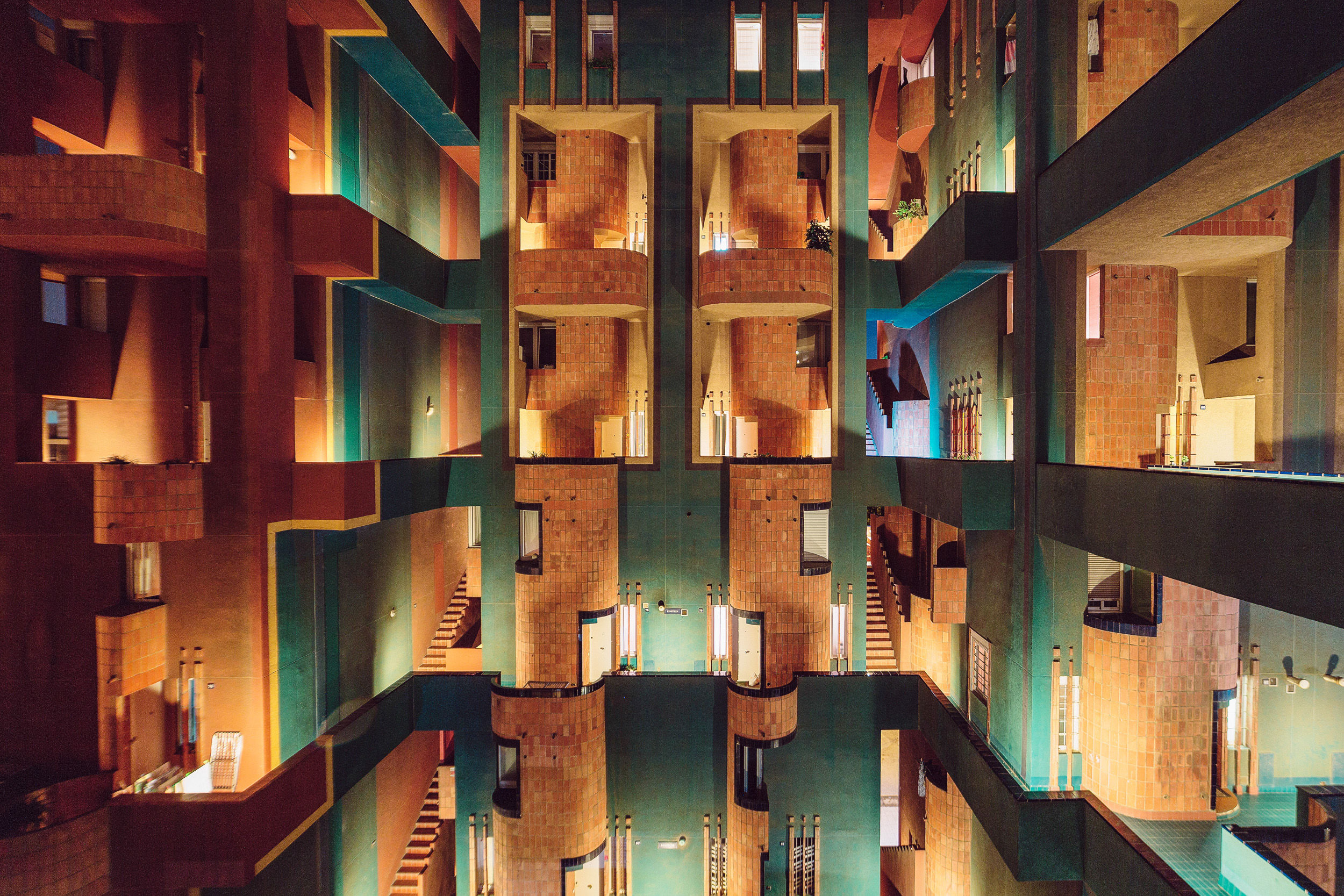
Ricardo Bofill’s Walden 7 rises Tetris-like from the gray urban sprawl of Sant Just Desvern, on the outskirts of Barcelona. Built in 1975, and named for Henry David Thoreau’s treatise on intentional living, the idiosyncratic housing complex of 446 subsidized apartments was an attempt to prove that imaginative architecture could exist outside of luxury commissions. Its labyrinthine structure is formed of 18 interlinked buildings, each 14 stories high. Five courtyards painted in ultramarine and celadon, connected by bridges, staircases, balconies and walkways, thread through the development, creating a journey that alternates between intimate, plant-dotted corners and vertiginous open spaces.
Bofill’s firm, Bofill Taller de Arquitectura, envisioned Walden as a “city within a city,” providing residents with everything they might need, including amenities like bars and shops on the ground floor and two rooftop pools. The interiors, designed around modular units of 320 square feet, could be reconfigured to suit residents’ needs and were equally radical, with freestanding bathtubs set boldly in the center of the unit (a feature most residents removed after moving in).
Walden 7 has a slightly tarnished legacy owing to technical flaws. The original ceramic tiles on the facade began detaching due to faulty adhesive, prompting an expensive recladding, and the building’s complexity has made maintenance challenging. But over time, perceptions have shifted: The dramatic forms and generous communal spaces came to outweigh its faults, and the building gained cult status among a new generation of architecture and design enthusiasts. Rent is no longer subsidized, but the relatively affordable prices have attracted a mix of artists, designers and young professionals, drawn to both the architecture and the strong sense of community it has successfully cultivated.