Cult Rooms Inside Alexander Calder’s studio, where chaos and kinetic art found a harmonious balance.

Cult Rooms Inside Alexander Calder’s studio, where chaos and kinetic art found a harmonious balance.

  • Words Stephanie d’Arc Taylor
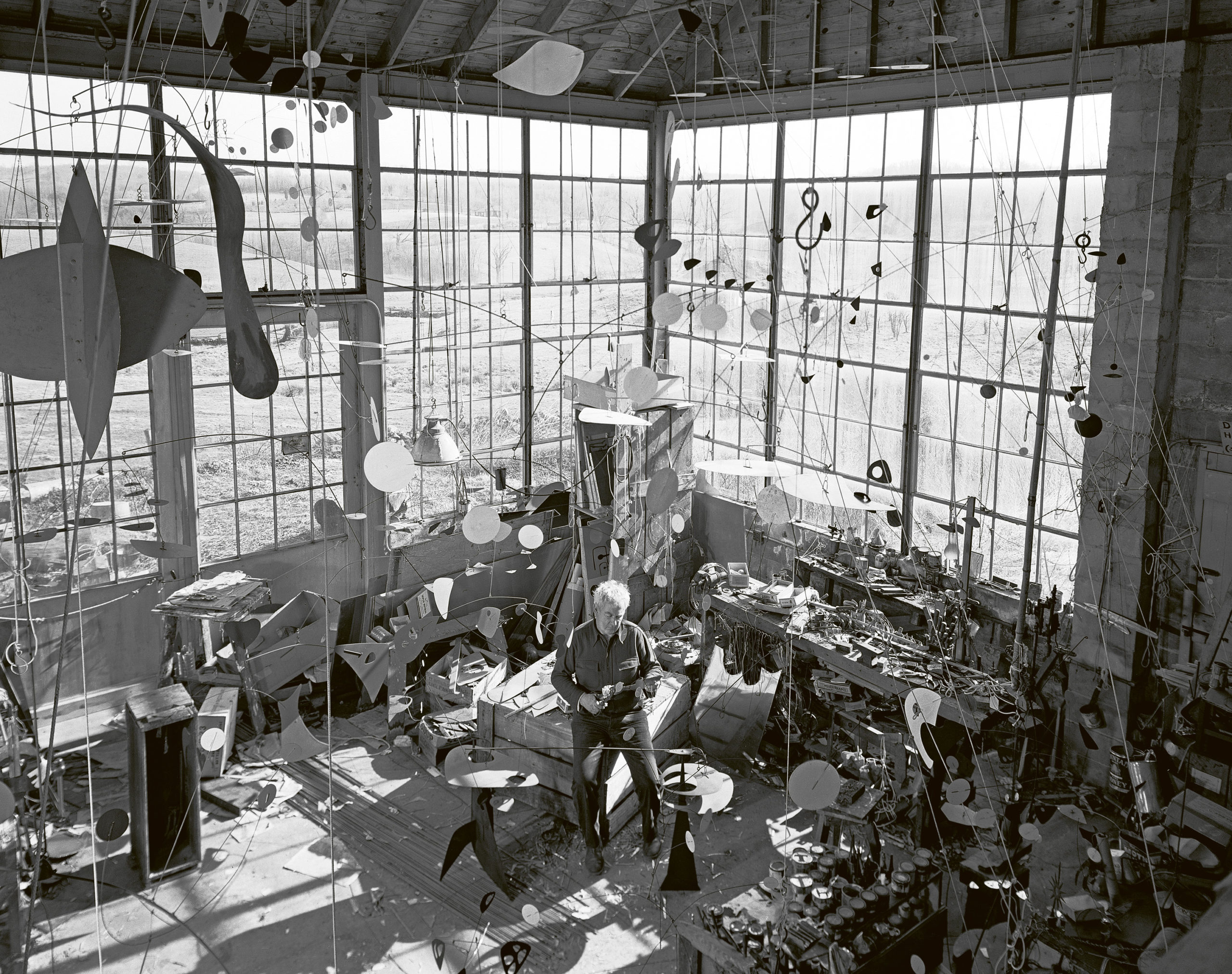
  • Photograph Evans/Three Lions/Getty Images

( 1 ) Calder’s legacy lives on in Roxbury, Connecticut. His 1975 sheet metal sculpture Angulaire stands on the grounds of the Minor Memorial Library, the city’s public library, on South Street.

The work of Alexander Calder is kinetic, fluid, constantly in motion. He’s best known for his elegant mobiles (the term itself has its origins with Calder; Marcel Duchamp applied it to his work after visiting the sculptor’s studio). These are abstract, colorful shapes cut from sheet metal, which hang on wires and are perfectly counterbalanced with either more sheet metal or a weighted ball. His mobiles, as well as much of his jewelry, painting, and other work, are just-so abstractions—gossamer delicacies which gently respond to changes in their environments like chiffon-wearing dancers. “Each element [is] able to move, to stir, to oscillate, to come and go in its relationships with other elements in the universe,” Calder wrote in 1932.

The exquisite precision of Calder’s work stands in stark contrast to the state of the atelier where he based his practice for most of his career. The repurposed icehouse—which stood adjacent to the farm in Roxbury, Connecticut where he lived for 30 years—was an utter shambles; Marie Kondo’s living nightmare. Pliers, hammers and scissors of all sizes lay on worktables in orgiastic metal jumbles interwoven with bits of string too short to use. Pieces of discarded wood and metal from generation upon generation of project were swept under the table and left there. The mess was illuminated in brilliant detail by nearly 20 feet of soaring windows. Mobiles hovered from the ceiling as if Harry Potter himself had suspended them in space. 

The fluid motion of Calder’s work, as well as the apparent chaos of his atelier, seem understandable when considering the artist’s upbringing and life before relocating to rural New England. Born in 1898 to artist parents—a four-year-old Calder posed for a sculpture by his father, a cast of which is part of the permanent collection at New York’s Metropolitan Museum—Calder and his family moved from Philadelphia to Arizona, to Pasadena, to New York and to San Francisco all before he turned 14. He then shuttled back and forth between New York and California for high school, completed college in New Jersey and got a job as a mechanic on a passenger ship sailing from New York to Seattle via the Panama Canal. 

While he was working as a timekeeper at a lumberyard in Aberdeen, Washington, Calder felt called to become an artist. He moved back to New York, and then to Paris.

It was in Paris that Calder, like so many of his peers in the heady days of Paris’ années folles, came into his own. Awestruck by the abstract, geometrical paintings of Piet Mondrian, whose studio he visited in 1930, Calder began exploring geometrical shapes and primary colors in his own work. Ultimately, he infused his abstractions with life by animating them: hanging them from the ceiling and letting them sway freely, or even powering them with a small motor. One of the latter pieces, A Universe (1934), was particularly captivating to Albert Einstein, who allegedly stared at it for a full 40 minutes when it was first exhibited at New York’s Museum of Modern Art.

But like for many other expats enjoying the moveable feast that was interbellum Paris, the energy of the scene proved exhausting after a while. Calder and his wife, Louisa (née James, the grand-niece of the author Henry James), moved to Connecticut in 1933 after courting and marrying in Paris. His life until then had been exciting and dramatic, with new stimuli coming in at rapid fire. In Connecticut, that changed: Calder settled in, raised two daughters with Louisa and developed his artistic practice at the Roxbury farm for the next three decades. Life was simpler (although he and Louisa did manage a three-month trip to India in 1955, where he produced nine sculptures as well as some pieces of jewelry). But the chaos on which he so obviously thrived lived on in his madhouse of an atelier. 

It was at the beginning of the Connecticut years that Calder began to be recognized as one of the foremost sculptors of his generation. He also started to amplify his mobiles to monumental size, creating large-scale installations he called stabiles. These were instantly popular; Calder was ultimately commissioned to produce stabiles to be displayed at New York’s Idlewild Airport (now JFK), UNESCO’s Paris office and at the 1968 Mexico City Olympics. 

But as the years passed, the old wanderlust returned. Calder left Connecticut in 1963, decamping for Europe once again.1 The second Atelier Calder was outside Tours, France. There, scraps and bits didn’t have decades to accumulate. But from the photographs we have, it seems that by the time he died in 1976, the piles were well on their way to Roxbury levels.

( 1 ) Calder’s legacy lives on in Roxbury, Connecticut. His 1975 sheet metal sculpture Angulaire stands on the grounds of the Minor Memorial Library, the city’s public library, on South Street.

FREE PREVIEW

Take a look inside Issue Fifty-Eight.

You are reading a complimentary story from Issue 41

Want to enjoy full access? Subscribe Now

Subscribe Discover unlimited access to Kinfolk

  • Four print issues of Kinfolk magazine per year, delivered to your door, with twelve-months’ access to the entire Kinfolk.com archive and all web exclusives.

  • Receive twelve-months of all access to the entire Kinfolk.com archive and all web exclusives.

Learn More

Already a Subscriber? Login

Your cart is empty

Your Cart (0)