Field NotesA guide to reading the winter sky.
Field NotesA guide to reading the winter sky.
The quality of light changes as winter sets in. In December, the midwinter sun is low—when it makes an appearance at all—and the shadows it casts are long; light feels precious and fleeting. The air changes too; as it gets colder, sound travels farther. You might be able to make out a faint honking as skeins of geese travel south to their wintering grounds.
On moonless winter nights, skies can be impossibly full of stars. In the Northern Hemisphere, the Big Dipper’s pan, Cassiopeia’s “W” and Orion’s Belt are the easiest constellations to pick out. Sometimes a dot of light will seem more solid and a pair of binoculars will reveal that these are planets; you might even be able to make out the moons around Jupiter or the thin lines of Saturn’s rings. Venus, low in the sky, is a steady bright spark visible to the naked eye. The vast sweep of the Milky Way lives up to its name. And tiny motes of satellites drift slowly with unknown purpose, high above.
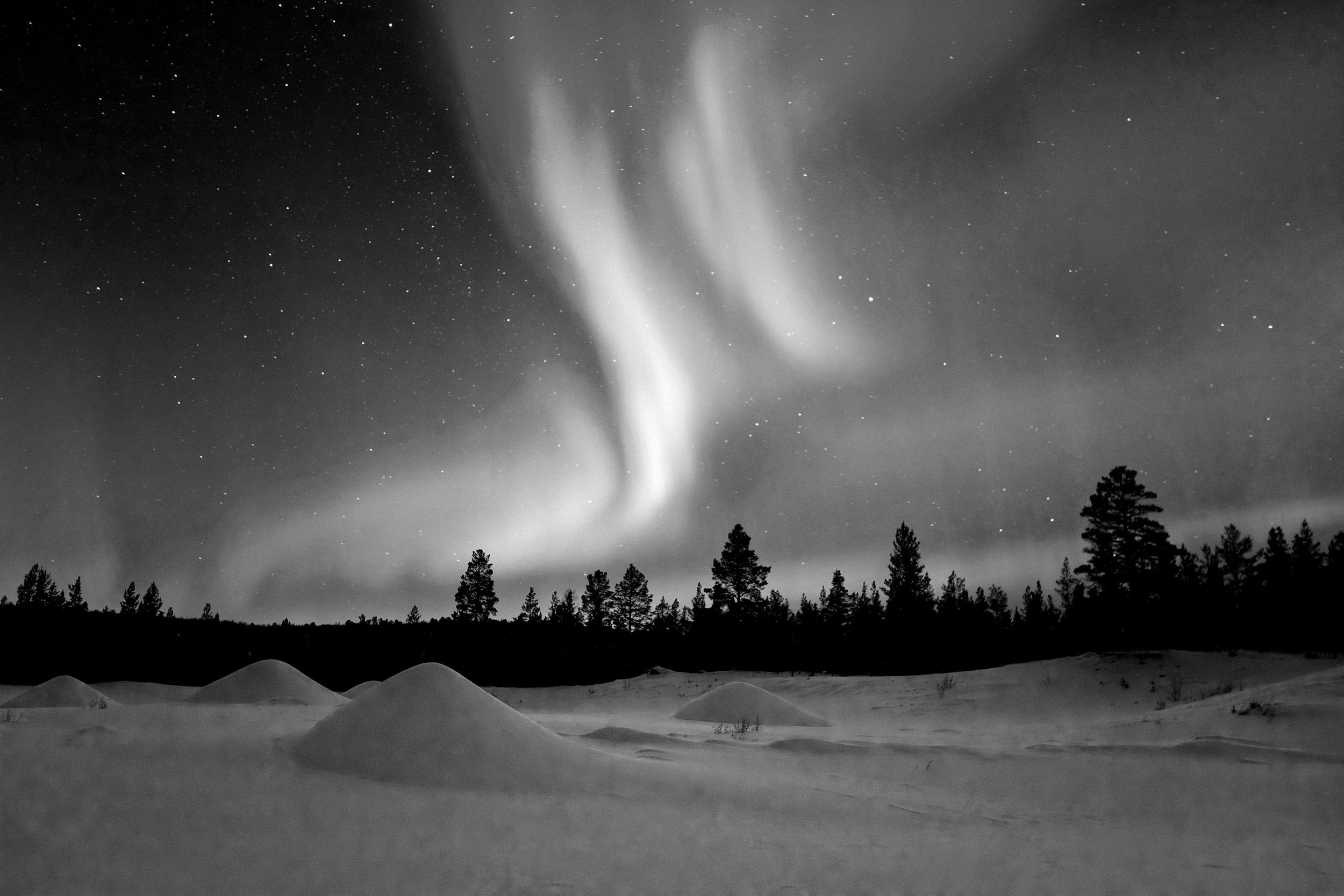
A cloudless night might also hold the promise of the northern lights, when the sky will start to ripple with curtains of iridescent greens, oranges and reds. Usually occurring north of 60 degrees latitude, they can sometimes be seen much farther south. In the dialect of the Shetland Islands, they’re known as the mirry dancers, the word mirr meaning to shimmer; in Scots Gaelic, they’re na fir-chlis, the nimble ones, and are said to be a sign of faeries dancing. Some Scandinavian fishing cultures thought they were the effect of light reflecting off huge shoals of herring and a sign of good luck. The Inuit believed they were the spirits of the dead.
The phenomenon can be easily explained by science—the product of electromagnetic storms and solar winds—but even if we no longer ascribe this spectacle to otherworldly forces, the lights remain a miraculous reminder of the wonder we seek in the sky.