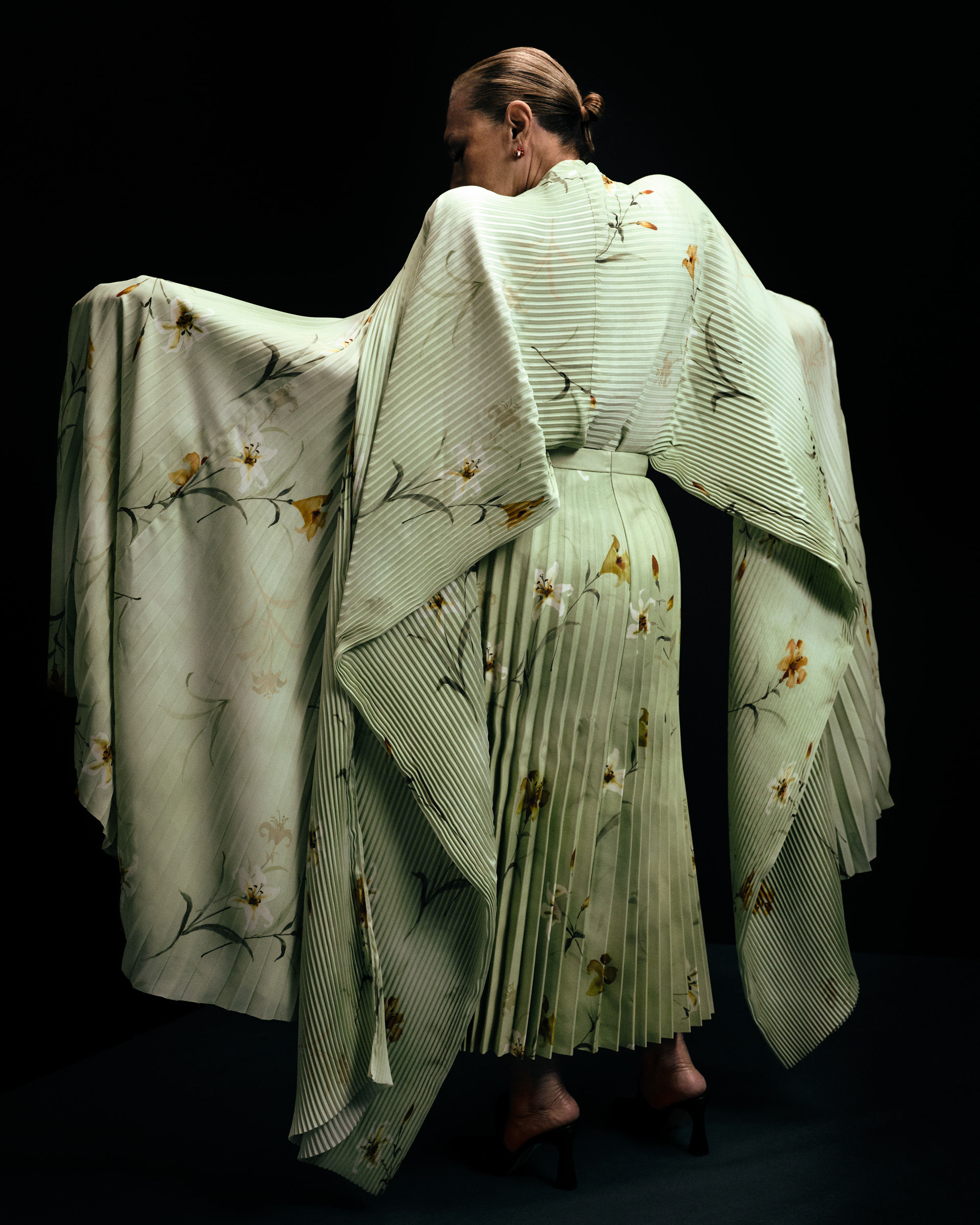
She wears a dress by BALENCIAGA, shoes by KALDA and earrings by BOTTEGA VENETA.
- Words Hooman Majd
- Photos Luke Lovell
- Styling Tana Grossberg
GOOGOOSH
She wears a dress by BALENCIAGA, shoes by KALDA and earrings by BOTTEGA VENETA.
- Words Hooman Majd
- Photos Luke Lovell
- Styling Tana Grossberg
- Hair Kelly Peach
- Makeup Omayma Ramzy
- Producer Alicia Zumback
- Set Design Romain Goudinoux
A rare audience with the queen of Persian pop.
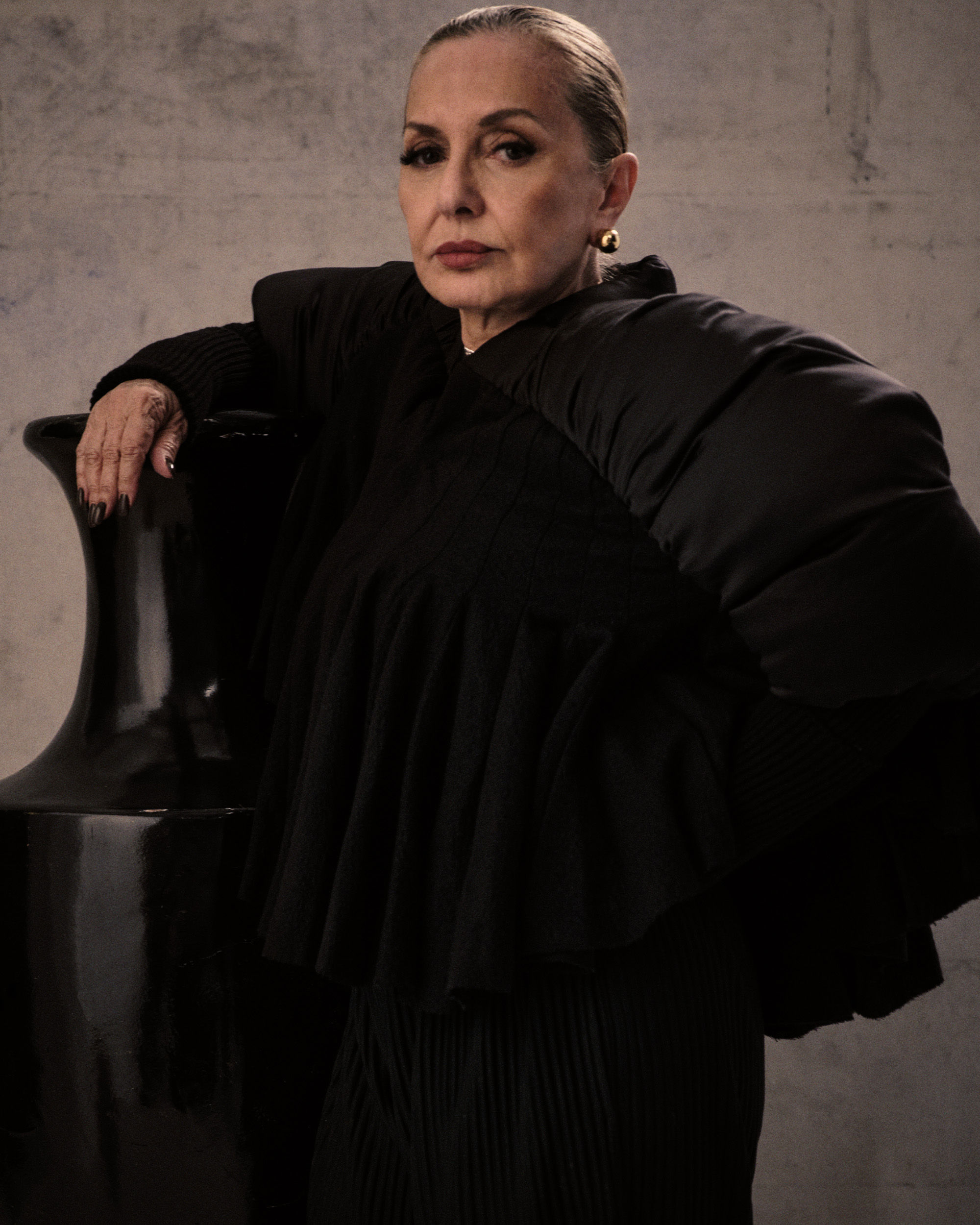
Googoosh wears a jacket by RICK OWENS and trousers by ISSEY MIYAKE.
It’s a sunny but unusually cold winter morning and Googoosh is sitting next to a heater at a desk off of her living room, wearing a turtleneck under a zip-up sweater. She is at her longtime home in Bel Air, in the hills above Los Angeles. One of her two Pomeranians is in her lap; her golden retriever is lurking in the background. We greet each other in Farsi before settling into a conversation in English, with just the occasional Farsi word thrown in.
It is impossible to overstate the importance of Googoosh in modern Iranian culture. Born Faegheh Atashin in Tehran in 1950 to Azerbaijani parents—but known as Googoosh since childhood—she is the preeminent singer and actress of prerevolutionary Iran. Every generation has its megastar—in the West, we’re arguably in a Taylor Swift era—but Googoosh has defied considerable odds to remain a star for generation upon generation of Iranians. Today, thousands of fans (many, if not most, born well after the 1979 revolution) travel from Iran to Turkey or Dubai to see Googoosh perform live, and thousands more in exile have flocked to her shows in cities including London, Toronto, Los Angeles, Las Vegas and New York—a testament to the way she has come to embody a vision of Iran that is at once contemporary and traditional.
“I was very little when I started performing,” she says. “In the beginning, I just wanted to make my father [entertainer and comedian Saber Atashin] happy but little by little, I noticed that people around me were enjoying what I do.” At the time, Iran (under Shah Mohammad Reza Pahlavi) was embarking on a furious drive toward modernization; by the time Googoosh turned 18 in the late 1960s, Persian society had fully embraced Western social mores and pop culture. It was in this heady atmosphere that she became a symbol of modern Iran: first as an actor, starring in a series of popular films, and as a fashion icon, with her miniskirts and haircuts (one of which came to be known as the Googooshi) copied by thousands of Iranian women.
It is in music, however, that Googoosh has made her lasting mark. During the 1970s, she was at the forefront of a new genre of Persian popular music, fusing the complex dastgah system of traditional Persian music with Western pop melodies. And while Persian pop had long since imported the violin into its repertoire, in Googoosh’s music, many of the classical instruments, such as the tar, ney, tonbak and santur, were supplanted by their Western equivalents: guitar and bass, flute (or clarinet), percussion and piano. “I wanted to be classical and modern,” she says. The result was a sound that was both instantly recognizable to an Iranian audience and yet strikingly new, allowing a young generation, open to Western culture and ideas, to claim her as their own. It made her one of the most popular figures in Iran, especially among young women for whom she represented female empowerment in a male-dominant, patriarchal society.
Yet for more than two decades, Googoosh was completely absent from public life. At the time of the Islamic revolution in 1979—when the shah was overthrown, the monarchy abolished and the fundamentalist Shia cleric Ayatollah Khomeini was hailed (and subsequently officially installed) as the regime’s highest authority, its “supreme leader”—she happened to be visiting the US. Despite the wholesale rejection of Western society by the Shia clergy now in charge, Googoosh decided to return to Iran. “It was a very bad situation for me and other Iranians at the time in America,” she says. “I felt lonely,” she explains. “I didn’t have anybody; I didn’t have money. I couldn’t stay alone in America.” She decided to catch a plane to Tehran from New York, not knowing “what would happen to me,” she says. “If I’m going to die, I prefer dying in my own country.” Many others waited anxiously to see what form the country would take after over two millennia of continuous monarchy.
On her return she was imprisoned for about a month, her interrogators in jail telling her that what she did for a living “was a sin,” and her passport was confiscated. There are differing notions in Islam as to whether a woman’s voice can be considered awrah—to be exposing the intimate parts of the body—and should therefore be prohibited. In Shia Iran, the clergy had always frowned upon singing, especially pop music; soon after Ayatollah Khomeini came to power, popular music was banned and musical performances by women outlawed. At the same time, an Islamic dress code made wearing the hijab mandatory. Iranian women today are among few women in the world whose grandmothers could claim having more rights; one of the first acts of the new regime was the overturning the Family Protection Law, which saw, overnight, the reversal of women’s rights in marriage, child custody and divorce.
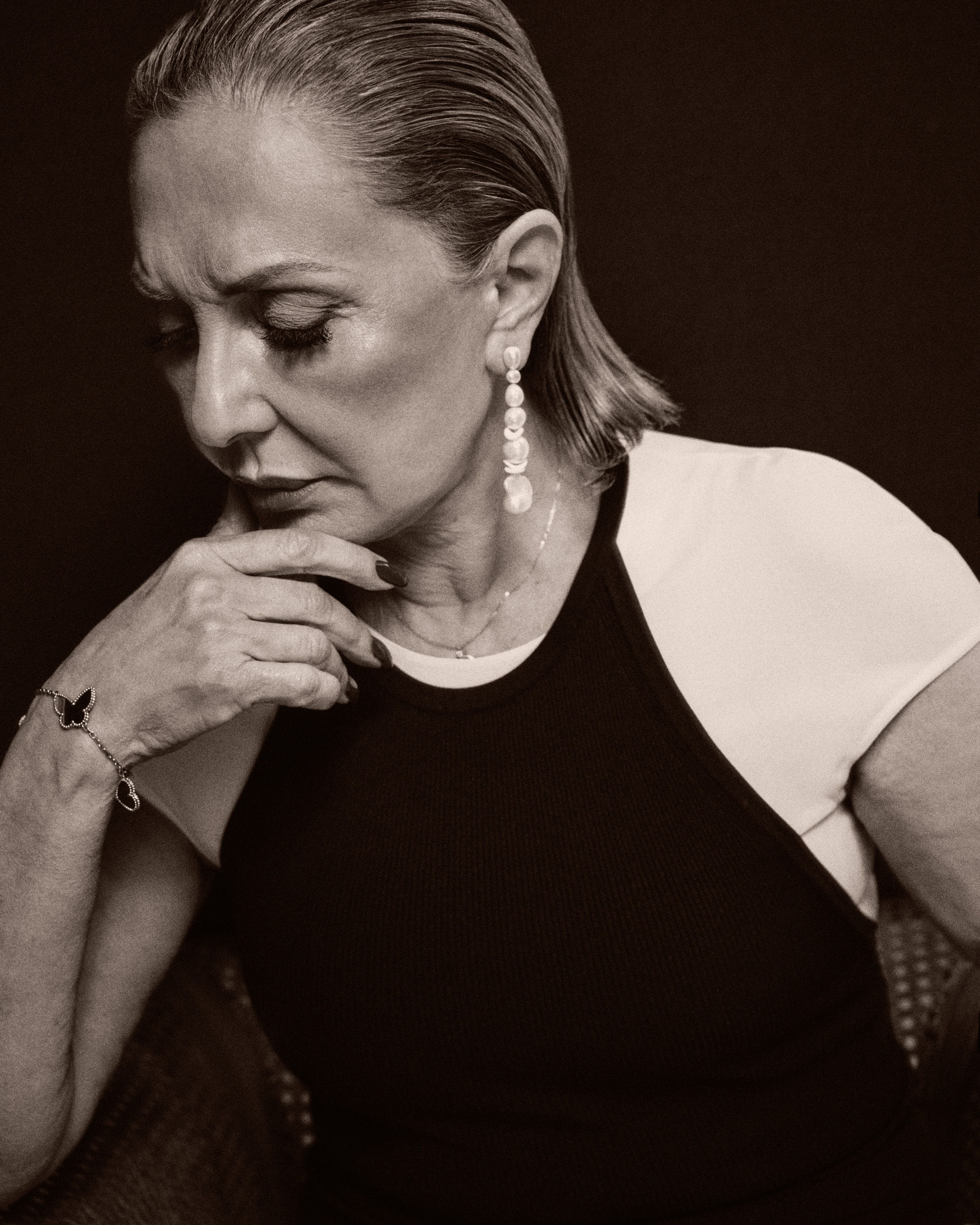
She wears a dress by FERRAGAMO and an earring by COMPLETEDWORKS.
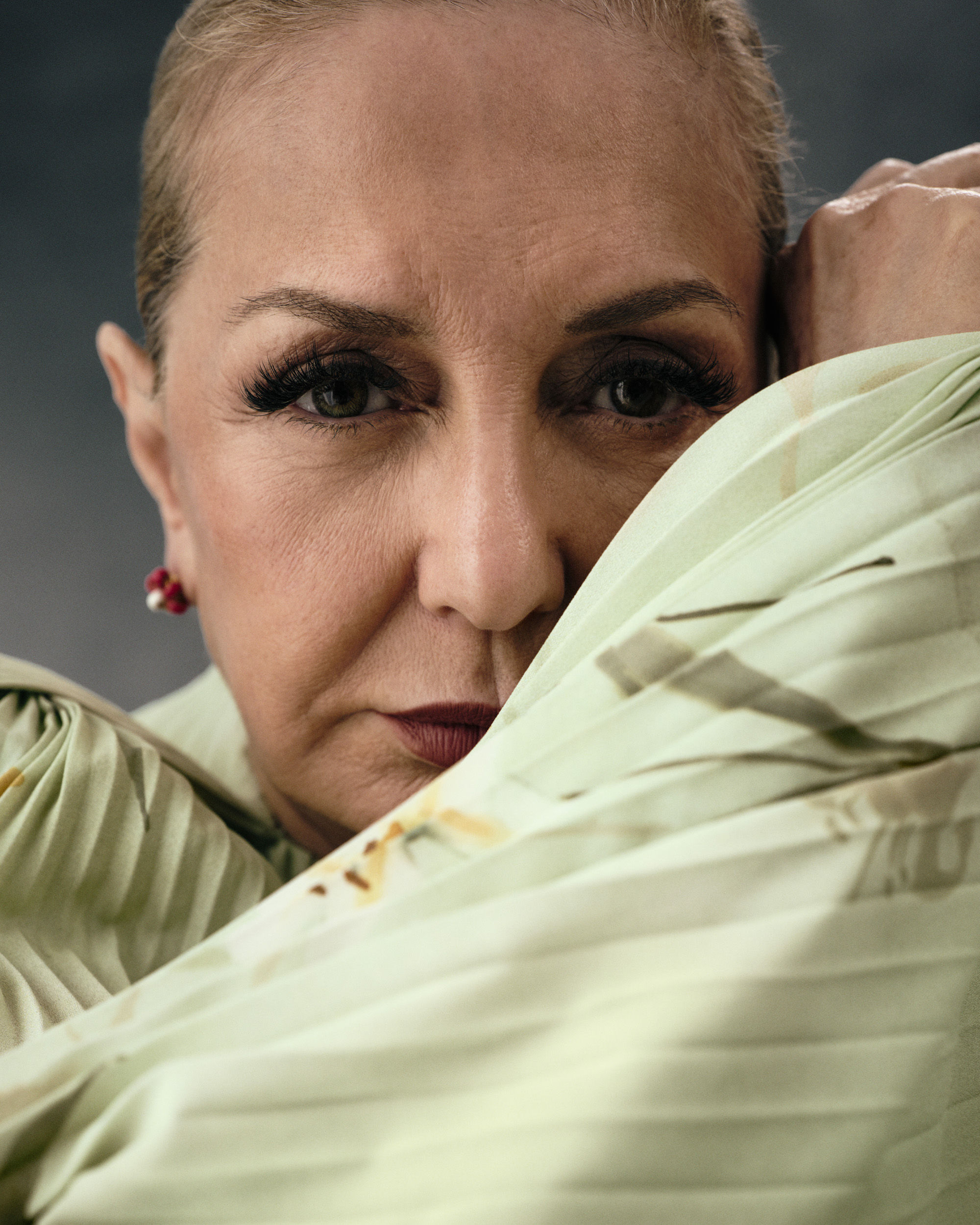
She wears a dress by BALENCIAGA and earrings by BOTTEGA VENETA.
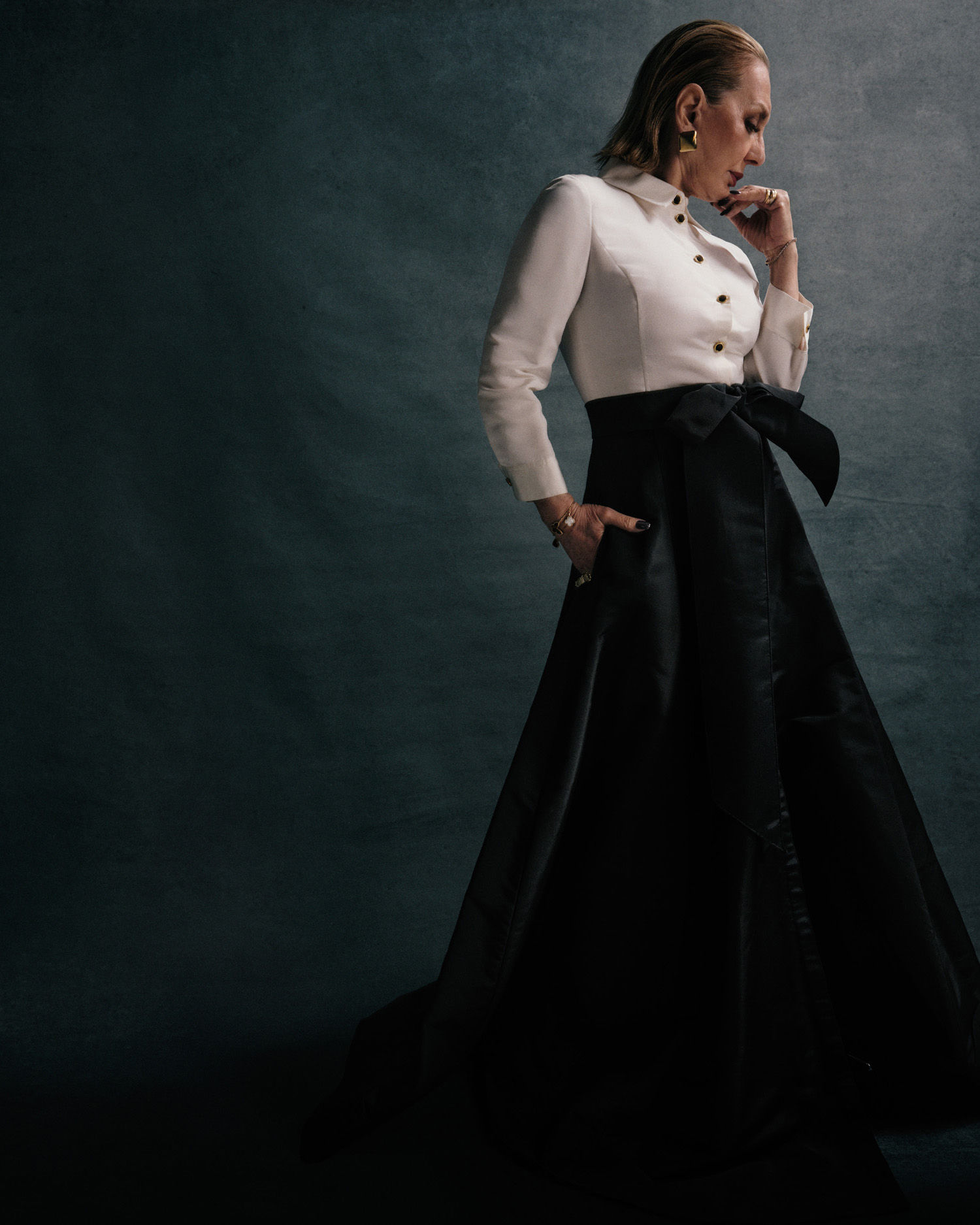
Googoosh wears a dress by CAROLINA HERRERA and earrings by JACQUEMUS.
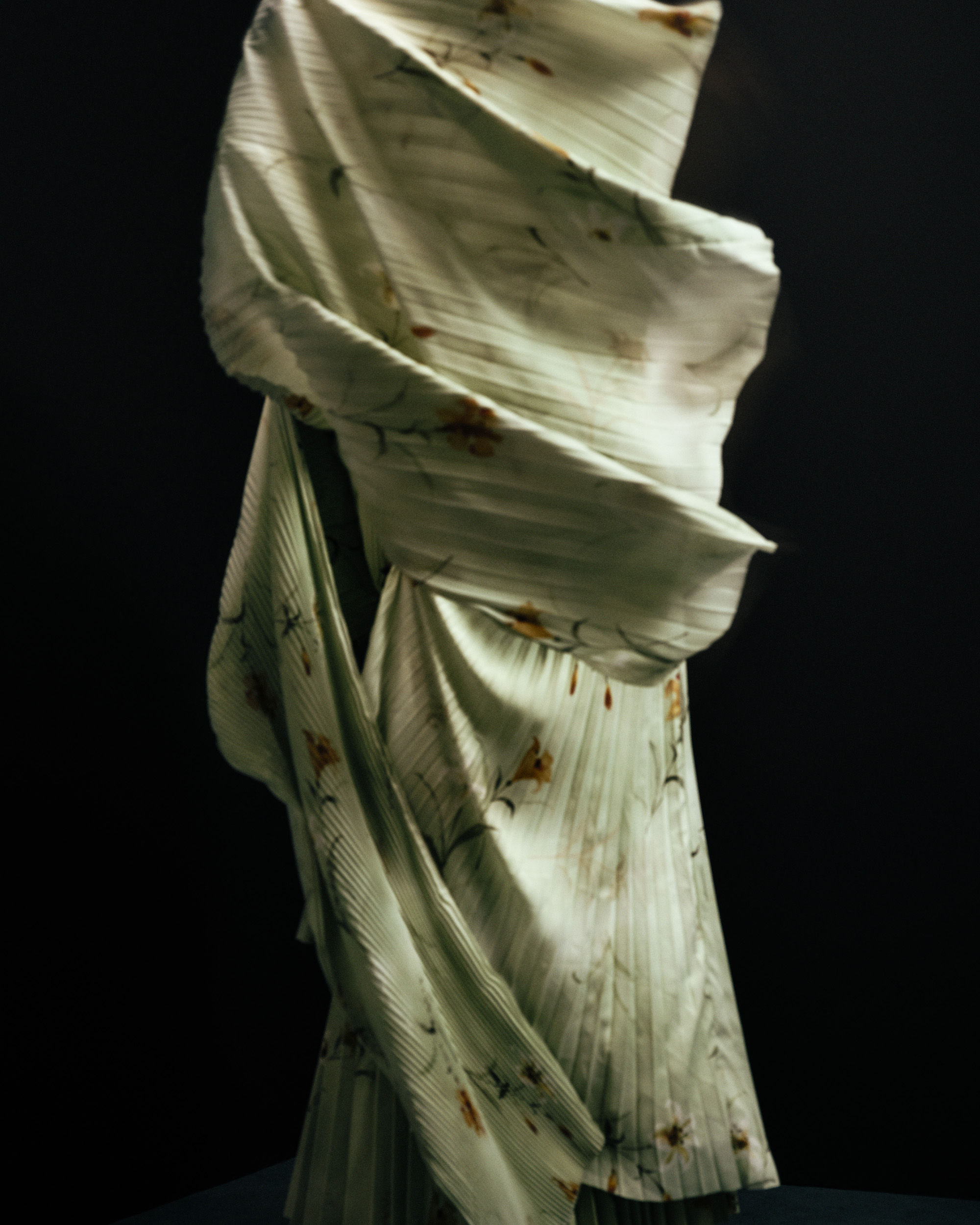
Googoosh wears a dress by BALENCIAGA.
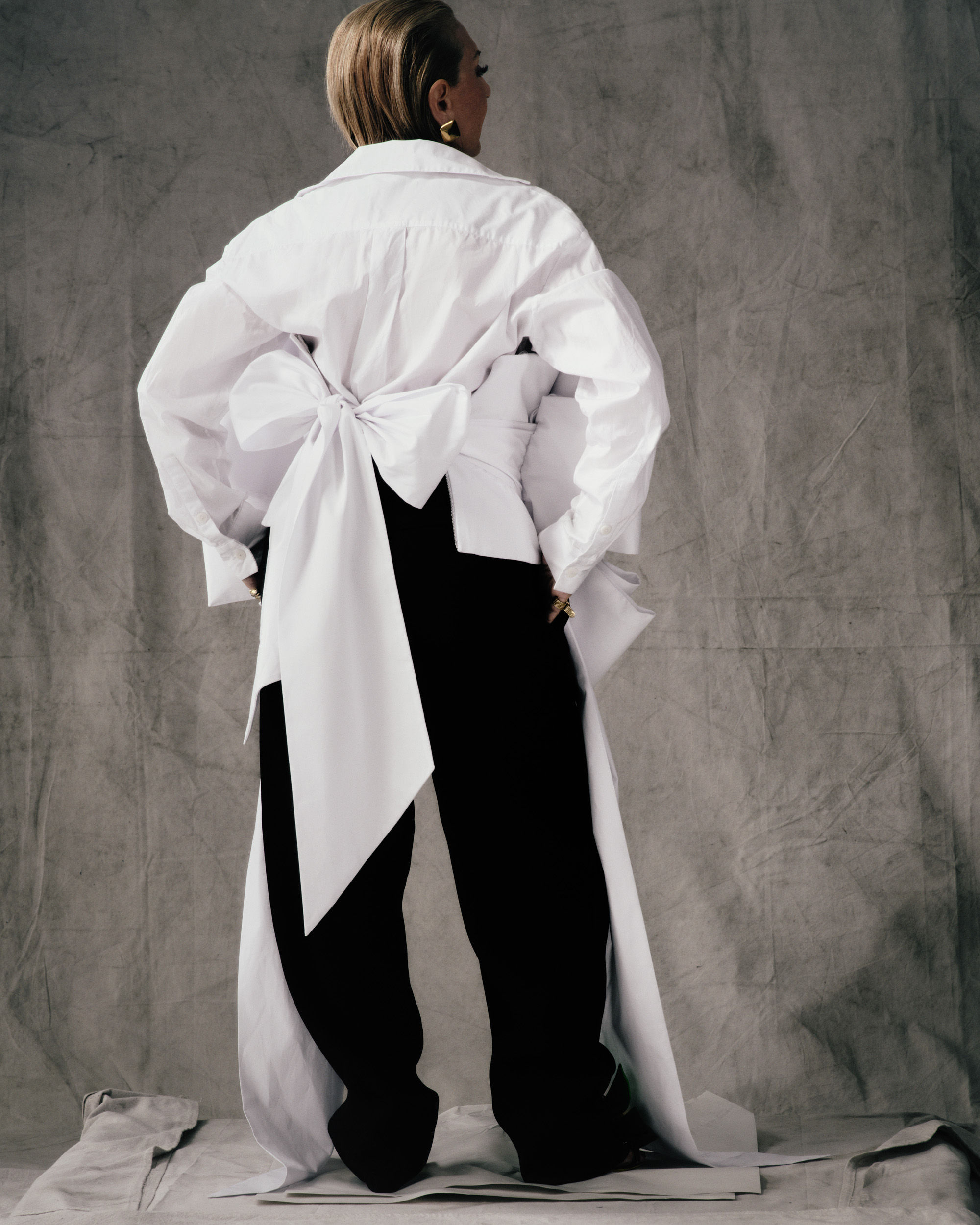
She wears a top by CHRISTOPHER JOHN ROGERS, trousers by WARDROBE NYC and earrings by JACQUEMUS.
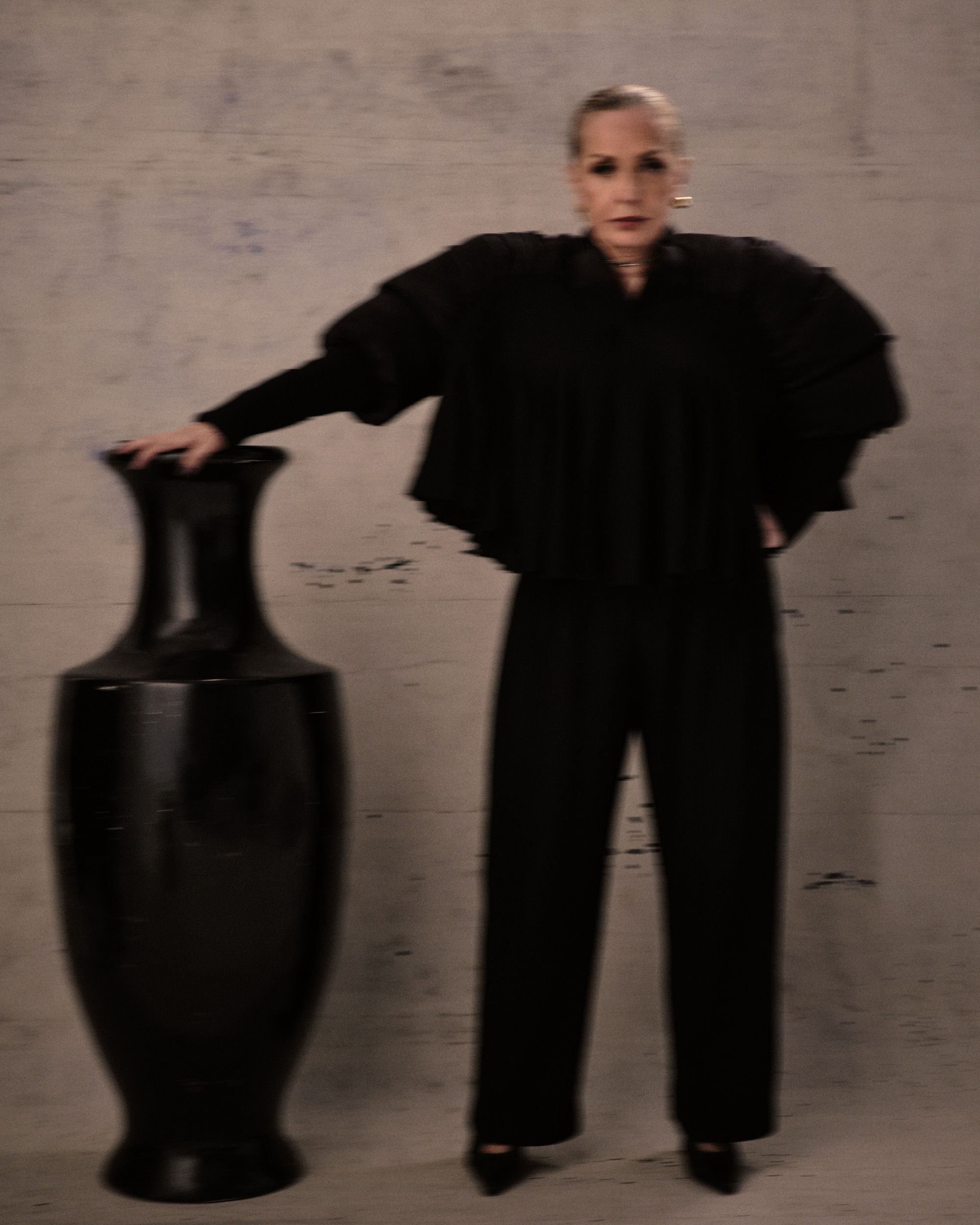
Googoosh wears a jacket by RICK OWENS, trousers by ISSEY MIYAKE and shoes by JIMMY CHOO.
( 1 ) Googoosh remains banned from performing in Iran but her music is still popular in the country. Bootleg DVDs of her concerts are sold on the streets of Iranian cities and her fans use VPNs to circumvent online censorship and watch her videos.
Life in Iran during this time was “very hard,” Googoosh says. The idea that a woman would ever sing in public again became suddenly implausible: “I tried to forget Googoosh and just become an ordinary person.” Did she regret having returned home? “No,” she says, “I wasn’t pasheemoun [regretful], but I packed up Googoosh, and threw it away.” For the next two decades, she “made do” without performing and like many other Iranian women, became a homemaker, waiting for change.
With the surprise election of staunch reformist Mohammad Khatami as president in 1997, expectations among many in Iran—and certainly among those who voted for him—were that society would be freer and the restrictions loosened. Googoosh says that she didn’t know whether to believe that real change could come, but her passport was returned to her and she was able to travel abroad.
“I signed a contract while still in Iran to be in a movie shot in Cuba by an Iranian director,” she says. “The producers asked me if I’d be interested in performing a concert in Canada, and I asked if I could come back to Iran if I did.” She was assured that she could and so she agreed, signing on for very little money. “I didn’t care how much they were going to pay me,” she says, “I just wanted to do a concert. When I had my first concert in Toronto, at the Air Canada Center, I was shocked! I didn’t know people still remembered me!” At first, she thought that the audience was made up of those nostalgic for a time when Iran was more progressive, but realized that there were many young people there who, as she says, “didn’t have a memory of the past.”
“I tried to forget Googoosh and just become an ordinary person.”
Now in her early 70s, Googoosh is perhaps as famous as she ever was and popular not just with Iranians inside and outside the country, but also among Tajiks, Afghans and others in the Persianate world and beyond. Since relaunching her career, she has come to live in Los Angeles, undertaken a series of concert tours and recorded new albums. These were sold not just to the many Iranians in Southern California, but have also been smuggled back into Iran.1
Throughout the early 2000s, Googoosh was not especially political, although, like many of her compatriots in the diaspora, she did attend protests in America in 2009, when the presidential election in Iran was believed to have been rigged in favor of the incumbent, Mahmoud Ahmadinejad. But after the death of Mahsa Amini, a young woman arrested for allegedly being in violation of the hijab rules, in police custody in September 2022, she took a stronger stance. She began to attend demonstrations across the world and a month after Amini’s death, she released the song “Dobareh” (“Again”), a collaboration with poets, actors and other musicians, in support of the protests against the Iranian regime.
“We were on tour in Istanbul, I think,” her manager, Raha Etemadi, says, “on our way to Germany, and when we landed, one of her bodyguards told Googoosh that Amini died.” Instead of canceling the concert in Germany, they altered the set list, swapping out upbeat songs for slower, more emotional ones. By her second concert in Hamburg, the slogan “zan, zendegi, azadi” (“woman, life, freedom”) was being chanted by the audience, and at the end of the final concert in Berlin, Googoosh told the crowd that she preferred singing this set to the one she had been performing before the protests in Iran.
After a career spanning six decades, Googoosh has decided that the time is right to step away from performing; when we speak she is on a short break from her farewell tour. I ask what she plans to do when it is over. “I’m not going to retire,” she replies. “I am leaving the stage, but in other areas I’m going to be active. I will still be there!” Etemadi adds that Googoosh has a foundation named Pol (“bridge”), which supports the younger generation of artists that don’t have the kind of platform she does. She is also writing a memoir with a book tour to follow, and working on launching a perfume line. I ask her about the hugely successful acting career she had in Iran before the revolution and whether she is interested in now resurrecting it. “I’m waiting for the right script!” she responds.
Retirement from live music aside, it is clear as we speak that Googoosh is still much the same pop star as she was when she began her career, more than half a century ago. She may have plans for other ventures, but it would hardly be surprising if she were persuaded to once again climb up on a stage somewhere and belt out a song or two. Her legion of fans may demand it.
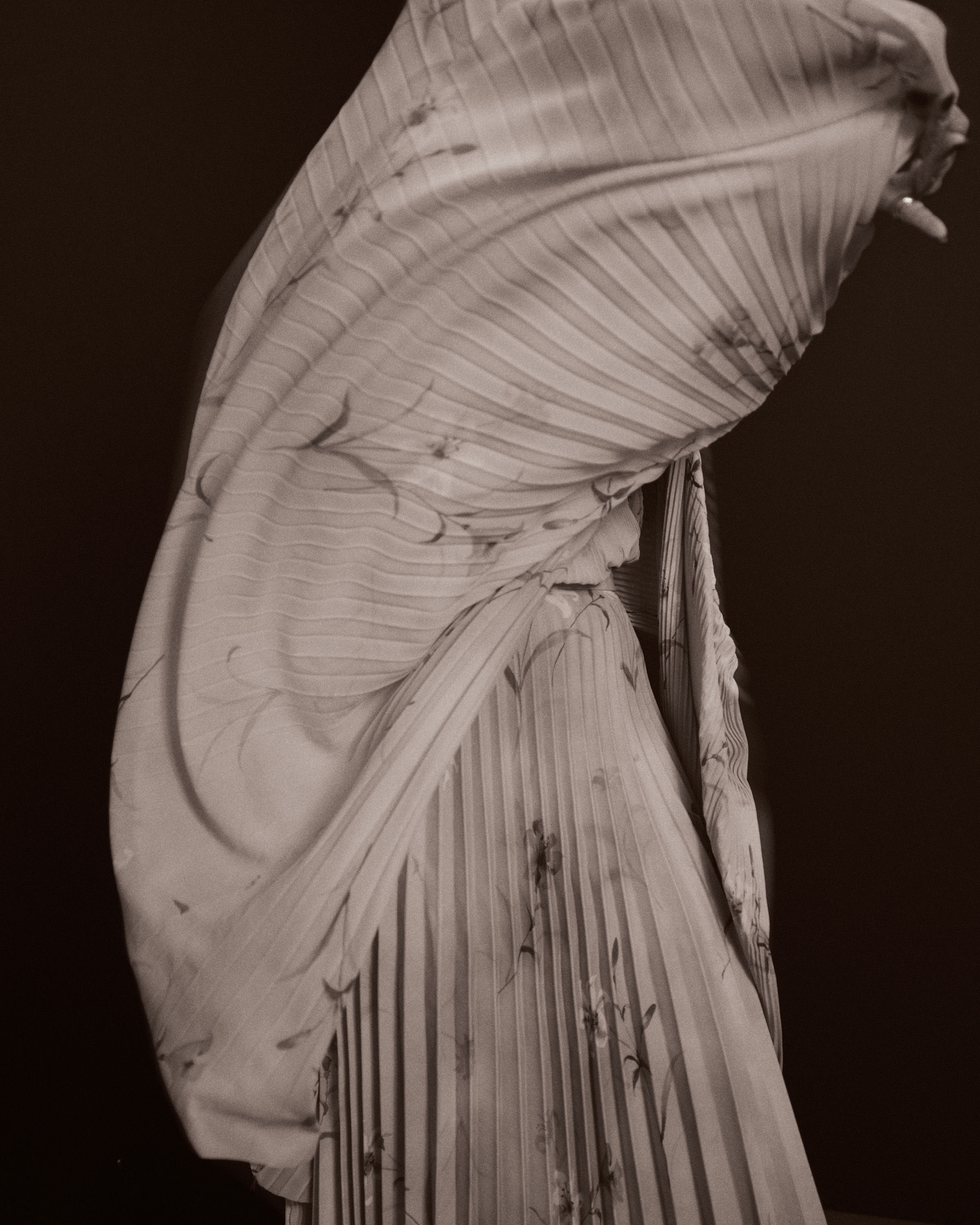
She wears a dress by BALENCIAGA.
( 1 ) Googoosh remains banned from performing in Iran but her music is still popular in the country. Bootleg DVDs of her concerts are sold on the streets of Iranian cities and her fans use VPNs to circumvent online censorship and watch her videos.