HALLEROED

  • Words Benjamin Dane
  • Photos Staffan Sundström

Meet the giants of Swedish retail design.

Issue 51

, Design

,
  • Words Benjamin Dane
  • Photos Staffan Sundström

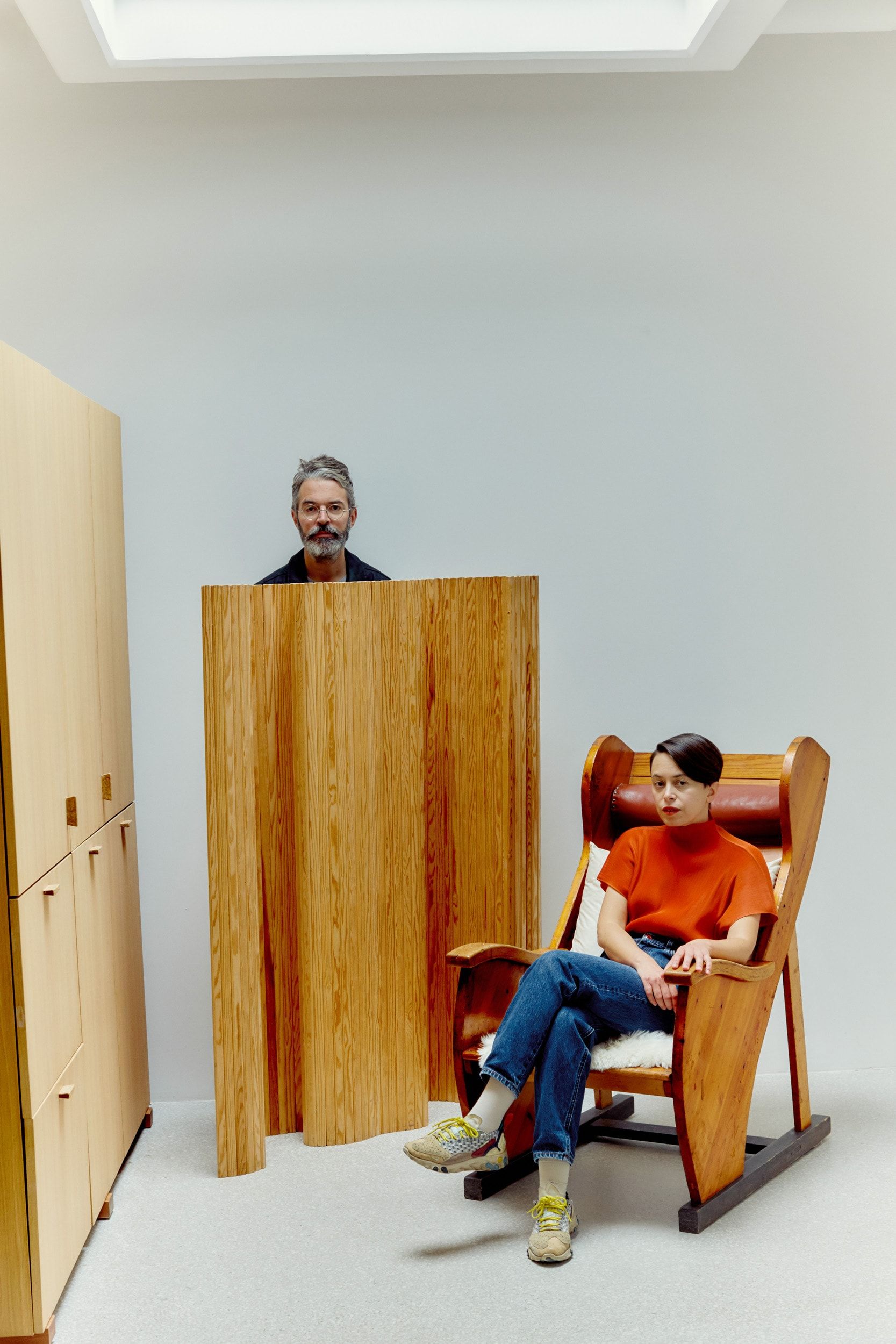
Christian Halleröd holds up a vintage Finnish chair in the atelier of Swedish fashion designer Saman Amel.

Acne Studios’ Chengdu location exemplifies how Ruxandra sees stores as having become showrooms. The four touch screens—mounted on slim poles throughout the store—provide an overview of the brand’s collection and stock availability.

If you’ve ever stepped inside an Acne Studios store, there’s a good chance you’ve found yourself in a space designed by Halleroed. The Stockholm-based design studio, led by Christian and Ruxandra Halleröd, has a long-standing relationship with the Swedish fashion brand’s co-founder and creative director, Jonny Johansson. Over the past 10 years, their clean, almost industrial, otherworldly interiors have come to define Acne’s retail spaces around the world. 

“We love to have that personal connection to the brands we work with; it really allows us to get into their DNA,” says Christian, who trained as a cabinetmaker, designing furniture for stores, before founding Halleroed in 1998. Ruxandra, an architect, joined several years later. The couple had met in a bar in the Swedish capital in the early aughts and had been together for 10 years before they decided to work together professionally. “It felt very natural,” says Ruxandra. “We’d had our daughter, and Christian was working a lot, so it was—and still is—the best way to make things work for us.”

Over the past 25 years, Halleroed has worked principally with luxury brands like Arket, Byredo and Toteme, creating refined and highly conceptual retail spaces. Their work is not only concerned with how a store looks but also how it makes you feel—typically achieved by including unusual or sumptuous materials and integrating different textures and finishes. While they don’t necessarily describe themselves as minimalists, they often find that they are associated with the term: “Perhaps it’s because we always try to get the most out of the existing space rather than stuffing it with a lot of things,” says Ruxandra.

This approach has partly been driven by the degree to which retail has changed in the past few decades. The rise of online shopping has altered both the purpose of stores and how they’re designed. “There was a period when retail became almost like mass storage—it was all about getting as many items into the store and as many customers through as possible,” Christian says. “Today, people enter a store to try and really feel the products, to get that experience, and the design of the space has to underline that.”

“Stores have become more like showrooms,” Ruxandra adds. “We work with a lot of younger brands who started online. They come to us because they want a physical space to ground their brand and make it stronger—something three-dimensional where people can better understand the feeling they’re trying to create.”

While their younger clients are often very keen to experiment, the firm’s desire to push the boundaries of the in-store experience is most evident in their work for Acne Studios: In Stockholm, you’ll find sculptures hanging from the ceiling made from slices of old Noguchi Akari lamps and hand-painted mannequins arranged to appear as if they are dancing, all set against floors and display units in pale pink marble. In Chengdu, furniture and touch screens are clad in a futuristic brown batik fabric by British designer Max Lamb, contrasting with the monochromatic gray sandstone and white gloss surfaces.1 The goal, as Christian says, is to evoke an emotional response in the people who spend time in the store: “Through interior design, I believe you can elicit the same emotion as music or literature. If people don’t feel something when they enter one of our stores, then we’ve failed.”

Acne Studios’ Chengdu location exemplifies how Ruxandra sees stores as having become showrooms. The four touch screens—mounted on slim poles throughout the store—provide an overview of the brand’s collection and stock availability.

Christian and Ruxandra Halleröd at their studio in Stockholm's Södermalm neighborhood.

A vignette of Halleroed’s design in the atelier of Swedish fashion design Saman Amel.

You are reading a complimentary story from Issue 51

Want to enjoy full access? Subscribe Now

Subscribe Discover unlimited access to Kinfolk

  • Four print issues of Kinfolk magazine per year, delivered to your door, with twelve-months’ access to the entire Kinfolk.com archive and all web exclusives.

  • Receive twelve-months of all access to the entire Kinfolk.com archive and all web exclusives.

Learn More

Already a Subscriber? Login

Your cart is empty

Your Cart (0)