IN THE VINEYARDS OF LEBANON
- Words Lina Mounzer
- Photography Bachar Srour
In an excerpt from our new book, Kinfolk Travel, winemaker Maher Harb takes us on a tour from grape to glass at his mountainside vineyard.

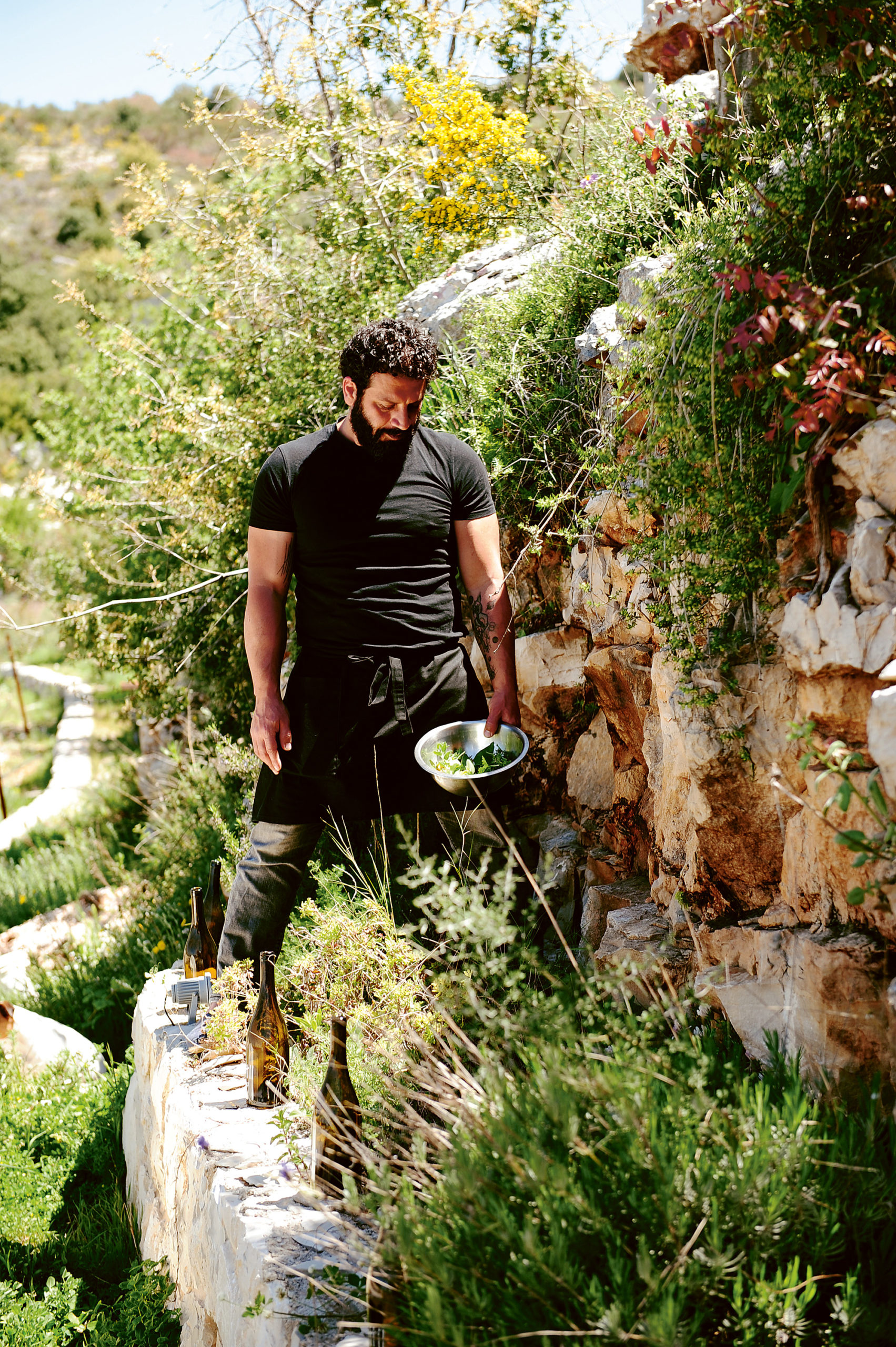
Sept Winery lies high above the historic Lebanese coastal town of Batroun, at the end of a winding mountain road flanked by oak trees on one side and panoramic views over green valleys on the other. The air up there is crisp, a little dry, redolent with the smells of wild aromatic herbs—thyme, sage, oregano—and alive with the chirping of birds and crickets. The setting offers perfect conditions for Maher Harb, the owner of Sept, Lebanon’s only biodynamic winery, to nurture the native grapes that he uses to make natural wines.
Harb is especially passionate about his mission: to highlight the value and singularity of what Lebanese vineyards have to offer. And he’s not the only local winemaker who believes in the potential of this terroir. This, after all, is one of the oldest winemaking regions of the world, and tiny Lebanon boasts some fifty-six wineries. The number is made more impressive by the fact that after the end of the country’s fifteen-year civil war in 1990, there were just five. Most are in the high-altitude plains of the Bekaa Valley, where a trip to Château Ksara (Lebanon’s oldest and largest winery, founded in 1857 by Jesuit monks) or the newer Château Marsyas can be combined with a visit to the Roman ruins of Baalbek, which include a massive temple dedicated to Bacchus, the god of wine.
But Lebanon’s winemaking is even older than the Romans; historical evidence shows that the Phoenicians were exporting wine to Egypt as early as 2,500 B.C., undoubtedly made with Lebanon’s native grape varieties. It is these varieties that Lebanon’s modern boutique wineries are trying to repopularize. While most of the older wineries use primarily French grapes, such as Cabernet Sauvignon, Merlot, and Cinsault, newer ones are using Lebanon’s indigenous white varieties, such as creamy obeideh and citrussy merwah. Vintners such as Château Kefraya’s Fabrice Guiberteau are going further and trying to reintegrate the indigenous red varieties, such as aswaad karech and asmi noir, that have fallen out of use.
For such a small country, Lebanon’s wines have impressive range as well as reach: many are available at boutiques or via online sales across the world. Connoisseurs interested in sampling them would do well to use wine writer Michel Karam’s book Wines of Lebanon as a purchasing guide. But nothing beats a personal visit to a winery, where one can taste the wine while relaxing on the very terroir that gave it life. Better yet is to get a guided tour of the entire winemaking process from grape to glass, such as the one Maher Harb gives at Sept Winery.
Visit Sept—the best way to do so from Beirut is to rent a car or hire a private taxi—and you are visiting Harb’s home, experiencing the same hospitality he would offer any personal guest. He will show you around, taking you across the terraced fields and into the dappled sunshine beneath the vines, explaining how they were grown. If you are hungry, he will cook for you: fresh, seasonal Mediterranean food “with a Lebanese twist.” Often the fare includes what he has foraged from around the vineyard: wild asparagus and leeks, tender shoots of new garlic. He will spread the feast out on a wooden table beneath the open sky on a grassy ridge that overlooks an unmistakably Mediterranean vista: green hills cascading down through wisps of cloud toward the sea glittering at the very edge of the horizon. Various wines and vintages are of course carefully selected to pair with the food. He wants those who taste his wines to come away having tasted “his mountain, his Lebanon, his terroir.”
“Lebanon’s winemaking is even older than the Romans.”


Sept is Harb’s passion project, more a calling than a business. This is something many businessmen say to personalize whatever brand they’re selling, but in Harb’s case, the philosophy by which he runs his vineyard is the one by which he conducts his life. He abandoned a lucrative but soulless career in France to come back and farm the fields that his father, who was killed during Lebanon’s civil war, had left him.
Coming back to the land was a healing process for him, and, in turn, he practices the sort of farming that is a healing process for the land. Like all biodynamic vintners, he farms according to the lunar calendar, aiming to understand the earth’s rhythms rather than employing chemicals to hurry them along to his own schedule. He uses no pesticides on the vines and no additives in the wine, making it natural.
Lebanon has been going through fraught times of late. The brief hope of an uprising in October 2019 gave way to an economic collapse that was exacerbated by the coronavirus pandemic. The currency went into freefall and many were left struggling to make ends meet. Then, in August 2020, over 2,000 tons (1,814 metric tons) of neglected ammonium nitrate ignited at the Beirut Port, resulting in one of the largest non-nuclear explosions in history. Harb, like so many Lebanese people, has been dizzied by every one of these blows, fighting to recover and readjust.
But throughout it all, he has kept the winery running, guided as ever by the rhythms of the planetary and lunar calendars that dictate the days on which to sow and which to reap. Like the land, it is constantly evolving.
And up there on his terraced fields, it isn’t difficult to believe that the powerful force that commands the tides can exert the same magnetism on the nectar encased in the delicate skin of every grape. And it isn’t difficult to feel, either, that everything that seems so overwhelming and insurmountable now in terms of the country’s circumstances is just a brief turbulence across the face of this land’s deep history. It has seen upheavals ranging from the rise and fall of empires—Phoenician, Roman, Ottoman—to earthquakes that wiped out entire cities and redrew the coastline. Nature’s cyclical lesson becomes tangible when visiting Lebanon: that everything is eventually transmuted by time into the mulch of history, all of it feeding the richness of the terroir that Harb hopes can be tasted in every bottle of wine.