( 1 ) There is no evidence that Marie Antoinette actually said “Qu’ils mangent de la brioche.” The earliest known source connecting the quote with the queen was published more than 50 years after her death in the French Revolution—in an 1843 article by the French writer Jean-Baptiste Alphonse Karr, who himself was writing to disprove its association with her.
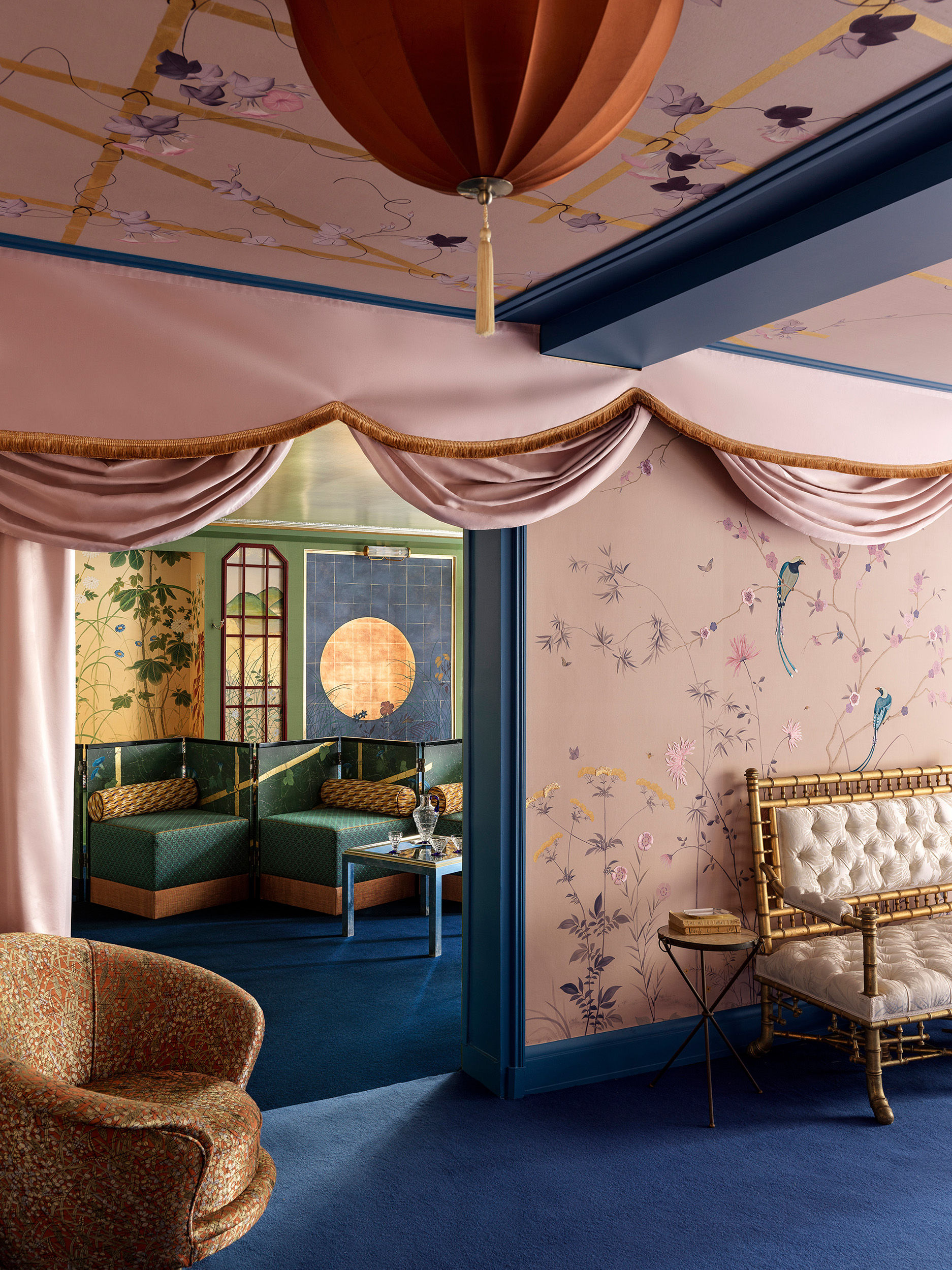
More fashion, furniture and decorative finishes were made for Marie Antoinette than for any other queen of France. This includes lavish wallpaper adorned with freehand depictions of exotic birds, whimsical flowers and Orientalist landscapes by highly skilled artists for her private quarters at Versailles. You could call it the “let them eat cake” school of decoration, but these creations are far more than a sign of extreme wealth and the queen’s disconnect with the Third Estate; they are works of art.1
It’s no coincidence that many of these motifs were Eastern-inspired. Besides being highly fashionable at the time, the style, known as chinoiserie, reflects the origins of hand-painted wallpaper itself. The Chinese were the first to hand-paint intricate nature-themed designs on rice paper and silk, which, by the 17th century, had begun to replace decorated wooden paneling in stately homes in Europe. The high absorbency of these materials significantly enhanced the precision of the artist’s drawings, allowing for a greater level of detail in the brushstroke, more vibrancy in the colors and a richer texture. As far as interiors go, the labor-intensive craft was rivaled only by the crystal chandelier as the quintessential symbol of sophistication.
Wallpaper was democratized with the advent of machine printing during the Industrial Revolution, but a tradition of painting by hand has survived. Heritage hand-painted wallpaper companies including Pierre Frey and de Gournay now coexist with a new generation of designers and artists like Elena Carozzi, who are eschewing computer-generated patterns in favor of the irregularity of freehand techniques. Sold at hundreds of dollars per yard, every piece is a testament that nothing remains more exquisite than the human gesture.
( 1 ) There is no evidence that Marie Antoinette actually said “Qu’ils mangent de la brioche.” The earliest known source connecting the quote with the queen was published more than 50 years after her death in the French Revolution—in an 1843 article by the French writer Jean-Baptiste Alphonse Karr, who himself was writing to disprove its association with her.