Photo: Copyright exploitation rights with Artek.
( 1 ) Aalto reportedly tested the Stool 60 by repeatedly throwing the prototype on the floor. “We’ll make thousands of these one day!” he shouted. To date, the stool has sold over eight million units.
Object MattersA surprising first for Finnish design.
Object MattersA surprising first for Finnish design.
In 1933, Finnish architect and designer Alvar Aalto presented a stool so radical in form and function that it would revolutionize modern furniture. Following a series of experiments in bending wood, he developed and patented the “L-leg,” cutting slits into solid birch wood, like a comb, and inserting glued veneer into the negative spaces to reinforce the wood while it was bent with hot steam. The result, Stool 60—and the whole series of L-leg furniture that followed—was incredibly sturdy without requiring complex joinery, allowing it to be mass produced.1 It was modest, architectural, unmistakably modern—qualities that have helped make it an enduring symbol of Finnish design.
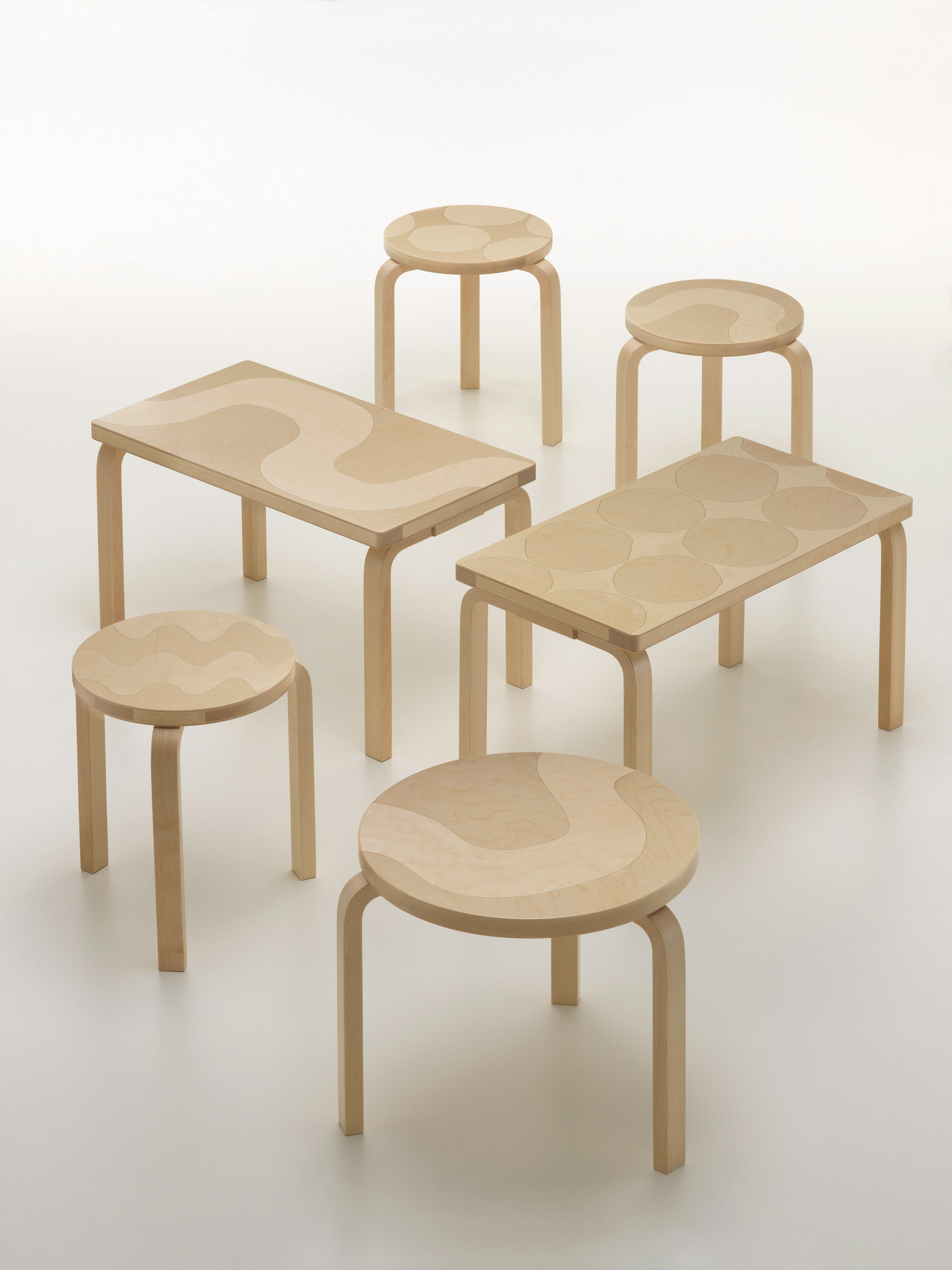
More than 90 years later, three Aalto designs (Stool 60, Table 90D and Bench 153B) have been reimagined through Artek’s first-ever collaboration with fellow Finnish design brand Marimekko. Though the two brands have long overlapped—Artek stools have appeared in Marimekko stores and runway shows—these pieces mark their first ever creative partnership. “Maybe it was too obvious,” jokes Artek’s managing director, Marianne Goebl. “Everyone assumed it had already happened.”
The new editions transform Marimekko designer Maija Isola’s famous, nature-inspired patterns into delicate marquetry for seats and tabletops. The Finnish birch veneers have been cut in opposing grain directions and swapped like puzzle pieces, allowing the design to emerge purely through light and texture. “We wanted to show the richness of our core material,” Goebl says. “There’s no color, no paint, just light and wood.”
For Goebl, the project underscores what makes both Aalto’s work and Finnish design timeless: pragmatic forms, poetic restraint and a deep respect for craft. “There’s an elemental power to Alvar’s work,” she says. “It’s formally simple, yet extremely refined and complex in production—without ever showing it.”