Point of ViewArchitect Peter Barber on the models that have shaped his practice.
Point of ViewArchitect Peter Barber on the models that have shaped his practice.
I’m in the meeting room of our office in King’s Cross, in London, which sits in an old Georgian terrace with a shopfront. It’s smallish, about the size of a living room; on three sides, the walls are covered with models, the fourth is the window onto the street, with shelves all the way up. You can peer through to see outside, and by the same token, people passing outside can look past the models into our meeting room. We get tourists, local people, residents from the homeless hostel around the corner. People come and press their noses against the glass. Sometimes they knock on the door, and we give them a little spiel about who we are and what we do. Sometimes it’s a parent with their child. It makes the office a kind of gallery—a nice interface with the street, which feels appropriate because our projects are, in the first instance, about the street: street-based housing rather than apartment buildings behind high fences.
The models are an important part of what we do. Increasingly, architects use computers to test their ideas, but for me that is unsatisfactory and inadequate. Architecture is a three-dimensional, physical medium, and a scale model is really the only way to truly test an idea. So we are surrounded by them, hundreds of them: small ones showing areas of cities cut from blocks of foam, more detailed ones where you can look into the interiors of the houses we’re making. They operate at different scales, and they go back through the whole history of the practice, from yellowing cardboard from the ’90s to gleaming white ones made in recent months.
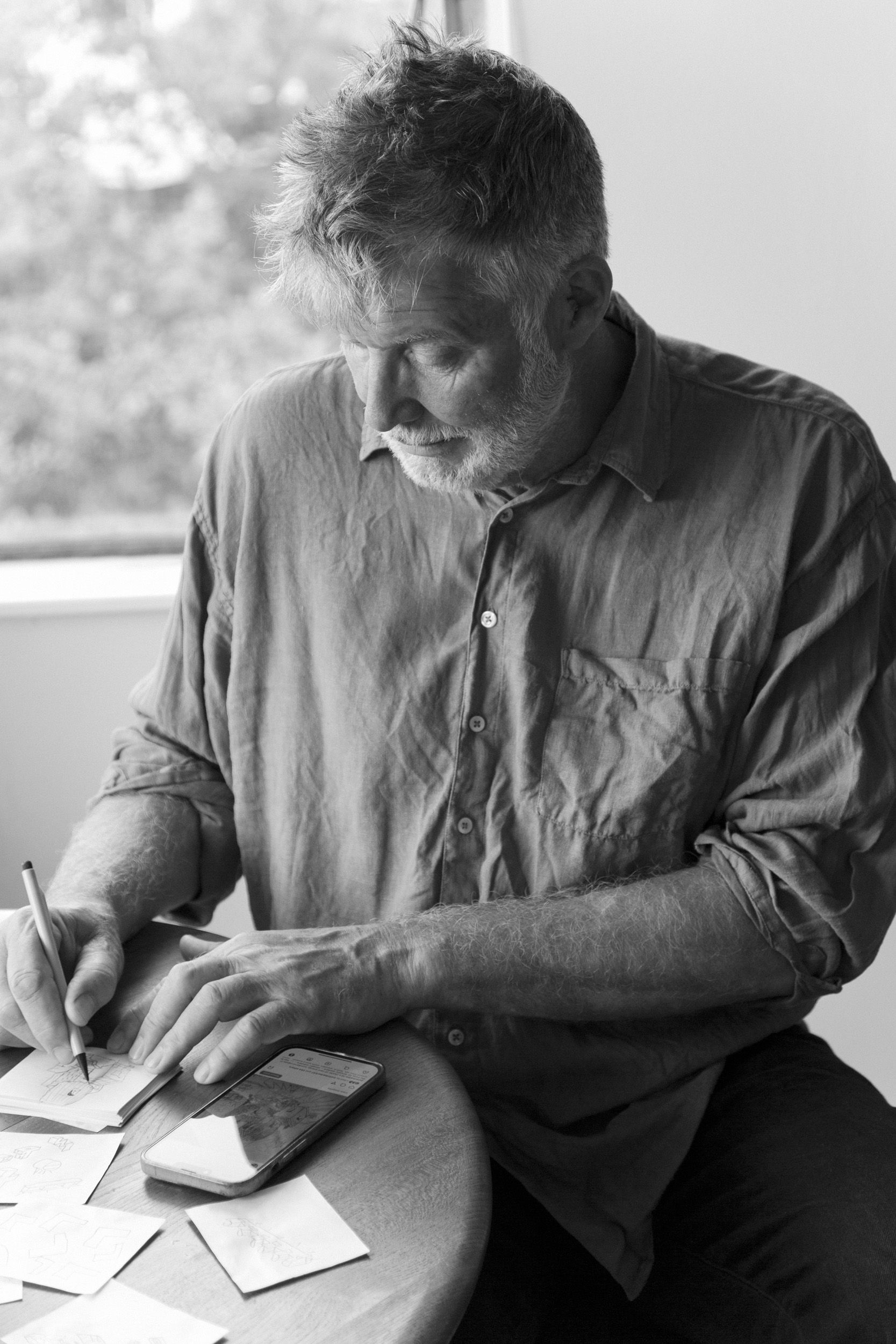
Everyone here is involved in making the models, even the directors. I’m really cack-handed, but I draw by hand, and my sketches work alongside them. They capture the spirit: people, trees, the atmosphere—together they are what make a building interesting. Looking around this room, I see the genesis of ideas, their elaboration, the way they’ve developed over the years. The sheer number of them is a good reminder, for an old bugger like me, of what one’s done with one’s life.
Occasionally, when we’re not very busy, we make a model for its own sake. There’s one of a theoretical project called 100-Mile City. It’s five feet long and three feet wide and very detailed; a whole neighborhood with little curving, barrel-vaulted roofs. It took an enormous amount of time to make, but it’s lovely.