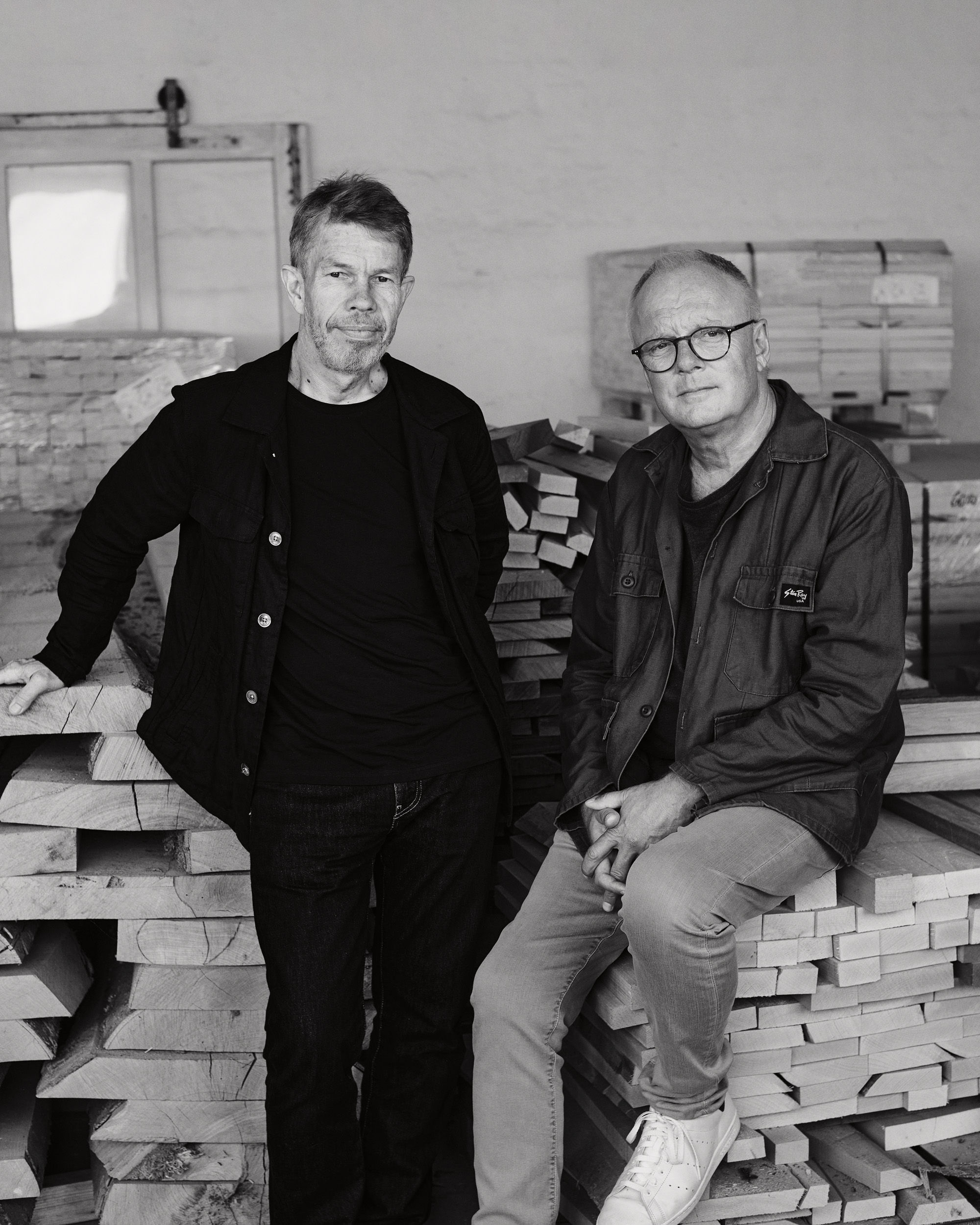
Power ToolHouse of Finn Juhl co-founders IVAN HANSEN and HANS HENRIK SØRENSEN on designer Finn Juhl’s use of wood.
Power ToolHouse of Finn Juhl co-founders IVAN HANSEN and HANS HENRIK SØRENSEN on designer Finn Juhl’s use of wood.
In Denmark, the use of wood is functional: We have wood, so we use it. But Finn Juhl didn’t come from the school of functionalism. Juhl’s pieces are all about feeling.
Juhl had wanted to study art history but his father wouldn’t let him; architecture was a compromise. You can see that love of art in his designs, how he’s interested in the human and the organic—especially in the way he used wood: The touch, the shape, even the color of it is at the core of his work. He had no idea of the limitations of material, but that let him be a pioneer. He would draw what he wanted and eventually found a cabinetmaker who was talented enough to bring his vision to life.
We started House of Finn Juhl in 1999 because Hanne Wilhelm Hansen, Juhl’s widow, wanted us to produce one of his sofas. We’re not craftspeople but we had the network, we knew the people with the skills. Key to that is how we source our wood, not just because of sustainability and ethics—that is, of course, essential—but also because, like Juhl, we know that the feel and quality of the wood is important.
We mostly work with American walnut and oak, in both solid wood and veneer pieces. People misunderstand sometimes but veneer is 100 percent wood; it’s just thin, so it’s easier to work with on flat elements, such as a tabletop or on shelves. Juhl has lots of pieces that combine veneer and solid wood, and some even combine different types of wood too.