Power ToolGraphic and type designer JOHANNES BREYER on the tool he couldn’t work without.
Power ToolGraphic and type designer JOHANNES BREYER on the tool he couldn’t work without.
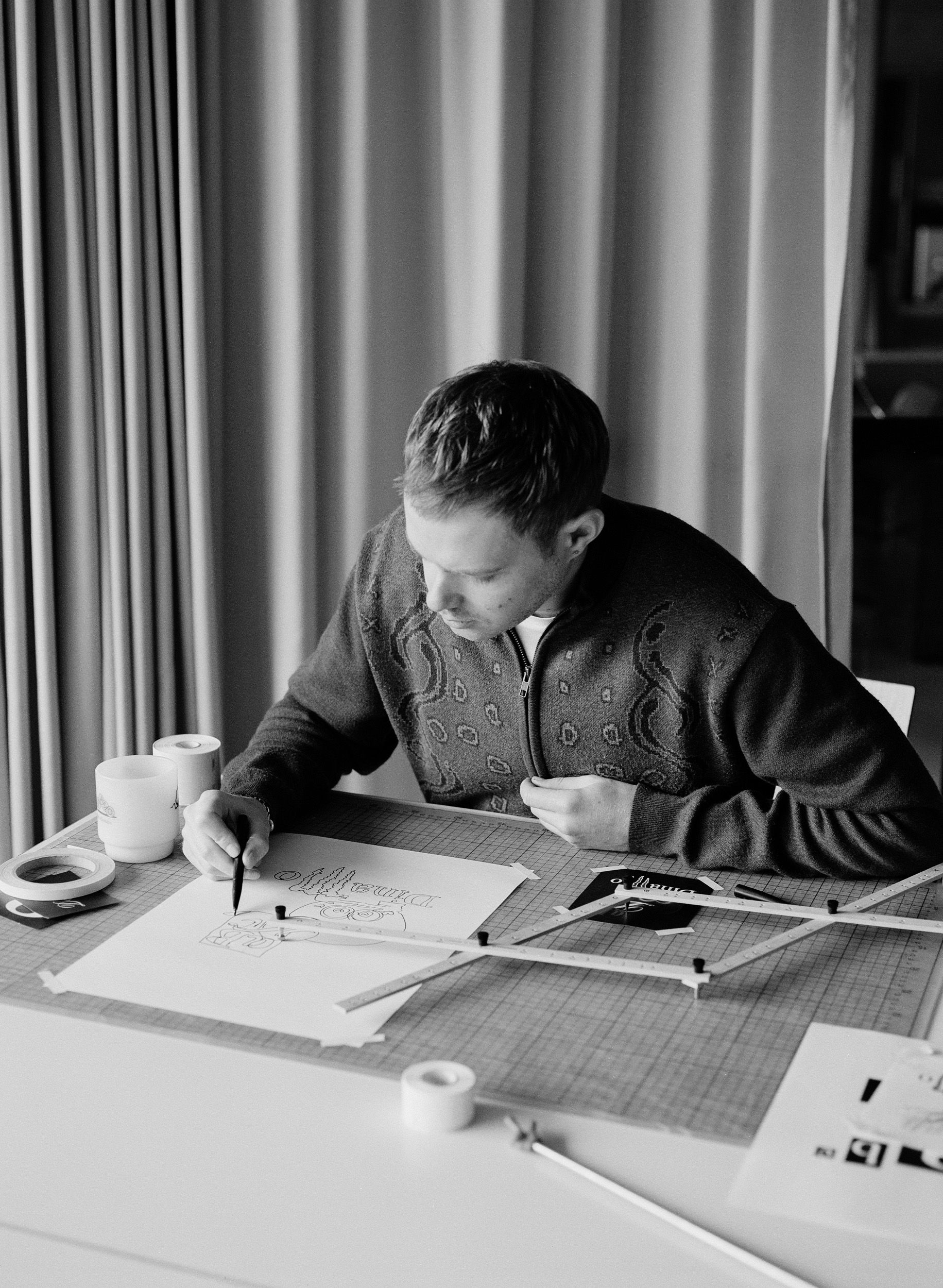
A pantograph is a deceptively complex but beautifully simple tool. It’s a mechanical device that consists of a few articulated arms, usually arranged in a parallelogram. You fix it to your table, trace an image with a metal pin at one end, and a pen mounted at the other end draws a perfect copy—either larger or smaller, depending on how you’ve set it up. It was invented at the beginning of the 17th century and used to enlarge everything from architectural drawings to letterforms for hot metal typesetting.
I first came across the pantograph when I was studying at the Rietveld Academie in Amsterdam. One of our class assignments was to build a tool that would surprise us. That sentence really stuck with me and when I came across the pantograph in my research for the project I thought: How can I mess with it? So I started building my own versions.
I swapped out some of the straight arms for curved or flexible parts. Suddenly, the machine wasn’t copying anymore; it was distorting. My friend Fabian drew a rabbit that I would trace, and what came out the other end was something wild and warped. You could identify part of an ear somewhere, but the rest had become an abstract cloud of lines. In that way, the pantograph became almost like an encryption tool: The only way to recover the original was to reverse the process using the exact same pantograph—like a password.
That logic—of using a tool not to control an outcome, but to create conditions for engineered surprise—has stayed with me since. It’s at the core of how we work at Dinamo, our design studio here in Berlin. Take our typeface Oracle, for instance. In its basic form, it’s an elegant sans serif with smooth contours, but then there’s a subsection based on a grid system where letters are assigned random amounts of spacing. That means a narrow character like an A might end up being stretched, or a wide one—an M, for instance—will get squeezed. The result is off-kilter and odd, just like the distorted rabbits I used to draw in school. But the strangeness is exactly what gives it character. And even though the font is made digitally, it works exactly as one of my manipulated pantographs would.