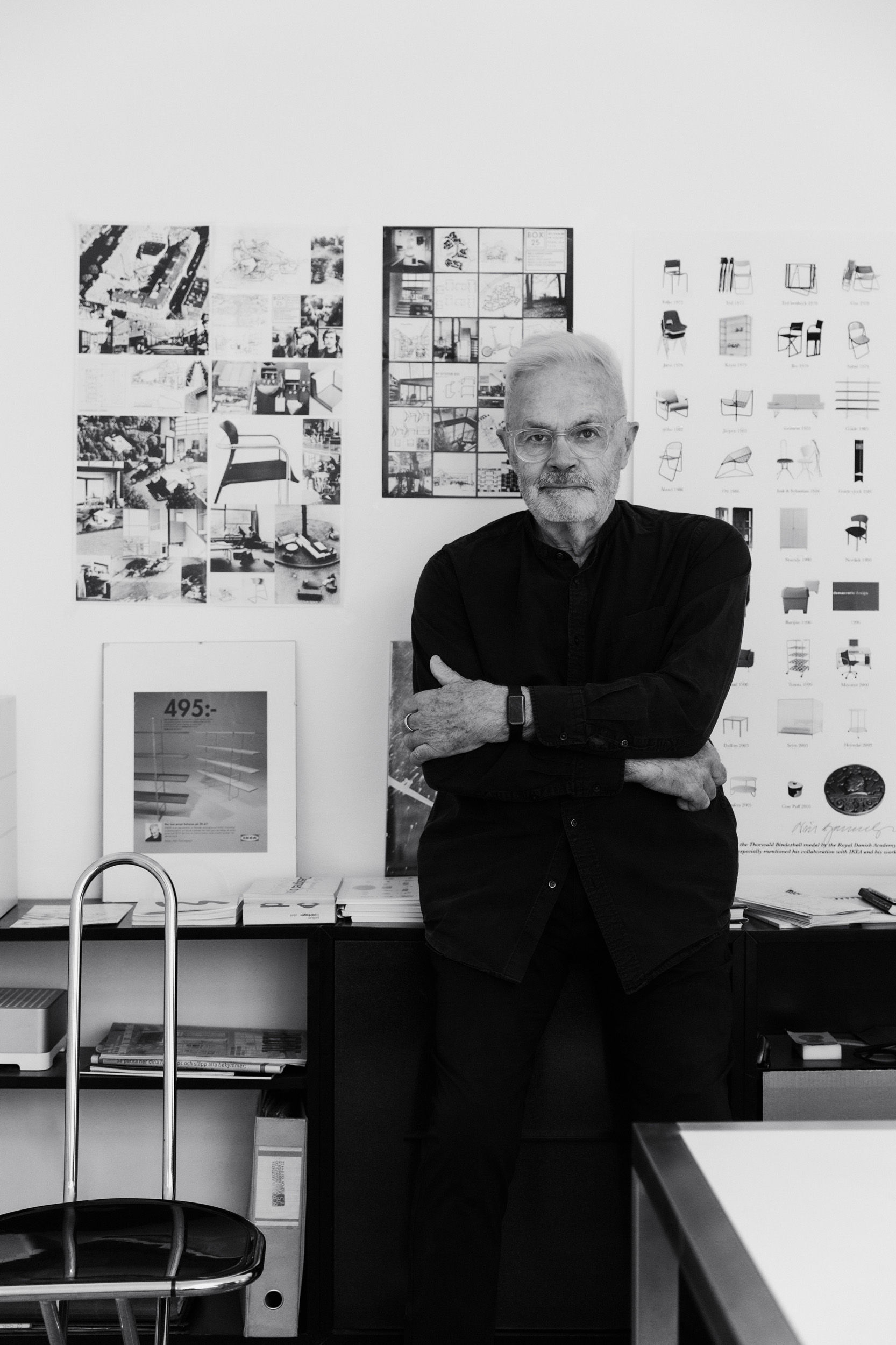
( 1 ) The popularity of Gammelgaard’s designs from the 1970s and ’80s has led IKEA to re-release models like the steel-mesh Järpen chair and the Guide shelving unit, dramatically undercutting the resale price of the vintage products in the process.
Received WisdomFurniture designer Niels Gammelgaard on patience, plastic chairs and why the best ideas stand the test of time.
Received WisdomFurniture designer Niels Gammelgaard on patience, plastic chairs and why the best ideas stand the test of time.
I’ve never had a job—not in the traditional sense, anyway. I grew up in a home of academics—both my parents were doctors—and my father insisted that we never be a burden on society. He financed my education himself, and I lived at home until I was 24 and got married.
My career didn’t follow a conventional path, and in many ways, I was just placed where I was supposed to be. Looking back, I think my mother knew exactly what she was doing. I had always been good with my hands—able to draw, to build things. My mother saw the artistic streak in me and enrolled me at the Royal Danish Academy of Fine Arts. I wasn’t accepted at first, but after training briefly as a carpenter and spending a few months sketching at the National Gallery of Denmark, I was admitted and ended up studying industrial design. I never questioned it. It felt like the natural progression.
My collaboration with IKEA started in the most unorthodox way. After an early project of mine failed commercially, I got in my car and drove to meet Ingvar Kamprad, the founder of IKEA. He was living in Denmark at the time and had moved the company head office to Humlebæk, north of Copenhagen. I didn’t know him; I just called and asked if I could visit. He told me, “Niels, I won’t buy your furniture, but I can see you understand chairs. Could you design one in plastic and metal?” I said yes, went home, built a prototype out of electrical tubing and cardboard, and drove back. That prototype became the Folke chair, which millions would eventually sit on.
I’m proud that the furniture I designed for IKEA in the ’70s and ’80s is now part of design history. Back then, we weren’t thinking about creating pieces that would end up at auctions or in museums, we were just trying to do good work. Yet, here we are. I’ve been told that my furniture is now even trending on TikTok.1