Spaceship House The mothership of Googie architecture.

Spaceship House The mothership of Googie architecture.

  • Words Tristan Rutherford
  • Photograph James Carriere, Spaceship House, La Selva Beach, CA

1. Although the Spaceship House looks like a sizeable building, its wacky proportions and extremely thick, curved walls mean that indoor space is limited. Speaking to Apartment Therapy in 2016, its then-occupier Angelina Rennell (daughter of architect Cynthia) admitted there wasn’t room for a single closet.

2. Space Age (also known as “Googie”) architecture waned in popularity shortly after the Spaceship House was completed in 1972. Apollo 11’s successful moon landing represented the culmination of a feverishly fought Space Race, and architects turned their attention towards more organic, earth-bound forms.

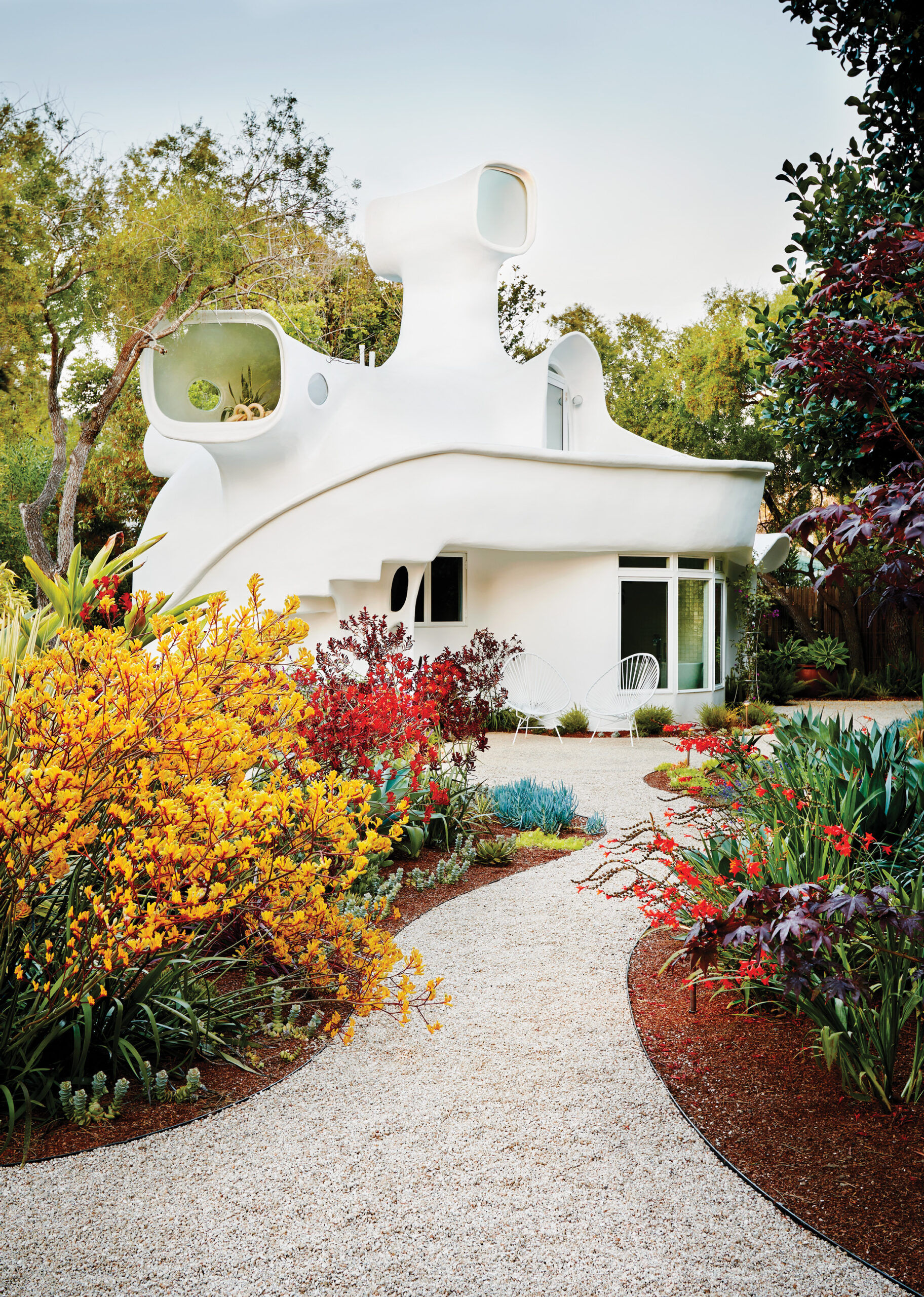
The Spaceship House, built in California by architect Mary Gordon, is a place that E.T. could call home: It’s a curvaceous white beacon topped by TV-shaped towers and encircled by an outdoor staircase that looks like a radar dish.¹

It could only have been built in the 1970s. Back then, the United States faced the twin specters of war and recession. These grim prospects forced some into spiritualism and yoga (Iyengar and Ashtanga both put down roots during that decade) while others sought solace in astronomy and acid. Architecture, music and film (see Close Encounters of the Third Kind and Invasion of the Body Snatchers) followed the Space Age trend.² NASA became so confident of finding extraterrestrial life that it blasted a gold-plated record into outer space containing a map to earth and a message from Jimmy Carter. Let’s hope E.T. hadn’t already upgraded to cassette.

Architectural futurism is all about embracing the unknown. While Frank Gehry’s Guggenheim Museum in Bilbao, Spain could conceivably message aliens, it also bends glass and titanium to cast a 21st-century cathedral within. Perhaps if we earthlings want to think outside the box about our own dismal prospects, we’d do well to follow the futurists’ lead and imagine bolder, less boxy, buildings.

1. Although the Spaceship House looks like a sizeable building, its wacky proportions and extremely thick, curved walls mean that indoor space is limited. Speaking to Apartment Therapy in 2016, its then-occupier Angelina Rennell (daughter of architect Cynthia) admitted there wasn’t room for a single closet.

2. Space Age (also known as “Googie”) architecture waned in popularity shortly after the Spaceship House was completed in 1972. Apollo 11’s successful moon landing represented the culmination of a feverishly fought Space Race, and architects turned their attention towards more organic, earth-bound forms.

FREE PREVIEW

Take a look inside Issue Sixty

You are reading a complimentary story from Issue 35

Want to enjoy full access? Subscribe Now

Subscribe Discover unlimited access to Kinfolk

  • Four print issues of Kinfolk magazine per year, delivered to your door, with twelve-months’ access to the entire Kinfolk.com archive and all web exclusives.

  • Receive twelve-months of all access to the entire Kinfolk.com archive and all web exclusives.

Learn More

Already a Subscriber? Login

Your cart is empty

Your Cart (0)