THE LIGHTHOUSE KEEPER OF BEIRUT
- Words Sabina Llewellyn-Davies
- Photography Bachar Srour
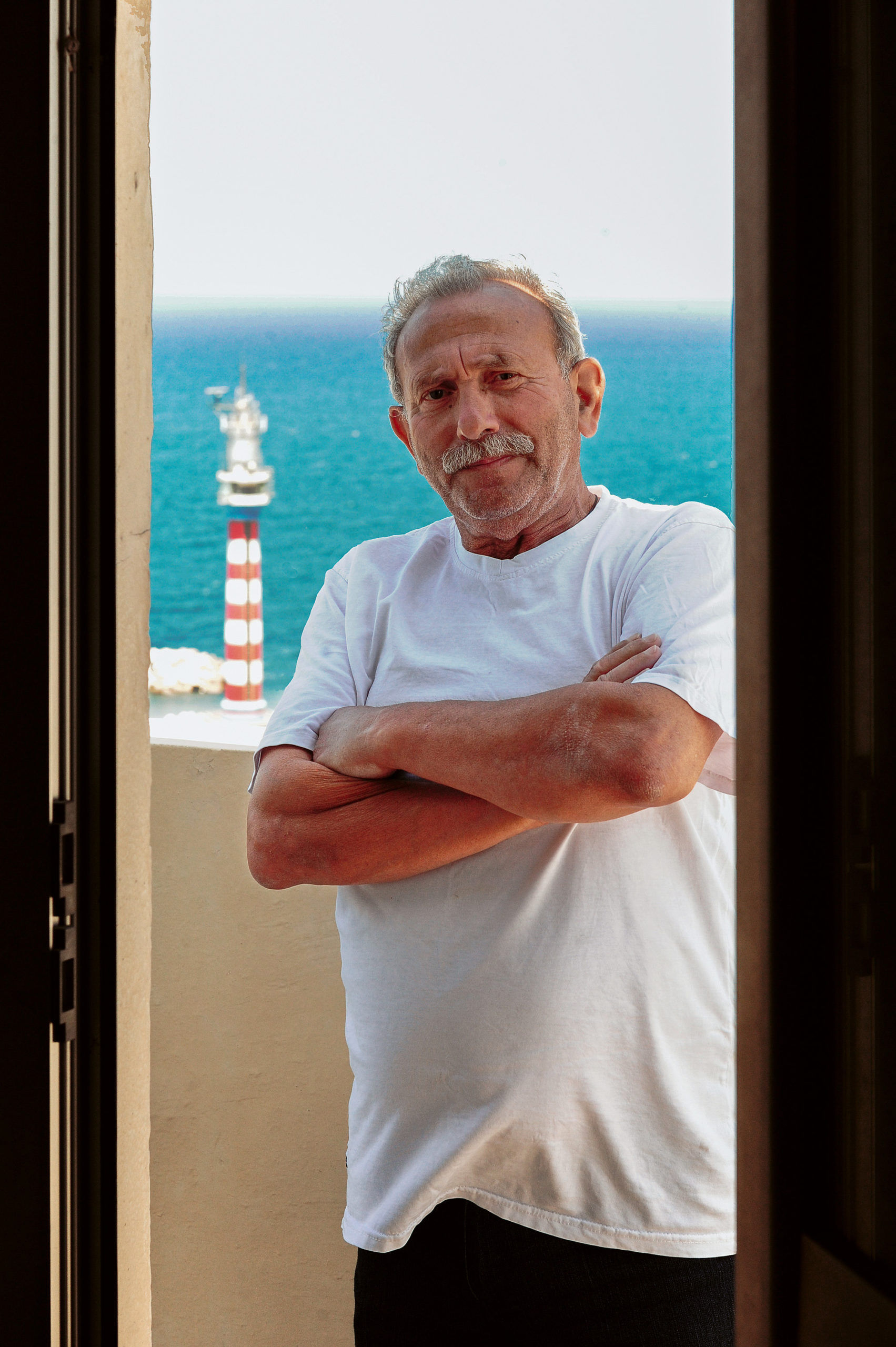
Victor Chebli has weathered storms, war and three kidnappings to maintain his family’s shining legacy.
Beirut’s old manara, the Arabic word for lighthouse, is perched on a hill facing the sea. The neighborhood where this black-and-white striped 82-foot tower is located was even named after it. Victor Chebli, whose family have been lighthouse keepers in the country for over 150 years, is committed to shining a light on Lebanon’s past. This lighthouse is not only a historic building but also a monument to the country’s resilience and a reflection on how individuals are playing a leading role in preserving the city’s heritage.
SABINA LLEWELLYN-DAVIES: Growing up in a lighthouse sounds like every kid’s dream come true. What was it like for you?
VICTOR CHEBLI: I was born here. As you can see, our family living quarters are annexed to the lighthouse. Being situated on shore in Beirut, I never felt isolated, unlike lighthouse keepers out on islands. There was always so much going on here. But of course it was not always easy. I was called on to help with the chores such as carrying gallons of kerosene to fuel the light. That was tiring. Then, in 1952, a French ship, the Champollion, sank off the coast of Beirut. My father was accused of not lighting the beam and thus causing the sinking. I was just a toddler at the time. He was sent to jail but thankfully he was proven innocent and released three months later. That same year, France sent a team over to evaluate the lighthouse and they offered to build a more modern structure that we moved into in 1957.
SLD: Having just climbed almost 300 steps to the top myself, I’m sure it must have been exhausting operating the lighthouse before automation. How did day-to-day operations change in the 1950s?
VC: When we moved to the [newer] lighthouse we had new machinery and electricity; it was very advanced, maybe the most advanced lighthouse in the region. A lift was installed, so there was no need to carry equipment up the stairs anymore. Electricity powered the beam, so there was no need for kerosene fuel. Operations became a lot easier. What remained the same was that my father still had to get up early every day to switch off the light at sunrise and return at sunset to switch it on to guide ships ashore. And I still do that to this day, day in day out.
SLD: Did your father expect you to take over the keeping of the lighthouse from him?
VC: For more than 150 years, the Chebli family has been in charge of guiding ships to Beirut—ever since the first lighthouse structure was built during the Ottoman Empire in the late 19th century. So, yes it was expected. I took over in 1973 after my father retired.
SLD: Just after you became the lighthouse keeper, Lebanon entered into its 15-year civil war. Many thousands were displaced from Beirut. Was it tough to stay and maintain the lighthouse?
VC: The war began in 1975. They were difficult years. I was kidnapped three times and our living quarter was hit several times by gunfire and bombs. I had to keep the lighthouse dark at night for safety reasons until the cease-fire in 1990, but I used to light it up during the day just to keep the engines from rusting. We never abandoned it. I repaired our home as well as I could and we sheltered in the basement with our four children waiting for peace.
SLD: Did you ever wish to leave the lighthouse, leave Beirut, maybe even to emigrate to another country?
VC: Our family has been in Beirut for 200 years. Our home was severely damaged, as was the lighthouse, but we rebuilt it. This is where I was born and this is where I will die. Now, my sons Joseph and Raymond help me with the daily maintenance and when I retire they will take over.
SLD: At the age of 72, you may just be the oldest lighthouse keeper in the world. How does that make you feel?
VC: Really? Maybe. Well, I haven’t really thought about it. I can’t imagine doing anything else.

A Fresnel lens uses glass prisms to refract and reflect light into a single powerful beam.

The view from Beirut's old lighthouse to the sea has been blocked by newly constructed high-rise buildings.