A CINEMA IN TANGIER.
- Words Aida Alami
- Photography Emma Trim & Karima Maruan
The artist Yto Barrada on co-founding a cinema for the city that inspires her art.

Photography: Emma Trim
( 1 ) Barrada’s work is deeply tied to Morocco and to the history of the Mediterranean. Her exhibition at Pace Gallery in East Hampton earlier this year, for example, featured a selection of textile collages dyed using natural sources from her garden in Tangier; paper collages responding to the 1960 earthquake in Agadir; and furniture sculptures that used traditional Moroccan wicker weaving techniques.
Yto Barrada discovered the magical world of film when she moved with her mother to Tangier at the age of seven. As a child, she often went to Cinema Lux, located in the city center, where the projectionist would let her sit on a chair beside him to watch a movie.
Some decades later, Barrada, who is now a successful multimedia visual artist, still enjoys watching films from the projection box.1 But today, she is doing so in a cinema she revived and saved from the neglect afflicting theaters across Morocco. Located in the old part of Tangier, a city on the tip of the African continent, Cinémathèque de Tanger is an art space that is unique in Morocco. Not just a movie theater, but also an art gallery and café, it sits on the city’s famed 9 Avril 1947 Square, also called the Grand Socco.
About 15 years ago, Barrada managed to corral a collective effort to help her buy the old and crumbling Cinema Rif and turn it into the iconic venue it is today. “Just like the cafés in Hamra in Beirut, if you don’t put your hands on them quickly, they start disappearing,” she says, speaking over Zoom from New York, where she lives part of the year with her husband and two children. “That’s what happened here. Things were being transformed with neon, new modern air-conditioned buildings. It was a very difficult project to put together because we got very little support. But it also made so much sense in Tangier.” In general, Barrada is opposed to the city’s rapid gentrification. “I can’t stand that they’re manicuring the gardens. It drives me physically crazy. They put in too many streetlights,” she laments.
Since it opened in 2006, Cinémathèque de Tanger, now a nonprofit, has become the epicenter of culture in the city. The theater, built in the 1930s, has been progressively renovated. Not long ago, viewers were still given blankets during cold winters; now the coffee shop attracts tourists, locals, young and old.
Barrada was born into a family of activists and intellectuals. Her father is the Moroccan journalist Hamid Barrada, who was sentenced to death in the 1960s for his political activism, and went into exile for many years before his exoneration. Living in Tangier after her early childhood in France, she has always been aware of her privilege, and worried that opening an art cinema in Tangier would contribute to inequality in the city. To combat this, she made sure to make the theater a welcoming place. With a full slate of easy-access cultural events—including special screenings for children—it is also a place where artists are encouraged to meet, to be inspired and to create and exchange.
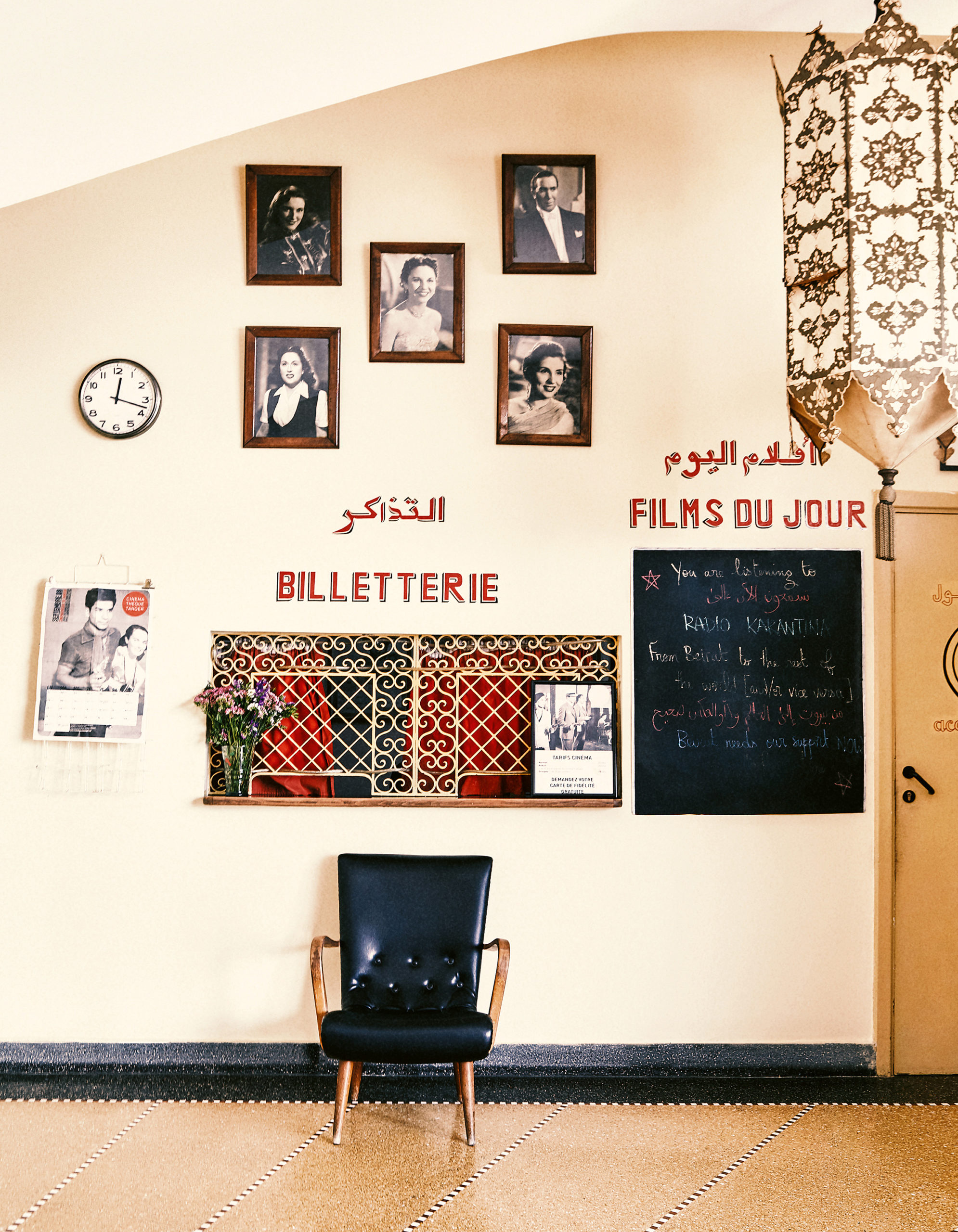
While renovating, the architect patched the old granite floors and found vintage decorations at the nearby Casabarata flea market, creating a strong visual identity in blue, yellow and red. An old-school marquee at the entrance still displays the names of the films that are showing. The monthly programs, which open like a newspaper, are designed over stills from iconic films like Hiroshima Mon Amour, All About Eve or My Sweet Pepper Land. Many people take them home and frame them. It is also one of the last theaters in Morocco—if not the last—to show films on reel-to-reel.
Barrada has left the day-to-day running of the cinema to others, but she is still a part of it. And sitting in the café remains one of her favorite activities. As a photographer, she spent years walking through the city that has inspired so many writers and artists, discovering its backstreets and getting to know its people. Tangier itself and multiple rich experiences have defined much of her artistic career. “I think the bad rep made it special,” she says. “It’s a port town. Here, people have strong survival skills. It was economically abandoned for years. The consequence to all of that was that it became a space of freedom.”
Tangier isn’t a city that reveals its charms easily. So many people pass through it on their way to Europe, not taking the time to discover its secrets and adventures. “You have to deserve it. That’s the trick,” Barrada says. “Nowhere else in the world am I as happy as when I wear my boots and walk in the mud in the rain, or eat a kalinté [chickpea flour pie] on the street. There is nowhere else I feel at home.”
( 1 ) Barrada’s work is deeply tied to Morocco and to the history of the Mediterranean. Her exhibition at Pace Gallery in East Hampton earlier this year, for example, featured a selection of textile collages dyed using natural sources from her garden in Tangier; paper collages responding to the 1960 earthquake in Agadir; and furniture sculptures that used traditional Moroccan wicker weaving techniques.