FINDING ALBION
- Words Tom Faber
- Photos Alixe Lay
The writer, broadcaster and DJ Zakia Sewell is on a quest through the history and folklore of the British Isles.
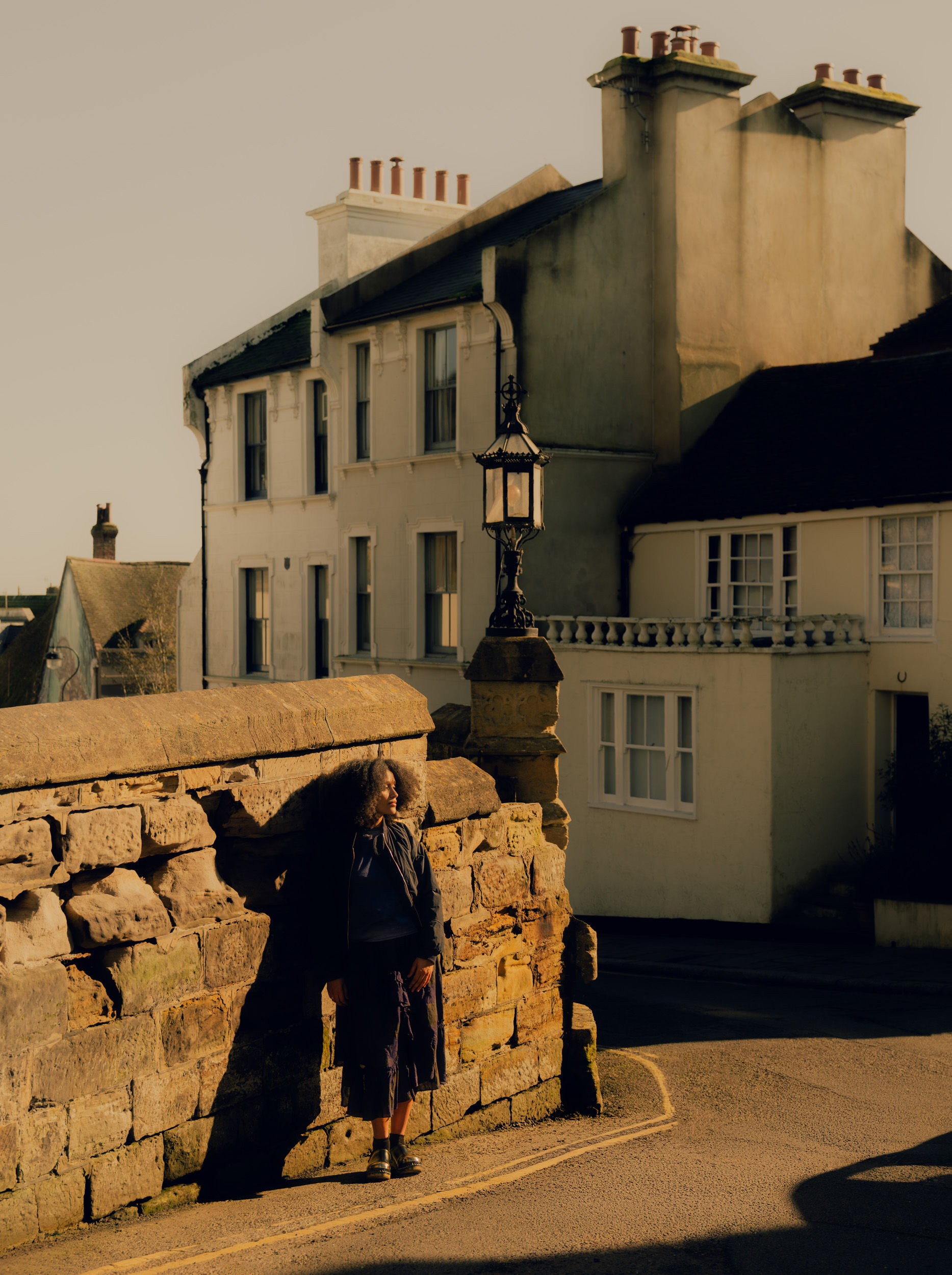
Sewell is pictured in Hastings, a seaside town in the UK she traveled to while researching Finding Albion.
Ten years ago, Zakia Sewell had an encounter that changed her life. She was 23 years old and working at Honest Jon’s, a record shop in West London. One day she was at a cheap Malaysian restaurant, her usual lunch spot, when she overheard a group at the next table talking about spirituality. “I was in quite a difficult chapter of my life,” she recalls. “It was before I’d started therapy and I was feeling lost and unhappy, and they were having this fascinating conversation and I thought: Oh my God, I need to know who these people are.” It turned out that they were Sufis, belonging to a mystic branch of Islam. One of them began to talk to Sewell about life’s core spiritual quest, which he described as “using the natural tools we’re given, like intuition, empathy and logic, to learn more about ourselves and the world around us.” She found herself strangely moved by the conversation. Outside the café, tears sprang to her eyes.
The man’s words would stay with her, and she credits that moment with prompting her to start therapy, question her religious beliefs and embark on her professional path. When she started her own show on alternative radio station NTS three months later, she knew exactly what to call it: Questing.
It’s a decade later almost to the day, on a gray afternoon in South London, and Sewell is sitting in a cozy café in an orange sweater, picking at a blueberry muffin. She’s clearly still moved by this pivotal moment in her life, and she starts explaining how it kick-started a winding path through the media, making audio documentaries, hosting a radio show on the BBC and now to the publication of her first book, Finding Albion: an exploration of the history of her family and her country, and a search for new narratives to heal a broken Britain.
Speaking with Sewell, it’s immediately obvious why she makes such a good radio presenter; she has a gentle, soothing voice and is formidably articulate. When she’s discussing a subject she’s passionate about, her eyes light up and she sweeps her long braids, woven with golden threads, behind her shoulder. You can’t help but be drawn in, even when she’s talking about something stale, pale and male, such as the topic of her book: British folk culture.
Mention “British folk” to a random passerby in the UK and it would conjure a variety of eccentric traditions, none of them remotely cool: dancing men in socks and sandals, hopping about gently on the village green; centuries-old ballads picked out on acoustic guitars; druids tracking ley lines at ancient stone circles. Yet Sewell has loved and been part of this culture since she was a child, when her father was in a folk band and took her to see jazz-folk pioneers Pentangle in concert, and from spending time with her grandparents in the Welsh town of Laugharne (pronounced “Larn”), “exploring ruined castles, hearing whispers of Merlin in the wind, and absorbing the magic and mysticism in the landscape.”
Her mother’s family is from the Caribbean island of Carriacou, and Sewell says she didn’t often see other non-white people in folk circles. Despite loving the music, she sometimes wondered if British folk culture really belonged to her. When Sewell wasn’t in misty Wales, she was in a distinctly urban foil: Hounslow, West London, right under the flight path of Heathrow Airport. While she played folk music at home, Sewell was listening to R&B and grime with her friends. She couldn’t quite articulate it at the time, but there was a tension between these facets of her identity: two halves, each pulling her in a different direction.
As she learned more about British history, the dissonance grew stronger. “Even though my ancestors were most likely enslaved in the Caribbean, living here in Britain today I’m benefiting from all that was extracted by colonial exploitation. I went to Oxford, I got free school meals. Can I make my peace with that?”
Sewell is not alone wrestling with the idea of Britishness. As the political landscape becomes increasingly more polarized—with surging support for smaller parties on both the left and right threatening to topple the country’s long-established two-party system—the idea of what it means to belong in Britain has become increasingly fraught. As part of the discourse, history is being reshaped and weaponized: On the left, there are calls from the Green Party to reckon with the country’s imperial past and confront the racism and systemic inequality embedded in its legacy; on the right, anti-immigration rhetoric from populist parties such as Reform recast Britain—falsely—as a nation that has always belonged to white people. The conflict reached a new peak last summer when fierce debate erupted over whether Operation Raise the Colours, a grassroots campaign encouraging people to hoist the St George’s Cross—the flag of England—signaled pride or prejudice. Some framed the act as harmless patriotism; others regarded it as a menacing display of far-right xenophobia.
“Folk connects us to all these radicals throughout history who tried to fight to make Britain a fairer place.”

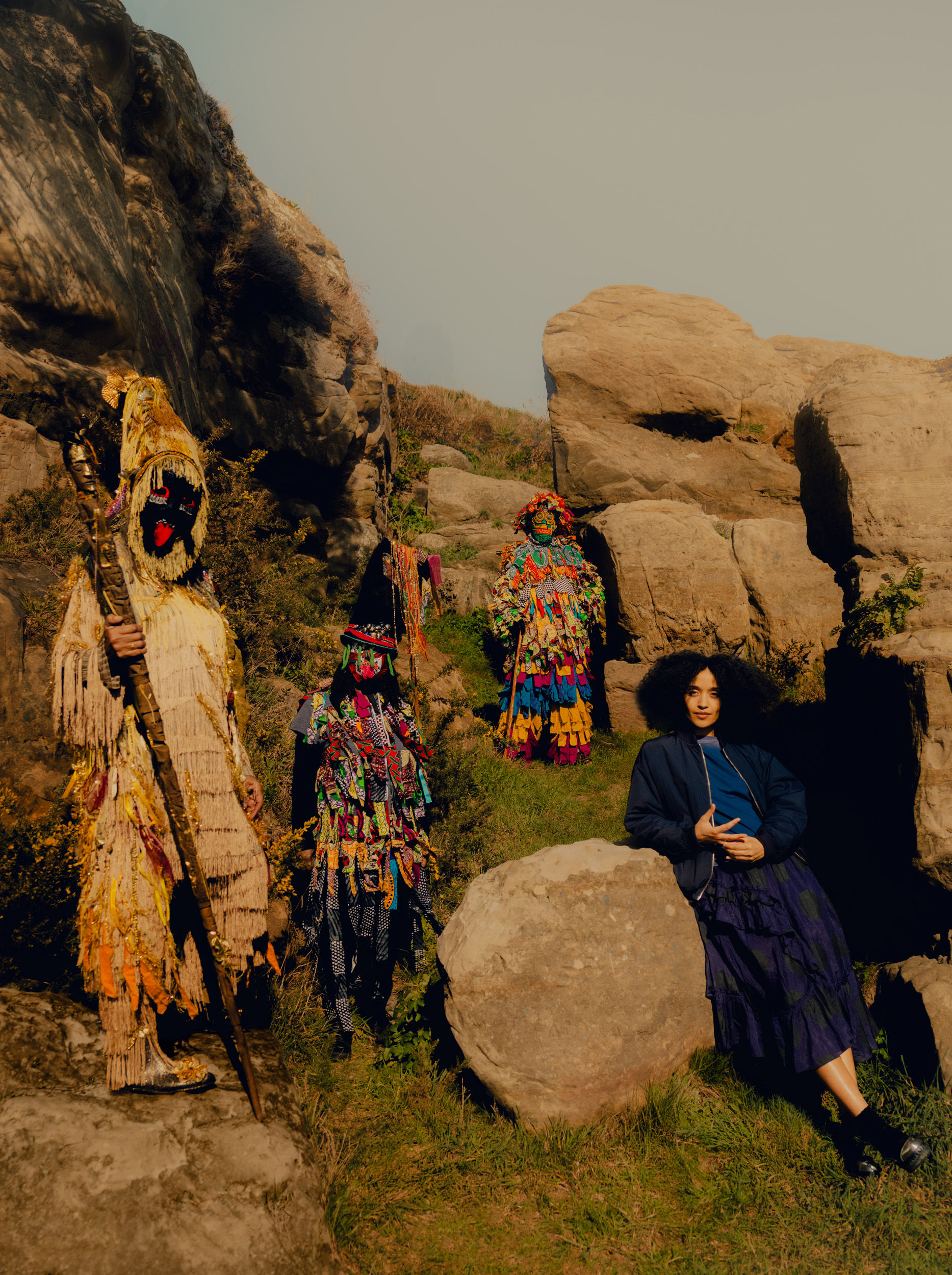
Sewell is photographed with members of the Hastings-based community arts organization Playing the Race Card, founded by Claudine Eccleston, whom Sewell met while writing Finding Albion. One of the organization’s ongoing initiatives is the Jonkunnu project, which revives a traditional Caribbean masquerade in the UK. Eccleston (fourth from left) appears here as the Queen of the Sets, a prominent character representing European royalty.

Sewell believes that folk culture may provide a balm and a way forward. Having first explored her own knotty feelings as a mixed-race person in the folk scene on My Albion, a four-part radio series for the BBC, she is now broadening the lens. In her book, she asks: “Can we conjure more progressive and inclusive visions of national identity through looking at our folk heritage?”
Finding Albion follows the course of a year as Sewell travels around the UK visiting neo-pagan events that mark the passing seasons, from the spring equinox at Stonehenge to All Hallows’ Eve in the ancient city of York. Her interpretation of what constitutes “folk” is broad, defined as stories or culture that are not created by the establishment. This means there is space for her to include London’s Notting Hill Carnival, a massive celebration of Caribbean culture and an essential date in London’s summer calendar.
Sewell wants to embrace readers who—like herself—do not necessarily relate to traditional symbols of Britishness. “Some people think: Oh God, the Union Jack, the monarchy, red phone boxes, policemen’s hats. What has that got to do with me?” she says. “But in saying you don’t want to have anything to do with Britishness, you’re ultimately rejecting a part of yourself. When we can find alternative stories and see ourselves reflected in them, we’re able to reclaim an aspect of ourselves and ultimately become a little more whole.”
Her research often starts with music, as in the case of a song she chronicles called “Rufford Park Poachers,” which in 1908 was one of the first folk songs to be recorded commercially. “It’s an incredible, crackling old recording with this old man’s voice, singing out to you like a ghost,” Sewell says. “And if you sit and listen again and again, you realize there’s more behind what he’s saying. Pulling threads, you discover a radical history that underpins the song.”
The lyrics tell of a clash between poachers and gamekeepers in the 1850s—a time when poaching laws forbade the working classes from hunting animals, such as pheasants or hares—and of the pain of starvation, imprisonment and being exiled. What sounds like a lovely old folk song is actually a fierce revolt against social injustice. Sewell connects this example to other moments of antiestablishment resistance in British history, such as the Luddites smashing up machines in protest against factory owners in the early 19th century, or the leaders of the Pentrich Rising who tried to topple the government in 1817 and were beheaded. “Folk connects us to all these moments and radicals throughout history who tried to fight to make Britain a fairer place,” she says, “and history is the tool that helps us to unpick and decode and reveal those messages.”
She looks out of the window of the café, as if debating with herself internally for a moment, before turning back. “Okay, as a person of color, some people might feel that’s not their history. But it’s an alternative vision of British people throughout the ages. It shows they weren’t all complicit with the colonial machine or slave owners, but that there were also people who lost their lives to fight injustice. We can see that as a fertile strain of Britishness, and incorporate that into our own sense of what it means to belong to this land.”
While Sewell’s quest began with the hope of finding a radical utopia buried in Britain’s past, in some preindustrial time untainted by Britain’s colonial legacy, she soon realized that such a place did not exist. Dig deep enough into any folkloric history and you will also find problematic people. Percy Grainger, for example, the man who recorded “Rufford Park Poachers,” was a virulent anti-Semite.
Another example can be found in Morris dancing, a 15th-century British folk custom, often mocked, which involves dancing through square formations waving colored handkerchiefs.

“I’ve studied and I know the truth. I know there’s this deep, dark history of exploitation, this pile of bodies on which Britain is built.”

A Pitchy Patchy is a figure from Caribbean Junkanoo carnivals whose traditional role is to keep both masqueraders and the crowd in order.


Over 200 years old, Junkanoo was started by enslaved Africans in the Bahamas as an opportunity to celebrate, dance and express culture, and takes place in the early morning hours of Boxing Day (December 26) and New Year’s Day.
When Sewell first saw it, she thought it was “so silly, eccentric, fun, merry and ridiculous, full of hope and possibility.” But during her research, she learned that there is a long history of Morris dancers wearing blackface, and that some still do it today.
“That was a moment where I really thought: Maybe this folk culture stuff isn’t for me,” she says. But time and again throughout her work, Sewell chooses to grapple with thorny histories rather than turn away. She does not excuse racism or anti-Semitism, but instead reckons with them as a fundamental part of the story. “If we’re looking for stories about who we’ve been as a nation, the complex, contradictory history of Morris dancing reveals a truthful story about who we are,” she says. “Blackface has to be part of it. We can’t not include it.”
“I’ve learned so much about this country, and the fascinating tension that comes at the meeting place of the darkness and the magic,” she continues. “That’s the aspect of British culture I find most interesting—where the two meet.”
Sewell’s book lands at a time when there is a growing interest in esoteric and alternative forms of knowledge, ranging from astrology to crystals to holistic medicines. She feels that this trend is the result of modern society not delivering on its promises. She also believes that while we’ve lived in an age of scientific empiricism since the enlightenment, this ideology has not brought peace, happiness or prosperity to the majority of the population. “The world is falling apart,” she says. “We’ve reached this hideous crescendo of our hyperrational, materialistic culture and people are not happy. We’re living in such a disenchanted age that there’s a real yearning for magic and mystery.”
Her journey has also shed light on the role that history plays in forming our personal and national identities. Sewell feels empowered by her journey through the UK, its past and present. “I feel like I just know the country better now,” she says. “Learning more about colonialism, enslavement and working class struggles in Britain, I feel really well equipped to fight off anyone who says I don’t belong here because I’ve studied and I know the truth. I know there’s this deep, dark history of exploitation, this pile of bodies on which Britain is built. And there’s so much work that needs to be done to really excavate that history, to come to terms with it and integrate it into our story.” Grueling as it may appear, facing the realities of our troubled histories can also be an act of hope for the future. In her book, Sewell quotes the Nigerian British author Ben Okri, who writes: “Nations and peoples are largely the stories they feed themselves. Change the stories individuals and nations live by and tell themselves and you can change the individuals and nations…. If they tell themselves stories that face their own truths, they will free their histories for future flowerings.”
After a couple of hours talking about folk culture and her new book, Sewell finishes the last of her coffee. “The latest quest was to finish the book, and now I’m back at the zero space,” she says. “There’s a new landscape unfolding, a new quest is beginning, but I don’t know yet what the grail is at the end.”
She knows better than to try and predict the next step before it’s ready to reveal itself. Her life has always been like this: “There’s never been a grand plan,” she says. “I never thought I’d write a book or be a radio broadcaster. All these things just sort of happened as a result of me following my passions and seizing the opportunities that came up.”
It might be all the therapy, or just life experience, but Sewell has learned something that many medieval knights of folklore never quite grasped. “I have to accept that I’m not really in control of my quest,” she says, shrugging on a plush blue puffer jacket. “I step out onto the path, I pack my bag, I have my map, but I can’t control which old sage will meet me by the bridge, or when the path suddenly becomes overgrown. I can do what I can do, but some elements are totally out of control. And with that, magic can happen.”

“There’s a new landscape unfolding, a new quest is beginning, but I don’t know yet what the grail is at the end.”