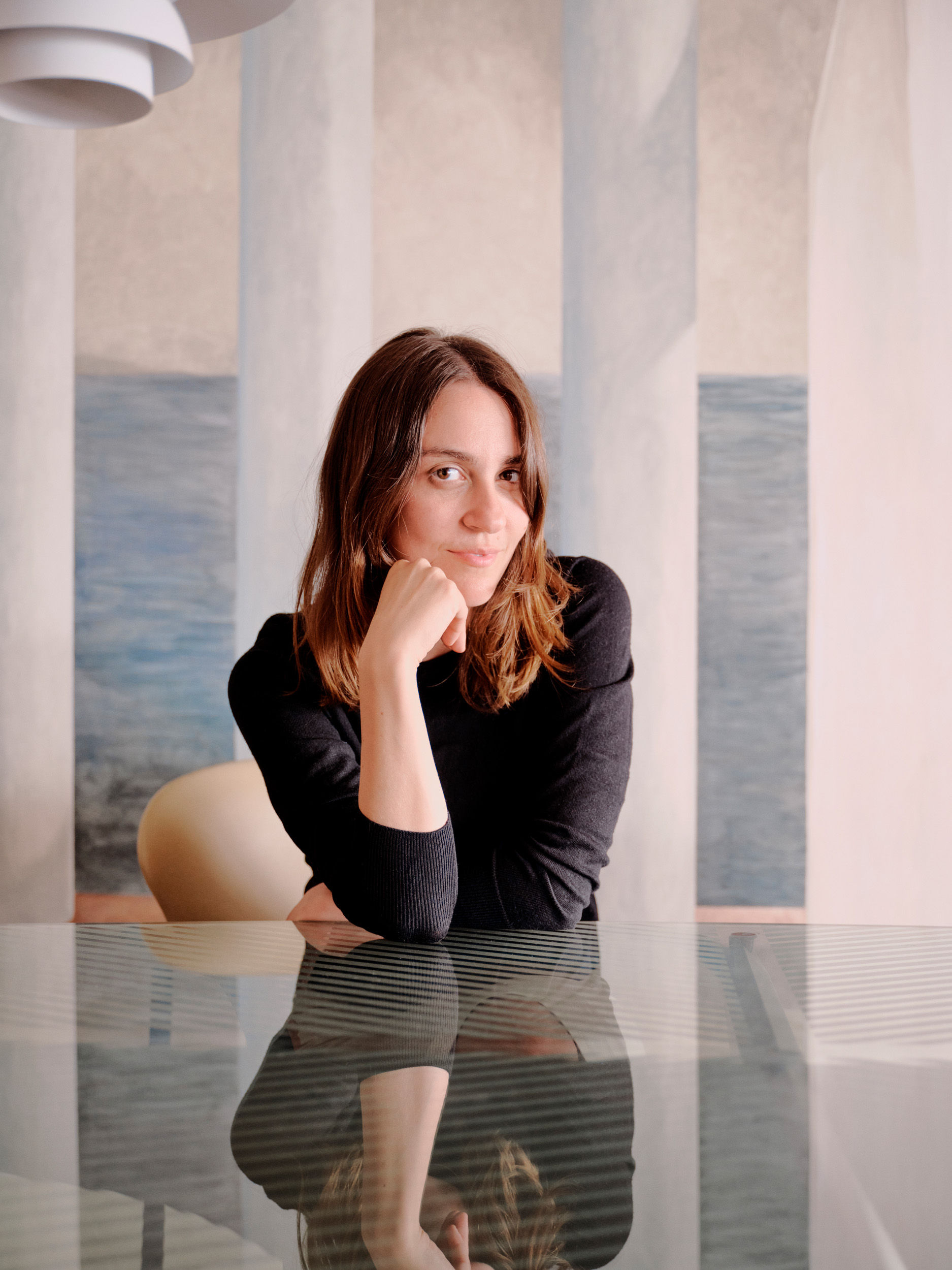
AT WORK WITH: ELVIRA SOLANA
- Words Emily Nathan
- Photos Marina Denisova
THE ARCHITECT-TURNED-MURAL PAINTER PLAYING WITH SPACE.
The work of ancient muralists was nomadic in nature. In order to paint enduring scenes of daily life, history or mythology on the walls of temples, tombs and public buildings, they were required to continually displace themselves, adjusting and adapting their work to suit each site and patron. A shifting physical context was their only constant.
In keeping with this tradition, incessant movement has shaped the professional life of Spanish-born artist Elvira Solana. Though she earned a degree in architecture in 2012, she doesn’t design new buildings. Solana has instead spent the last six years decorating the interiors of existing ones, painting illusory perspectives, landscapes and even architecture. And in the manner of her predecessors, she has traveled for each commission—working on-site in private homes, hotels and boutiques in Paris, Provence, Lisbon, Milan and Santo Domingo before moving on, every few months, to confront the specifics of the next new space.
“When I left school, the economy had paralyzed the architecture industry and I got tired of being treated like a child with nothing to offer,” Solana says, speaking from her home in a small fishing town on Spain’s northern coast. “I missed the feeling of working with my hands. So I quit and decided to start painting, but I guess I couldn’t get rid of the architect in my core. You might say it’s only natural that I ended up painting on the wall.”
Solana’s lush, lyrical murals stretch from floor to ceiling, extending across windowsills and doorframes and occasionally taking over entire rooms. Often her compositions appear to break through the wall, opening onto expansive trompe l’oeil views of an imagined world, at turns tropical, cosmopolitan and pastoral.1 Others are more purely geometric, but all share a searching, gestural touch that explores the nuances of darkness and light, form and absence.
She approaches each new space with an investigative curiosity. Before Solana paints a single stroke, she spends time watching: noting the room’s architectural features, the flow of natural light as the sun moves through the sky and the play of shadows across the wall. She then weaves this understanding of the physical site into a design that draws on a history of mural painting dating back through the Renaissance to Roman frescoes, incorporating references from a visual lexicon that includes ancient mythology, historical anecdote and contemporary culture.2 It is only then, having developed a series of preparatory sketches and studies, that she begins to paint, building up the image gradually to achieve complexity and depth.

“It’s only natural that I ended up painting on the wall.”

The bathroom in Solana’s home features a Grecian-style frieze and a trompe l’oeil shelf with geometric forms that play with the architecture of the space.


( 1 ) Translating to “deceive the eye,” the French term trompe l’oeil describes a technique that creates the optical illusion of three-dimensionality on a flat surface, making painted objects appear real through the use of perspective and shading.
( 2 ) Much of what we know about ancient wall painting comes from the Roman cities of Pompeii and Herculaneum, which were buried in volcanic ash when Vesuvius erupted in A.D. 79. There, excavations have discovered murals that include trompe l’oeil marble, still lifes, narrative friezes and illusory architecture.
( 3 ) Vitruvius was a Roman architect and engineer best known for De Architectura (On Architecture), a 10-book treatise in which he outlined the principles of good architecture, emphasizing the importance of durability, functionality and beauty.
“I decided to start painting, but I guess I couldn’t get rid of the architect in my core.”
“People often ask me to pick one: Am I an artist or an architect?” she says. “But I can’t answer. I have always interpreted murals from an architect’s perspective, and I believe that a sensory perception of shapes can create and define a room as much as its walls, roof or pillars. So I use paint to construct a new space; instead of knocking down a wall, I change the way we perceive the wall. In a way, I am building architecture by painting architecture.”
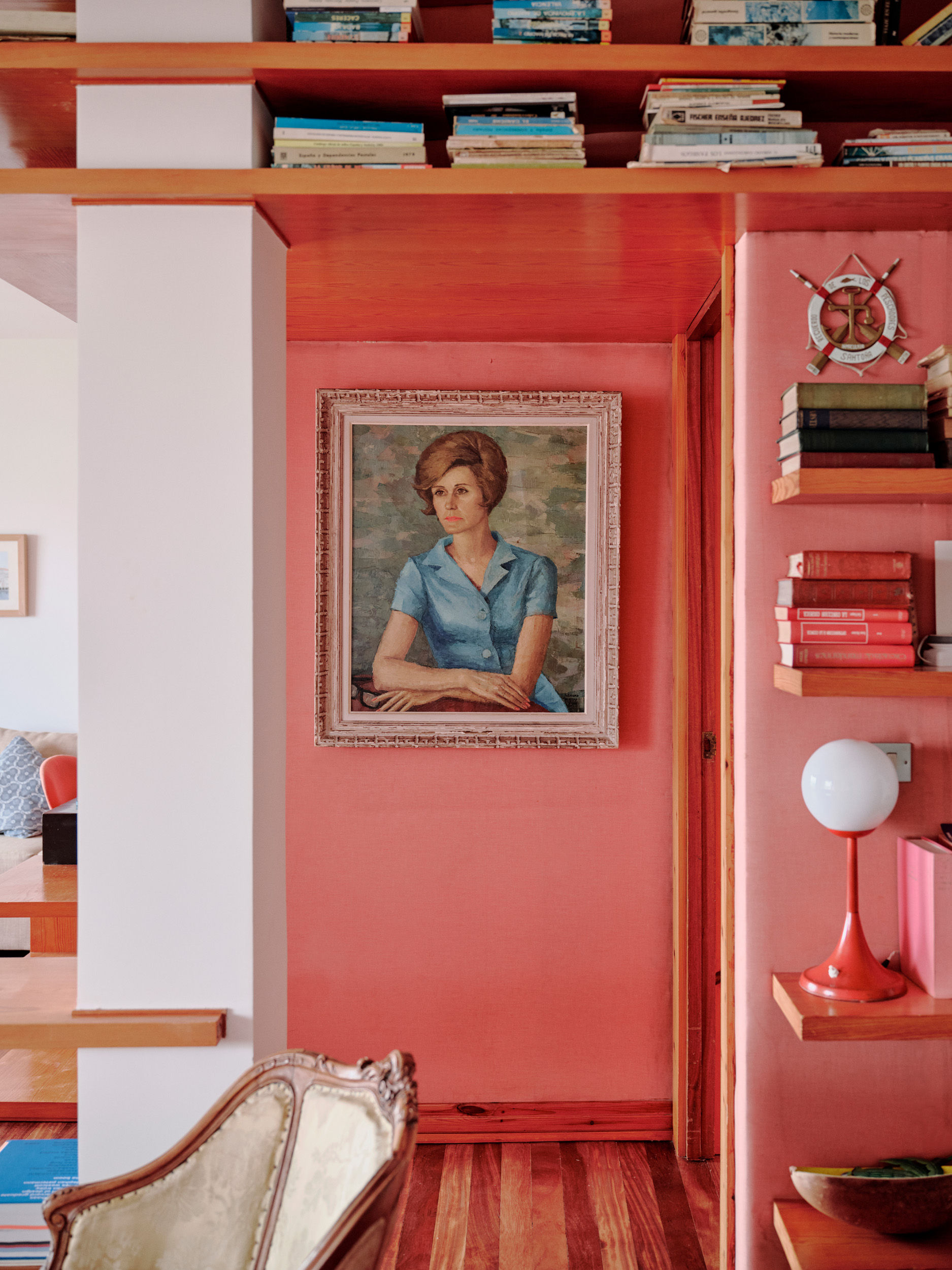
Early in her career, Solana transformed her home into a laboratory of overlapping perspectives and spatial planes. In her living room, one wall appears to alternate between interior and exterior fields: Nooks and cracked-open doors lead the eye through a maze of rooms, suggesting deeper, unseen spaces; illusory windows frame a sequence of marbled colonnades and a tranquil sea.
In her bathroom, she decided to attempt a more specific illusion: inverting the angle of the corners with paintings of three-dimensional geometric forms placed on a trompe l’oeil shelf that runs around the room. Below this is a tongue-in-cheek frieze titled Private Pleasures and Misfortunes—a strip of Grecian-style fresco whose allegorical figures perform a suite of erotic activities. Visitors will likely find pleasure in the overall result, Solana explains, but she reserves a private satisfaction for the unassuming painted structures in the corners.
Such experiments with space recur throughout Solana’s murals. In another early work, she painted a hunt under moonlight: nude bodies thrusting and pressing against each other beneath bowing trees and stone arches. The work is rich and figural; it’s a complex composition that appears narrative in scope. Yet, as she explains, this was incidental—her goal was to explore fluid, painted transitions, investigating how to elide a human body into an animal, and an animal into architecture. The image’s visual appeal operated as a kind of Trojan horse for experimentation with color and form—and a way to ensure its longevity.
“Vitruvius taught us that beauty was one of the three founding pillars of architecture, and you really can’t discount it: You can’t forget the eyes,” she says.3 “From my education, I understand the logical part of the visual puzzle; I know structure and composition. It’s when the beauty of the surface comes into play that I’m in new territory, and here I let myself indulge in the pure pleasure of painting. I believe that beautiful things have a better chance of survival.”
During her initial research into mural painting, Solana was thrilled to discover that her decision to straddle architecture and painting has a long historical precedent. Those ancient muralists were often also trained as architects, with their work similarly bringing walls, windows and doors into harmony with flat representation. The embrace of linear perspective by muralists during the Renaissance further vindicated Solana’s understanding of the fluid relationship between two and three dimensions.
Yet her impulse to address architectural questions of space through painterly methods is as much a principled undertaking as a theoretical one. She occasionally describes her murals as “surface interventions,” implying interruption, and she insists that murals are a way to give anyone an inspiring vista, even if they can’t afford an actual ocean view.
“There are physical and material limits—I believe and respect that—but they won’t stop me,” Solana explains. “Of course, we can’t all have a swimming pool, but in a virtual way, I can help people expand their home. And with paint, I build on something that already exists, and that is a much more sustainable way to conceive of the future of our spaces.”
For now, Solana is busy establishing her first brick-and-mortar studio in Madrid. Its defining feature is ample wall space. Always keen to draw a connection with history, she explains that more recent muralists have put down roots and worked this way, too, painting on massive swaths of canvas from the comfort of their own atelier. Her goal is to continue making “refurbishments” in houses, as architects do, but by painting the wall rather than knocking it down. She also hopes to one day work with clients from the beginning of a project, designing their home, and its murals, from the ground up.
“As a muralist, you’re painting the background to someone’s life,” Solana says. “It should be the context, not the main character; good architecture—and good painting—should be invisible. It simply facilitates the life that’s lived there.”
( 1 ) Translating to “deceive the eye,” the French term trompe l’oeil describes a technique that creates the optical illusion of three-dimensionality on a flat surface, making painted objects appear real through the use of perspective and shading.
( 2 ) Much of what we know about ancient wall painting comes from the Roman cities of Pompeii and Herculaneum, which were buried in volcanic ash when Vesuvius erupted in A.D. 79. There, excavations have discovered murals that include trompe l’oeil marble, still lifes, narrative friezes and illusory architecture.
( 3 ) Vitruvius was a Roman architect and engineer best known for De Architectura (On Architecture), a 10-book treatise in which he outlined the principles of good architecture, emphasizing the importance of durability, functionality and beauty.