At Work With: ORIOR

  • Words Brian Ng
  • Photography Alex Wolfe

Brian Ng meets the Irish family making New York’s favorite furniture.

  • Words Brian Ng
  • Photography Alex Wolfe

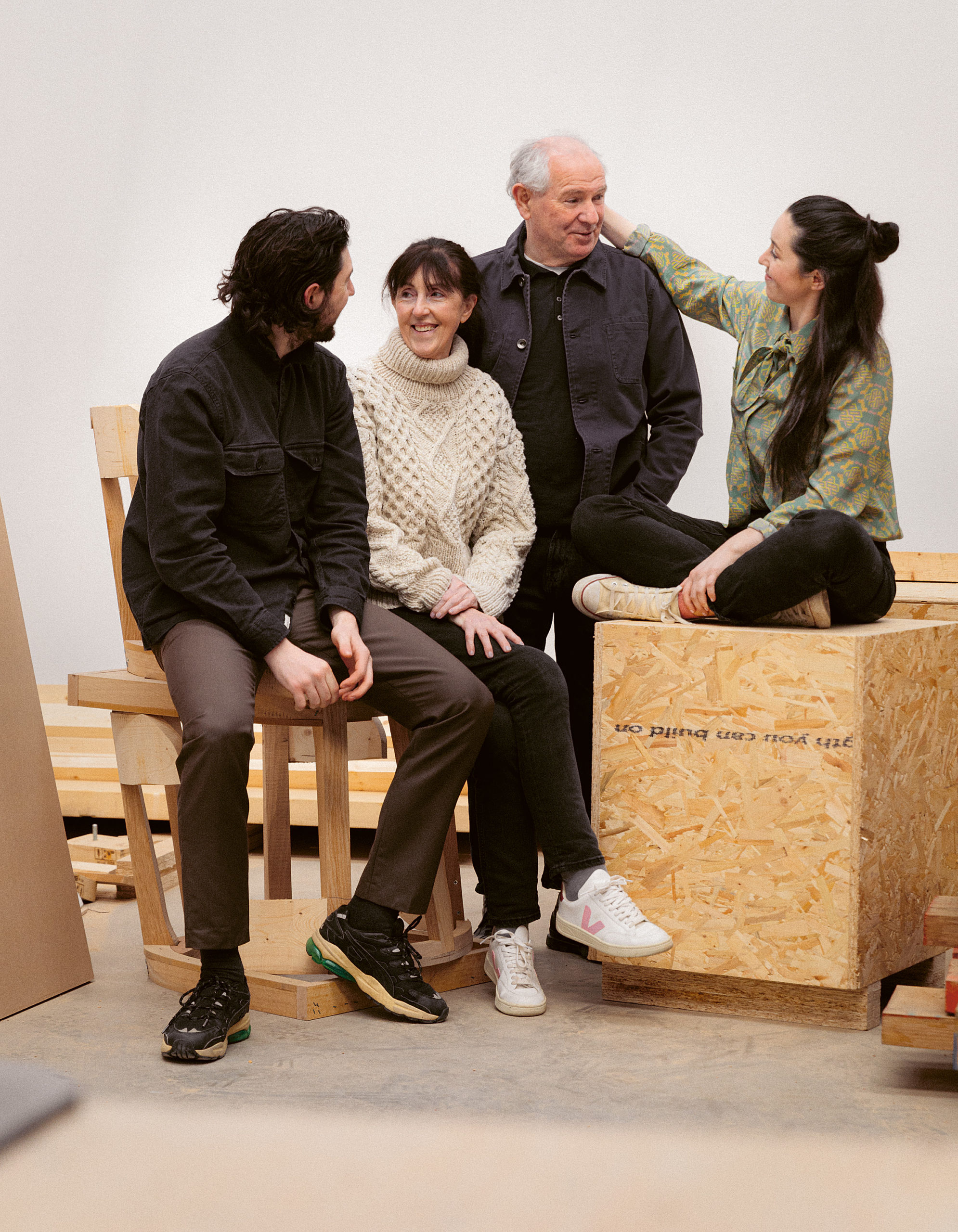
Orior has always been a family business, but it was the pandemic that really brought it all back home to Newry, Northern Ireland. Ciarán McGuigan, the furniture brand’s creative director, had flown back from his base in New York in March 2020 to check out some prototypes at the factory. Katie Ann, his sister, who has her own fashion label, returned from London two days later. And then the world shut down.

It was “class” being back with the family, says Ciarán. “We appreciate it now because we aren’t teenagers being little shits.” The McGuigan family are lined up for our Zoom interview on one side of a dining table, Brian (their father) on the far left, followed by Ciarán, then Rosie (their mother) and Katie Ann. Their computer’s webcam is too narrow to take in this family portrait, so Ciarán spins the computer throughout the interview to face whoever is speaking. 

Their unexpected time together has led to all sorts of collaborations, he says, one of which is a handwoven rug collection, whose colors were inspired by their walks: the different blues of the locks on the river, the sky’s pinks and reds at sunset. They’ve been testing out new digitally printed fabrics, as well as fabrics woven from Donegal yarn, and wallpapers. And they’re looking at fresh ways to combine materials—marble, metal, leather, fabric, crystal. “You might think Irish design is diddly, diddly, diddly,” says Ciarán, conjuring a parochial picture. “You don’t necessarily think attitude.

But “attitude” radiates from the brand’s creative output: Its campaign photos of deep, velvet chairs, sculptural marble tables and mid-century-inspired cabinets have the light and saturation seemingly turned up so that they glow in jewel tones. In the section of the Orior website that documents their clients, chic creative types gaze at the camera, lounging on the furniture. 

 The desire for this kind of design did not exist in Ireland when Brian and Rosie were growing up in the 1960s and ’70s. There were more pressing concerns. It was a bleak period politically—a time of violent conflicts between Irish nationalists, who wanted the six counties governed by the United Kingdom to be returned to the Irish republic, and the unionists, who wanted to keep their British identity. There were few job prospects during the Troubles. Brian, who grew up on Orior Road in Newry, left school at 15 and started working as an upholsterer in a factory. Soon after, he met Rosie at a rugby club just over the border in Dundalk.

Six or so months after they met, the couple left for Copenhagen in search of work. He was 18, she had just turned 17. They worked in fast-food restaurants and in hotels, window-shopping during their free time. There was all “this kind of color, design, clean lines,” Rosie recalls. Back in Ireland, everything was brown and gray; in Copenhagen, it was in technicolor—they would pick up or crawl under the furniture to see how it was made.

In 1979, when they had been in Copenhagen for almost three years, Brian felt the itch to go back to Newry and try his hand at making his own furniture, based on the Danish designs that had enthralled them. He set up Orior immediately, hiring his sister as a sewer, his brother to handle sales and the next-door neighbor he grew up with to help with reupholstery, which they did for local clients for most of the week to make ends meet. In the snippets of downtime he could find, Brian designed his own original pieces. “It allowed us to be more creative in a small way,” Brian says. Brian and Rosie established a storefront in Belfast for their tiny product line, but things were slow to pick up. Rosie says that it was so bad in those first years that had they put the furniture outside and tried to give it away, no one would’ve taken it. “Not in a month of Sundays could I have done what Dad had done back in the day,” Ciarán says. “I had no choice,” Brian counters. 

Working in Northern Ireland was dangerous: Brian recounts how one time, when he was moving some furniture with a van, British troops thought he was a paramilitary. It was also difficult to convince local manufacturers to supply smaller quantities to artisans, meaning Orior had to get materials from overseas. A large, naturally tanned bull hide from Scandinavia was made into Brian’s first design, the Shanog sofa. They worked with Kvadrat, the famous Danish fabric maker, back when they could only afford to put in tiny orders. At a Danish furniture exhibition, Rosie remembers the Kvadrat representative telling her encouragingly: “18 meters from you, 18 meters from the man in Hong Kong, 18 meters from somebody in Germany. It all goes into the one pot.” One English trader, by contrast, told them that the minimum order size was a thousand meters. 

“You might think Irish design is diddly, diddly, diddly. You don’t necessarily think attitude.”

Newry is a sizeable city, but surrounded by the natural beauty of the Mourne Mountains and the Ring of Gullion.

Alongside his design career, Ciarán is a former professional footballer who played for Dundalk in Ireland and Syrianska FC in Sweden.

( 1 ) Around 30 to 40 of the staff have been with the company for as many years. Orior is now hiring across the board and has recently brought two female Irish returnees on board as upholsterers (traditionally, makers have been male in Ireland), and its first Danish maker too.

It was a hard slog during the first few years, until they started to secure bigger wholesale clients including Selfridges and Liberty in London. In the ’90s and ’00s, the Irish economy boomed and “things were absolutely flying,” says Ciarán. Then, in 2008, the phones stopped ringing. Ireland became the first country in the eurozone to enter into a recession. Brian held on to his workforce—just—reasoning that their makers were highly skilled and they wouldn’t be able to get them back if they let them go. 

In 2013, Ciarán was “catapulted” into the family business. He was in Newry, on break from university in the US, when Brian got sick. Ciarán finished most of the rest of his degree via online learning, all the while helming the brand as its creative director. When Brian was well again, Ciarán decided to change Orior’s focus to the American market, moving to New York City at the end of 2014 and opening a studio in Williamsburg, Brooklyn, on a shoestring budget in May 2015. They won a commission to fully outfit Vice Media’s Toronto offices, and word of mouth began to spread through the rich and fashionable of the East Coast. 

Orior’s showroom is now in Tribeca, “a natural next step,” according to Ciarán. There will also be an Orior hotel, of sorts: a client retreat in Savannah, to be opened at the end of the year. But Ciarán maintains Orior will stick to a slow drip of new products each year: only two or three new designs, and an updated handful from Brian’s archives, which counts over 200. “I don’t want to oversaturate,” he says. And the brand, despite its US market, will remain resolutely Irish. To that end, Orior is investing more in training domestically—many of Ireland’s talented makers currently go overseas for opportunity.1

 Ciarán and Katie Ann, while intending to stay in their adopted cities for the next few years, are both thinking about returning to Newry permanently. “We have our own passions,” Katie Ann says of herself and her brother, “and we have Orior as the glue that holds us all together.” The pandemic has shown the family that they can operate a global brand from their hometown, which has a population of fewer than 30,000 people. “It’s important in life,” Rosie says, “that if you believe in something, you stick with it.”

( 1 ) Around 30 to 40 of the staff have been with the company for as many years. Orior is now hiring across the board and has recently brought two female Irish returnees on board as upholsterers (traditionally, makers have been male in Ireland), and its first Danish maker too.

The countryside of County Down has been an inspiration to the family during the pandemic; the colors influenced the design of the new rug collection.

An advantage of working in Northern Ireland is that the Orior team is able to visit the country’s many quarries and source raw materials directly from them.

FREE PREVIEW

Take a look inside Issue Sixty

You are reading a complimentary story from Issue 41

Want to enjoy full access? Subscribe Now

Subscribe Discover unlimited access to Kinfolk

  • Four print issues of Kinfolk magazine per year, delivered to your door, with twelve-months’ access to the entire Kinfolk.com archive and all web exclusives.

  • Receive twelve-months of all access to the entire Kinfolk.com archive and all web exclusives.

Learn More

Already a Subscriber? Login

Your cart is empty

Your Cart (0)