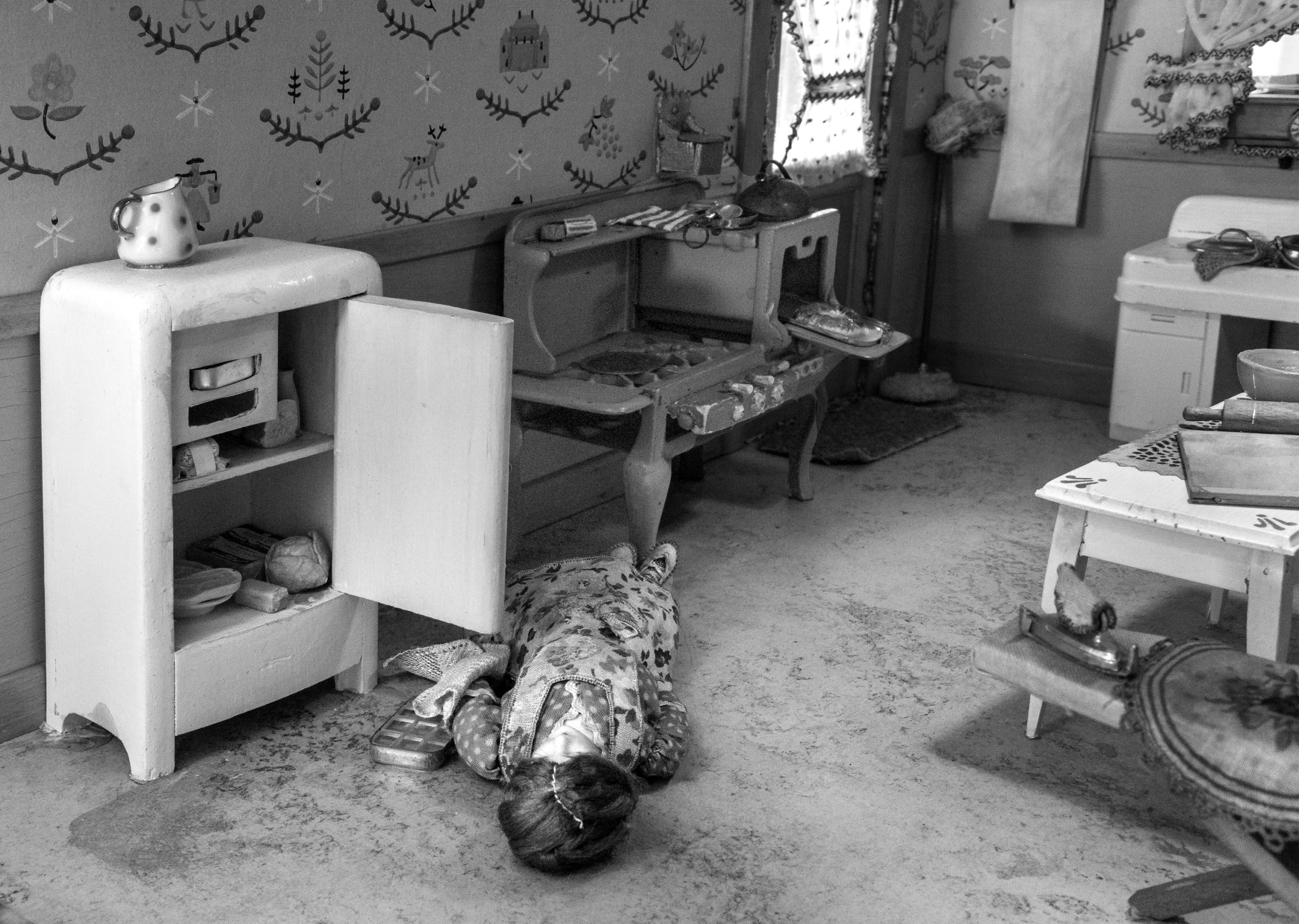
Photograph: Frances Glessner Lee, Kitchen (detail), about 1944-46. Collection of the Harvard Medical School, Harvard University, Cambridge, MA. Courtesy of the Office of the Chief Medical Examiner, Baltimore, MD.

Cult Rooms The Nutshell Studies of Unexplained Deaths rendered gruesome crimes in divine miniatures.

Cult Rooms The Nutshell Studies of Unexplained Deaths rendered gruesome crimes in divine miniatures.

  • Words Stephanie d’Arc Taylor

( 1 ) When the dioramas were exhibited in 2018 at the Smithsonian American Art Museum, at the height of the country’s true crime fever, visitors keen to play amateur detective often found themselves outwitted. “I think people do come here expecting that they’re going to be able to look at these cases and solve them like some Agatha Christie novel,” curator Nora Atkinson told NPR at the time. “And when you look at them you realize how complicated a real crime scene is.”

Our fascination with murder is enduring. True crime is one of the most popular podcast categories, and police procedurals are bigger business than ever: The CSI franchise alone has an estimated audience of two billion people. But it’s not everywhere you find depictions of ghastly murders that could also be described as twee. In 1940s America, however, Frances Glessner Lee achieved this feat by rendering crime scenes in adorable dollhouse miniatures. 

Glessner Lee, born wealthy in Chicago in 1878, was a strange girl. At age four, she allegedly told her mother that she “had no company but my doll baby and my God.” In addition to typically feminine pursuits like dolls and sewing, she was fascinated by medical texts and Sherlock Holmes. Forbidden to go to school by her father, she was adrift for decades until the rest of her family died, leaving her with the family fortune.

Finally free to spend her time and money as she liked, she turned her eccentric attentions to murder. Disturbed by what an investigator friend told her about crime scene contamination by bumbling, untrained detectives who would move bodies, disturb blood spatters and put their fingers through bullet holes in clothing—Glessner Lee took it upon herself to develop a teaching curriculum for would-be crime scene investigators. And if she couldn’t bring them to crime scenes, she would just have to bring the crime scene to them.

The resulting oeuvre is The Nutshell Studies of Unexplained Death, a series of 20 meticulous dioramas of grisly murder scenes. “The inspector may best examine them,” she advised, “by imagining himself a trifle less than six inches tall.” The crime scenes she selected were not only real, they were the most puzzling ones she could find, to test potential detectives’ powers of observation, logic and inference. Some clearly depict crimes (like her lurid re-creation of a teenage Dorothy Dennison’s decomposing corpse covered in bite marks, white dress ripped open, knife in the gut). Others are more puzzling: Ruby Davis’ body at the bottom of the stairs, for example, may or may not have been pushed there by her husband. (Despite the discrimination she faced, Glessner Lee was not immune to society’s fascination with the gruesome deaths of women in particular.)

As any sleuth knows, cases rest on the tiniest detail. Glessner Lee’s attention to detail is immaculate, frequently drawing the viewer’s eye to lurid, almost cinematic noir minutia. Years of grime appear to accumulate on light switches of seedy motel rooms. Half-peeled potatoes languish by dirty sinks. Ashtrays overflow and liquor bottles seep brown liquid into moldering carpets. Tiny family photographs grace vanities draped in lace, and newspapers feature minuscule representations of the relevant front page. “When I saw these miniature crime scenes,” filmmaker John Waters told The New York Times, “I felt breathless over the devotion that went into their creation.”

It’s the juxtapositions of the Nutshell dioramas that make them impossible to turn away from—the control and exactitude Glessner Lee devotes to these scenes belie the murderous rage at their core, perhaps the most out-of-control moment of the participants’ lives. 

It makes perfect sense, somehow. As a woman fascinated with murder and death, Glessner Lee must have frequently felt as though her talents and passion were stymied by the misogynistic mores of the time. After her miniatures were incorporated into the curricula for trainee detectives at the Harvard Association of Police Science, she was awarded the position of honorary police captain by the New Hampshire State Police in 1943. Press gave attention to her otherness, such as the magazine cover emblazoned with “Grandma: Sleuth at Sixty-Nine.”

Glessner Lee kept the answers secret to preserve the dioramas’ utility as training tools. Either way, the mysteries her dioramas reproduced weren’t meant to be solved without impossible-to-obtain supplemental information like medical examinations or suspect interrogations.1 Murder is messy and complicated, just like life—even if it’s rendered in twee miniature. 

( 1 ) When the dioramas were exhibited in 2018 at the Smithsonian American Art Museum, at the height of the country’s true crime fever, visitors keen to play amateur detective often found themselves outwitted. “I think people do come here expecting that they’re going to be able to look at these cases and solve them like some Agatha Christie novel,” curator Nora Atkinson told NPR at the time. “And when you look at them you realize how complicated a real crime scene is.”

FREE PREVIEW

Take a look inside Issue Fifty-Eight.

You are reading a complimentary story from Issue 43

Want to enjoy full access? Subscribe Now

Subscribe Discover unlimited access to Kinfolk

  • Four print issues of Kinfolk magazine per year, delivered to your door, with twelve-months’ access to the entire Kinfolk.com archive and all web exclusives.

  • Receive twelve-months of all access to the entire Kinfolk.com archive and all web exclusives.

Learn More

Already a Subscriber? Login

Your cart is empty

Your Cart (0)