Cult RoomsThe history—and future—of Luna Luna Park.
Cult RoomsThe history—and future—of Luna Luna Park.
( 1 ) In 1985, Heller received a grant of about $350,000 from the German magazine Neue Revue for the project. “The number of artistic movements it covers is kind of crazy,” Kathy Noble, the curatorial director of the new Luna Luna, told The New York Times last year. “Everything from abstraction, art brut, Dada, Fluxus, Neo-Expressionism, nouveau realism, pop art, surrealism, Viennese Actionism—most exhibitions will not cover this breadth.”
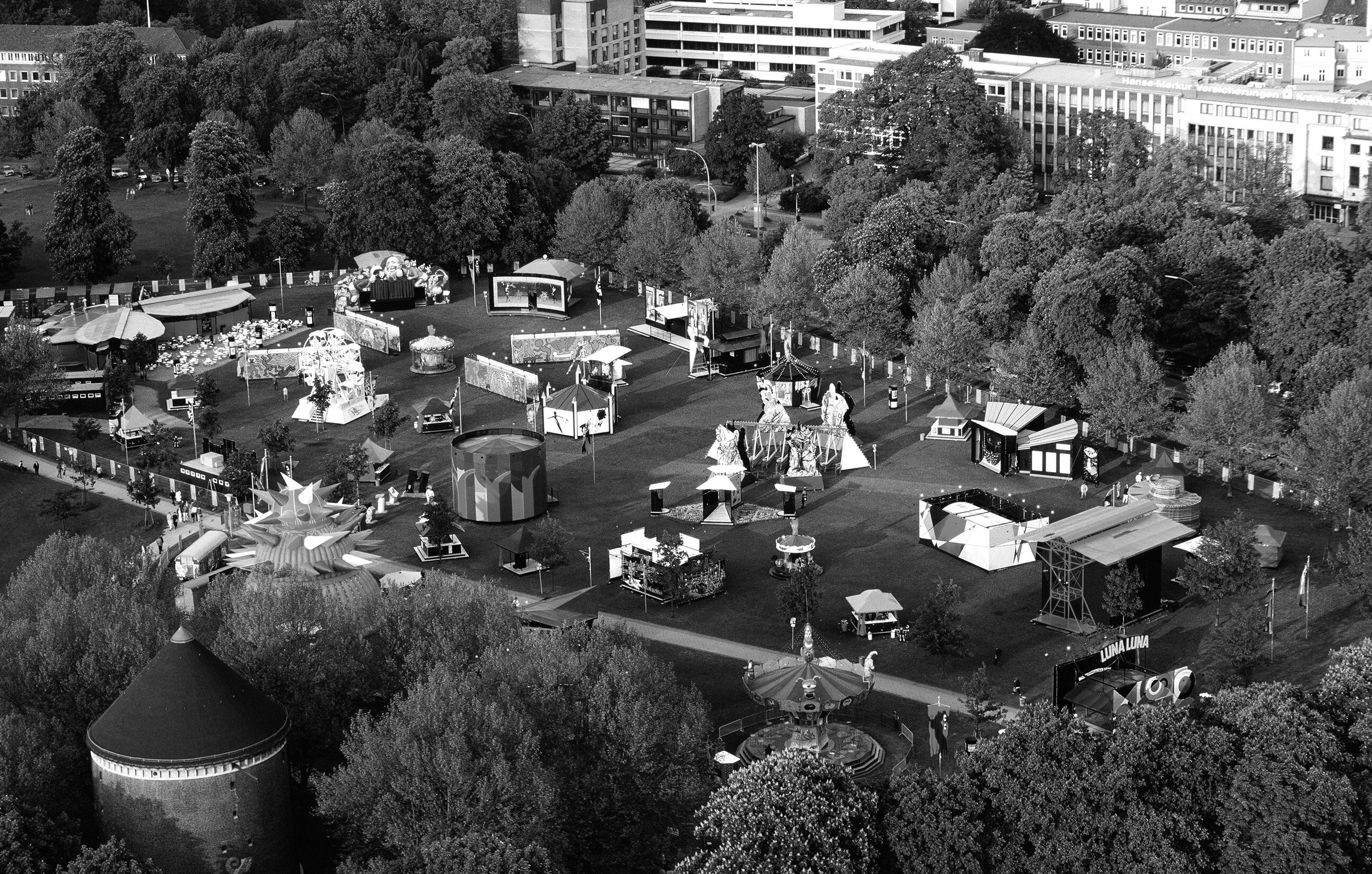
A large-scale avant-garde art carnival—largely forgotten in the years since its 1987 debut in Hamburg—has been plucked out of obscurity by superstar rapper Drake and is currently being prepared for a comeback world tour. It’s the coup of a lifetime for André Heller, the Austrian multimedia artist who brought the project to fruition more than 30 years ago and who has been haunted by its aborted promise ever since. The memory of Luna Luna, his name for the project, is “like a[n old] love affair where you can’t stop having erotic dreams,” he has previously said.
Every aspect of the resurrection saga reflects the fantastic, surreal qualities of the park’s art installations, which were modeled after those that can be found in many regular Luna Park amusement parks around the world. To start with, it’s an astonishing feat that Heller persuaded 30 of the most celebrated artists of the 20th century to create working carnival rides that were enjoyed by the hoi polloi usually left cold by high art. Compensation—just $10,000—was a fraction of their normal fees.1
At the time, the German magazine Der Spiegel attributed Heller’s charm to a particular style of subtle, dark Viennese humor, known in German as Wiener Schmäh. Whatever he was doing seemed to work: The experimental American musician John Cage was the only artist who turned Heller down. The names of those who agreed to take part ring out: Keith Haring contributed a carousel, and Salvador Dalí a mirrored fun house. Carnival-goers rode a Ferris wheel painted by Jean-Michel Basquiat, accompanied by a Miles Davis song. Philip Glass also composed an original soundtrack to accompany a glass labyrinth by Roy Lichtenstein, and David Hockney created a musical “enchanted tree.” Dazzled by the boldface names, Andy Warhol wanted to participate as well, but the other American artists involved objected to his inclusion, citing what they perceived as his crass late-career interest in profit.
Hailed by critics as a brilliant success, the show drew more than 250,000 attendees throughout the summer of 1987. Heller dreamed of a tour—of the world as well as of “the suns and the moons”—but the exhibition soon fell into a bureaucratic morass where it was to languish for decades. In 2007, without a buyer or a clear legal path forward, the exhibition ended up in a storage unit in rural Texas.
Over a decade later, something stirred in the zeitgeist. In 2019, Heller heard from three different art world characters interested in resurrecting Luna Luna. There was a catch, aside from the multimillion dollar asking price: One of Heller’s conditions was that the contents of the storage units were to be bought as-is, sight unseen. When Heller learned that Drake was interested, he did a deep dive into the rapper—“listening to his music, watching his attitudes,” Heller has said.
The deal went through. For a reported $100 million, Drake’s company, DreamCrew, was the owner of 44 shipping containers no one had looked into for over a decade. They lucked out: Not only were the artworks intact and largely undamaged, but there was original merch—posters and T-shirts designed by the artists.
Luna Luna is now being revitalized and reassembled in a warehouse in Los Angeles, and in the coming years, it will finally embark on the world tour Heller envisaged nearly 40 years ago. But he won’t be at the helm. After it came out that he had repurposed Basquiat drawings and passed them off as originals, Heller stepped away from the project.
Perhaps it doesn’t matter. Luna Luna has never been about Heller, just as it’s not about Drake now. It’s about the power of experiential art, celebrity and a unique view into the legacy of some of the artists who created the aesthetic world we live in today.
( 1 ) In 1985, Heller received a grant of about $350,000 from the German magazine Neue Revue for the project. “The number of artistic movements it covers is kind of crazy,” Kathy Noble, the curatorial director of the new Luna Luna, told The New York Times last year. “Everything from abstraction, art brut, Dada, Fluxus, Neo-Expressionism, nouveau realism, pop art, surrealism, Viennese Actionism—most exhibitions will not cover this breadth.”