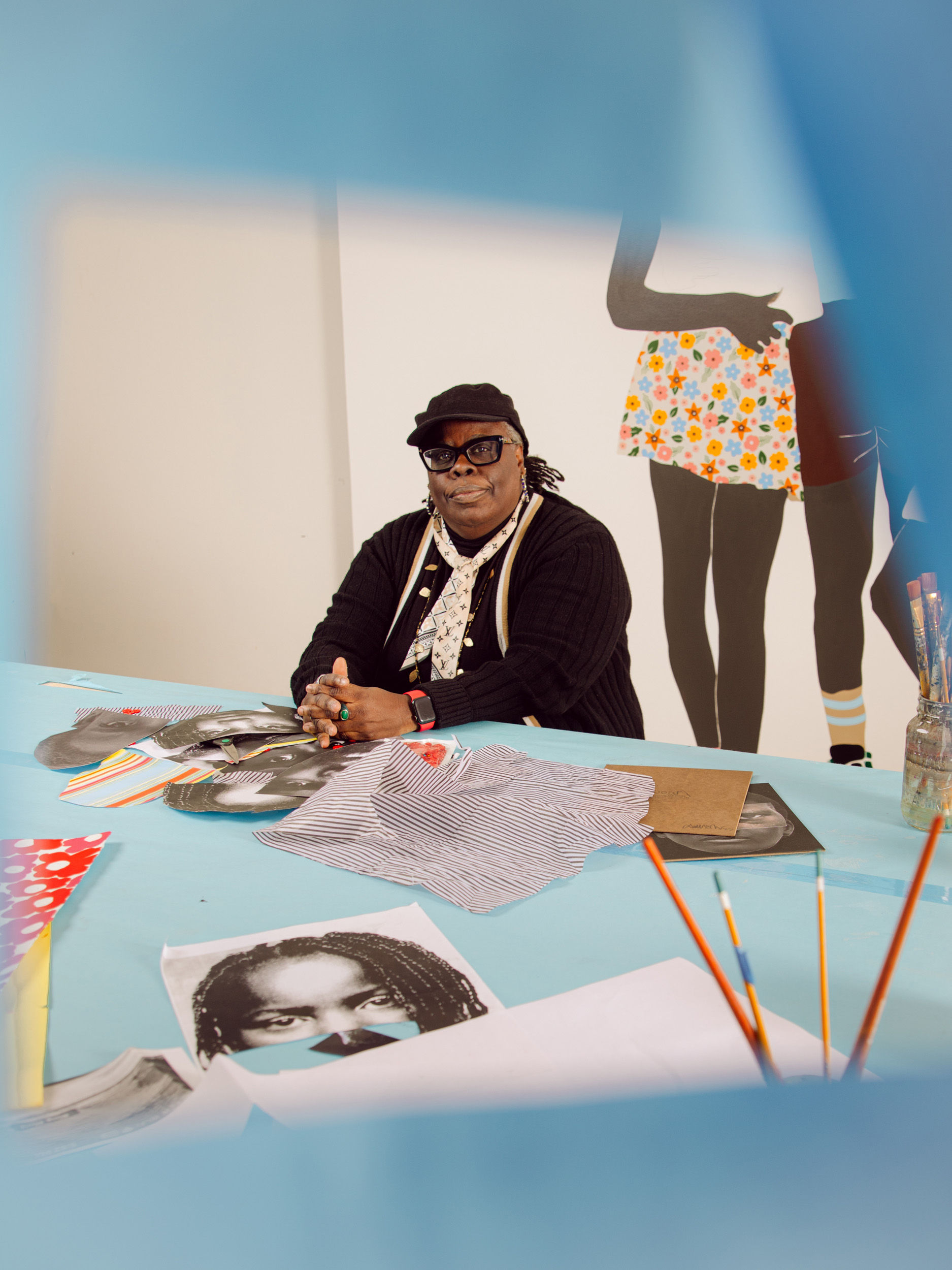
AT WORK WITH: Deborah ROBERTS.
- Words Sala Elise Patterson
- Photos Sadie Culberson
THE ARTIST ON PIECING BLACKNESS BACK TOGETHER.
- Words Sala Elise Patterson
- Photos Sadie Culberson
( 1 ) The Points of Light award was established by former President George H. W. Bush in 1989 to recognize American volunteers making an impact in their community. Roberts received her award for her work with young artists.
( 2 ) There is a particular significance to challenging beauty standards through art. For centuries, Western art has reflected and defined the conventional ideas around beauty, most notably in the depiction of classical figures like Venus. While preference for some factors like body shape has changed over time, one constant has been the whiteness of the figure.
Deborah Roberts talks quickly. Words come rapid-fire, keeping pace with a mind primed by keen observations and deep feelings. The 61-year-old artist doesn’t seem to be agnostic about anything, least of all questions of race and beauty in America. As an African American woman, she knows intimately how racist constructs of beauty play out in a country that “dismantles, marginalizes and regulates” Black people. At times, the experience consumes her: “It’s hard to get the anger and hurt out of your body.”
These are the themes that dominate Roberts’ art, and they become the focus of our conversation one February morning in her hometown of Austin, Texas, where she continues to live and work. Her vibrant multimedia practice, which is now entering its fourth decade, has earned her the Presidential Point of Light award,1 exhibitions on both sides of the Atlantic and entry into the collections of the Whitney Museum of American Art in New York and the Los Angeles County Museum of Art. Critics point to how her deceptively playful work manages to tackle complex issues, like the psychological toll of being othered, diminished and ignored because of your race and gender.
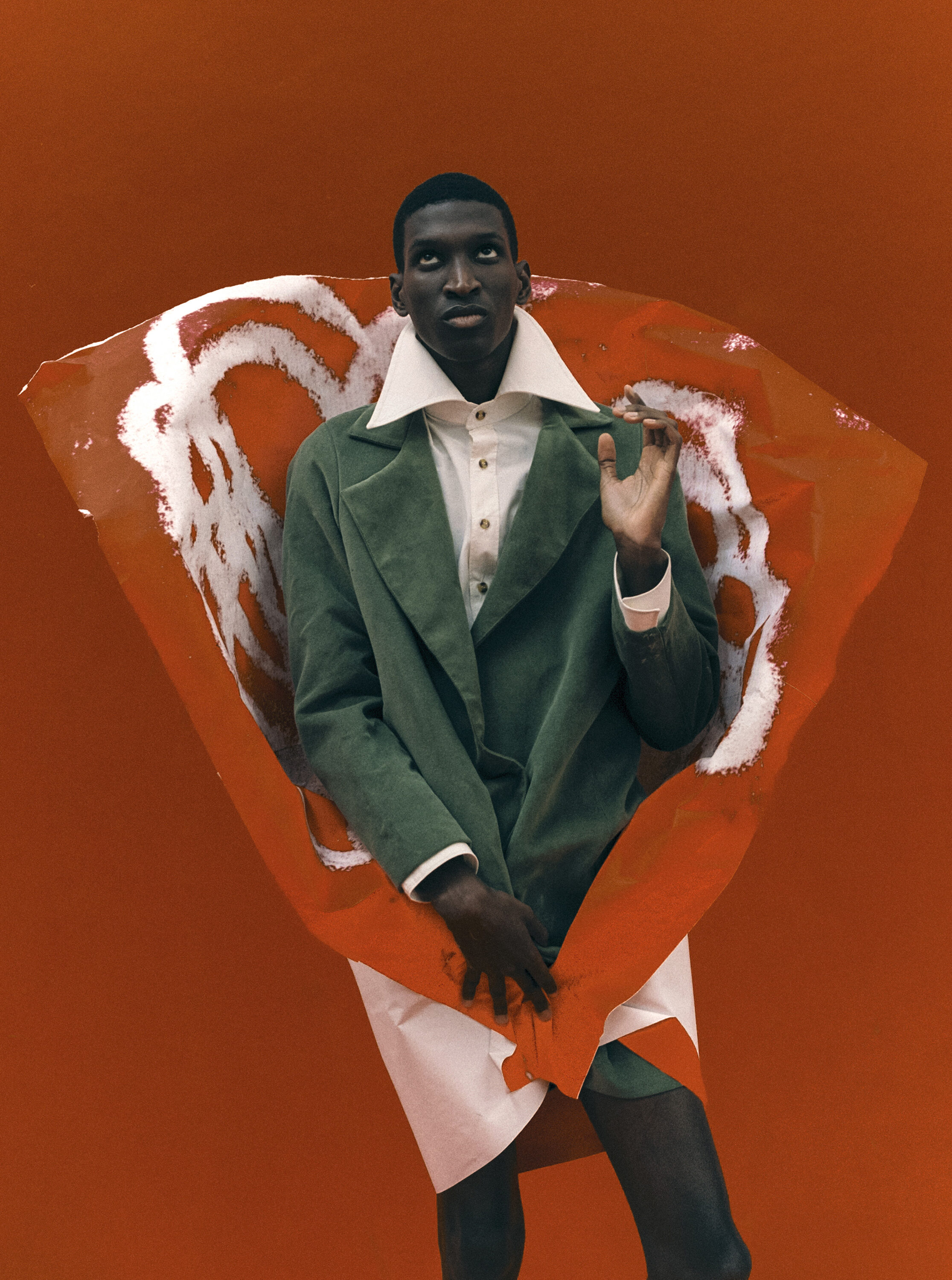
Roberts has produced both figurative and abstract work in her long career, but she is best known for surreal photocollages of Black children that combine painting, drawing and photographs, some found and some manipulated. These “collaged portraits,” which have become the main focus of her practice in recent years, aim to deconstruct conventional beauty standards.2 The very features we are told make Black people unattractive—full lips, dark skin, kinky hair—are exaggerated and repeated, and the children are presented as proud and defiant, as they levitate against infinite white backgrounds.
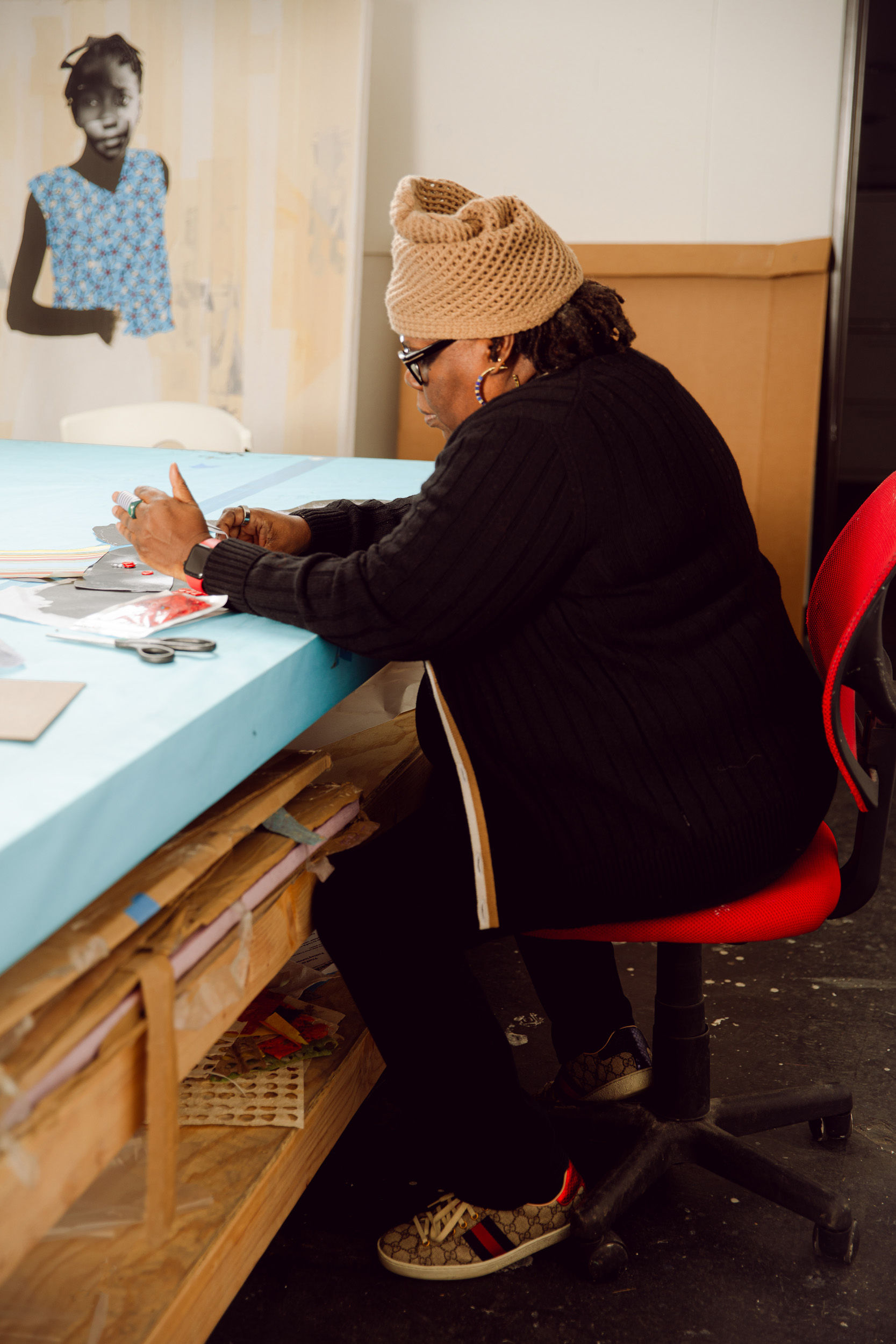
Her art, like the issues it confronts, consumes Roberts, which is why she is grateful that her studio is a 15-minute drive from her home—“otherwise, I would never be out of [there], and that’s not good.” It’s located in two white-walled, cement-floored, windowless rooms of a former bakery carpeted with discarded scraps of images. “As kids, we would come through the same door I walk through each day and watch as they twisted the dough and put it in the oven,” she recalls. “When it came out, we would get a big slice of bread with butter and go sit under a tree out back and eat.”
Over the years, Roberts has finessed the process in her studio. She works on four pieces at a time, Monday through Saturday, assisted by two student artists from a local university. Roberts does all of the collaging and the painting of nails and hands. The assistants do what she calls the flat painting. “The first thing I tell my assistants to do is the color that makes the skin. I come in, and the canvas is white with black skin on everything. No faces, no nothing. And then I start collaging in the faces,” she says.
( 1 ) The Points of Light award was established by former President George H. W. Bush in 1989 to recognize American volunteers making an impact in their community. Roberts received her award for her work with young artists.
( 2 ) There is a particular significance to challenging beauty standards through art. For centuries, Western art has reflected and defined the conventional ideas around beauty, most notably in the depiction of classical figures like Venus. While preference for some factors like body shape has changed over time, one constant has been the whiteness of the figure.




( 3 ) At this time, Roberts sold her work alongside other Black artists at an art shop and framing service she ran for a decade in the suburbs of Austin. When she was forced to close the shop in the late 1990s, she supported herself through odd jobs in supermarkets, shoe stores and working as a freelance illustrator.
When Roberts leaves the studio in the early afternoon, her assistants press on and at the end of the day send her pictures, so she can see how the works have progressed. “That way, I already have an idea how I’m going to move the next day. I like that because it cuts down time. It’s only in the last three years that I can walk into a room and get right to work.”
Roberts grew up with seven siblings on Austin’s East Side. She credits a high school art teacher with recognizing and feeding her talent and determination. “She told me I had to be a well-rounded artist. She taught me how to do pen-and-ink, watercolor, oil paint. You had to be good at everything,” she remembers.
At first, Roberts began painting what she calls the Black Romantic: “Little kids and flower beds and old ladies walking to church and choirs—the Black Americana that I grew up with.3 I thought Black people were the most beautiful people in the world, especially women in a church. They weren’t on magazine covers, but they were the ones who fed families, who went to church on Sunday, who wore clean clothes, who sang beautifully. The people you were in awe of. So that was my notion of beauty, until I grew up and started seeing what the world thought was beautiful.”
“That was my notion of beauty, until I grew up and started seeing what the world thought was beautiful.”
Roberts came to find that her figurative work failed to fully address that painful realization. A new approach, she explains, led to a lot of very bad work. But it was also around this time that she began to explore the politics and history of the Black experience in America and, while pursuing an MFA at Syracuse University in 2014, encountered the ideas of scholars like civil rights attorney Michelle Alexander and the philosophers Frantz Fanon and Judith Butler. She began thinking more about how society comes to view some lives as less valuable than others, and witnessed “the work starting to function differently, in pieces and parts, not even in a way that I understood… And once that door was fully opened, the work demanded more scholarship, time and attention,” she adds.
That intellectual shift pushed her toward installation and text-based work. In one mixed-media piece, What if?, she wrote out the names of 400 Black women who had gone missing between 2016 and 2020. She used brown felt for the lettering to recall their hair and skin: “All these things that say, ‘We exist, We’re human.’” She found it was refreshing to talk about the Black body without having to rely on imagery but, as her life got busier (she had six shows between 2021 and 2022), she realized that it was difficult to continue to make these works. “Text only works if my life is quiet. And my life is not quiet anymore.”
( 3 ) At this time, Roberts sold her work alongside other Black artists at an art shop and framing service she ran for a decade in the suburbs of Austin. When she was forced to close the shop in the late 1990s, she supported herself through odd jobs in supermarkets, shoe stores and working as a freelance illustrator.

Roberts is now thinking about moving into sculpture, but collage is still the place she chooses to work through the many forms of violence experienced by Black Americans today. “It’s important to create pathways to talk about Blackness so people can see us as a whole human,” she says. “There’s so much involved in the Black body and diaspora. I don’t want to just talk about Blackness one way. It’s not one thing. It has never been.”

Her work is a visceral response to the distortion and perversion of the vulnerability, resilience, dignity and beauty that she cherishes about the Black experience. It’s a way to process the anger she feels when she hears, for example, of a friend’s child being called the N-word for the first time; or if she sees a news story about a young Black child being murdered by the police; or even a viral moment like the 2004 brawl at an NBA game. “Sometimes I build a monstrous face of a child and come in the next day and destroy it. Or maybe I let it stay, if I’m in my anger and in my hurt about what has happened. But that work never, ever goes into the world.”
It is a sort of exorcism by way of momentary surrender to the trauma of racism; as if to find her way back to the beauty, she has to fill a canvas with the most horrific stereotypes of Black people. It reminds her of the absurdity of those stereotypes and affirms her choice to challenge them. Roberts might find an endless source of material to respond to in America, but she does so with a tenacity and faith in the power of art to present a different, more hopeful narrative.


