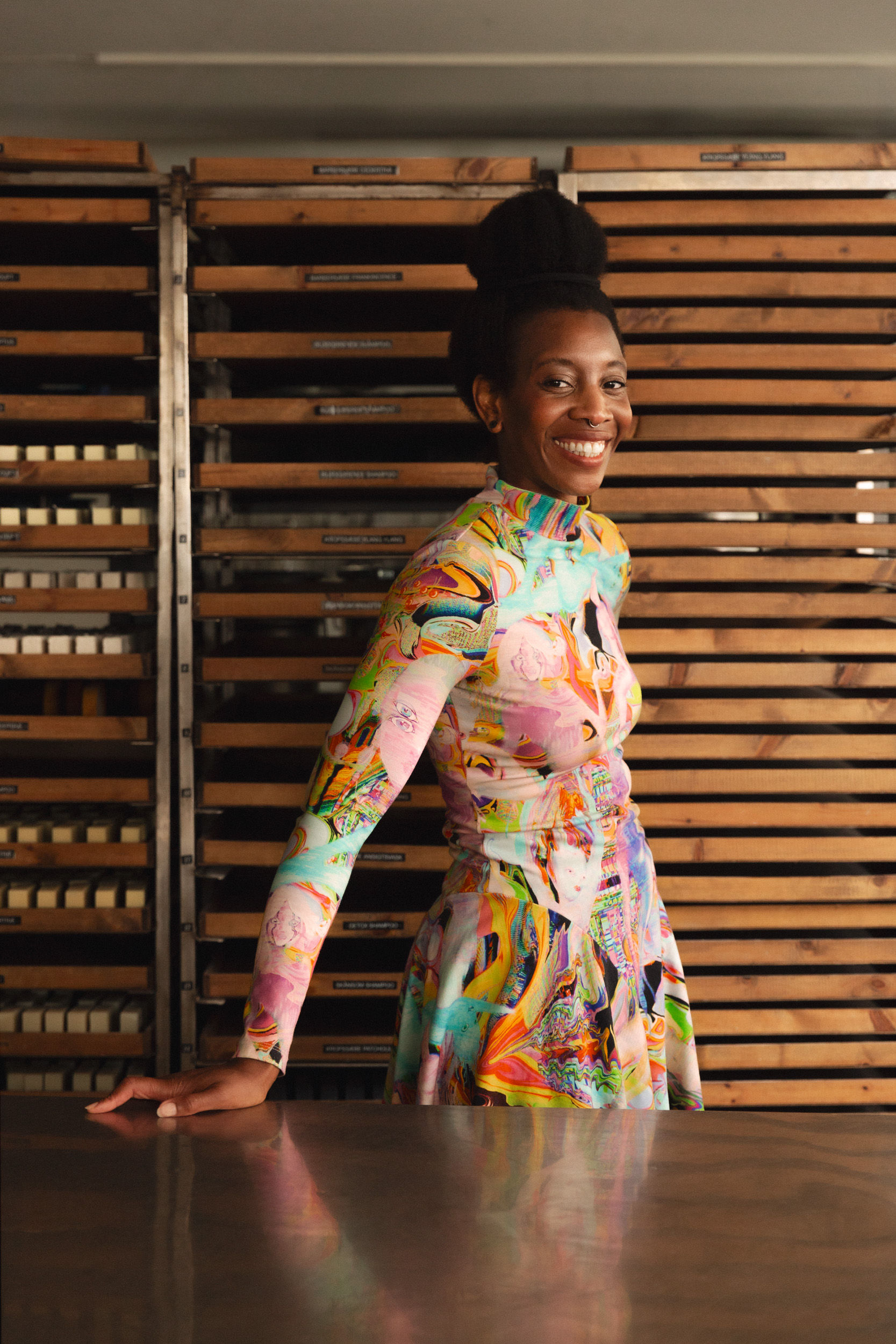
Degrowth: IsangsSundra Essien on slow growth as a winning strategy.
Degrowth: IsangsSundra Essien on slow growth as a winning strategy.
What does it mean to build a business without chasing growth? For Sundra Essien, founder of Copenhagen-based hair- and body-care company Isangs, the answer lies in redefining the meaning of success. Her shop runs on principles of degrowth: no advertising, no plans to scale up and physical limits built into production. Instead of expansion, she prizes relationships, craft and impact.
Benjamin Dane: The idea of degrowth sounds appealing in theory, but how does it work in practice?
Sundra Essien: That’s the question, right? I’ve had this conversation for years. The response is always the same: nice idea, doesn’t work. So, part of this is just my stubborn way of saying—Well, I’ll show you. And really, it’s not that radical. Most of human history has been slow-growth or no-growth: local bakers, cobblers, small shops that never franchise. Degrowth for me is simply designing limits into the business—working at a scale that is sustainable, not chasing expansion for its own sake.
BD: How did your background shape the choice to start Isangs on these principles?
SE: I studied business, then law, worked as a corporate lawyer, moved into human rights, spent time on a permaculture research farm in Belize and taught at Copenhagen Business School. But I wanted something more tangible. I’ve always loved chemistry—my mom was a chemistry teacher—and hair and body care touches everyone. It’s an interesting way to introduce ideas like overconsumption and supply-chain issues through a familiar product. People don’t expect to have a discussion around degrowth in a soap shop, and that disarms them in a positive way.
BD: If not by revenue or expansion, how do you measure success?
SE: You could call it qualitative growth instead of quantitative growth. We’re growing in our relationships, knowledge, craft; in how we spread information. It doesn’t translate into bigger profits or larger spaces, but into better processes and richer conversations. We deprogram consumers one person at a time—because we’ve all been trained to always want more. If someone comes in and already has a product at home, we’ll tell them: Use that first.
BD: How do you handle demand if more people want your products?
SE: We’ve built slow growth into everything. Production is limited to the shop. Soap is handmade and cured for weeks, so capacity is capped. We don’t advertise; it’s all word of mouth. Employees aren’t trained to push sales but to build relationships. We also rarely release new products—we’ve been selling the same deodorant for seven years.
BD: To what extent do you see Isangs as an experiment?
SE: Very much so. It’s an experiment and a playground. When people say it can’t work, this is how we show them it can. Sometimes experiments fail but that’s part of it. Most businesses fail, growth-centered or not. You have to be naive enough to believe you’ll make it, but realistic enough to know failure is always possible.
BD: If you did face failure, would you ever compromise by scaling up to increase income?
SE: No. Growth doesn’t necessarily solve problems—it often creates new ones. Expanding means more expenses, more entanglements. I prefer subtraction over addition: reducing costs and complexity instead of chasing more money.
BD: How has running Isangs for more than a decade changed your ideas of wealth and value?
SE: It’s been a feedback loop. My parents both grew up poor—in Texas and in Nigeria—but chose to live within their means. I carried that into the business, and the business feeds it back to me. When people tell me something resonated, when we spend an hour with a customer, laugh or cry with them—that’s real value. Growth would actually prevent those moments. For me, success is building a life and a business small enough to sustain.