• Words John Ovans
  • Photography Alixe Lay

Home Tour:
GERGEI ERDEI

  • Words John Ovans
  • Photography Alixe Lay

This terra-cotta urn was made in collaboration with ceramicist Giuseppe Parrinello.

Inside the London apartment uniting Greek mythology, medieval iconography and 1970s glamour.

Lamb’s Conduit Street is fiercely protective of its independence. The partly pedestrianized street in London’s Bloomsbury is lined with characterful Georgian buildings home to independent boutiques and restaurants; when Starbucks tried to open, residents blocked the move. Charles Dickens was once a local, and W. B. Yeats attended séances here. The area also inspired the setting for Virginia Woolf’s Jacob’s Room. 

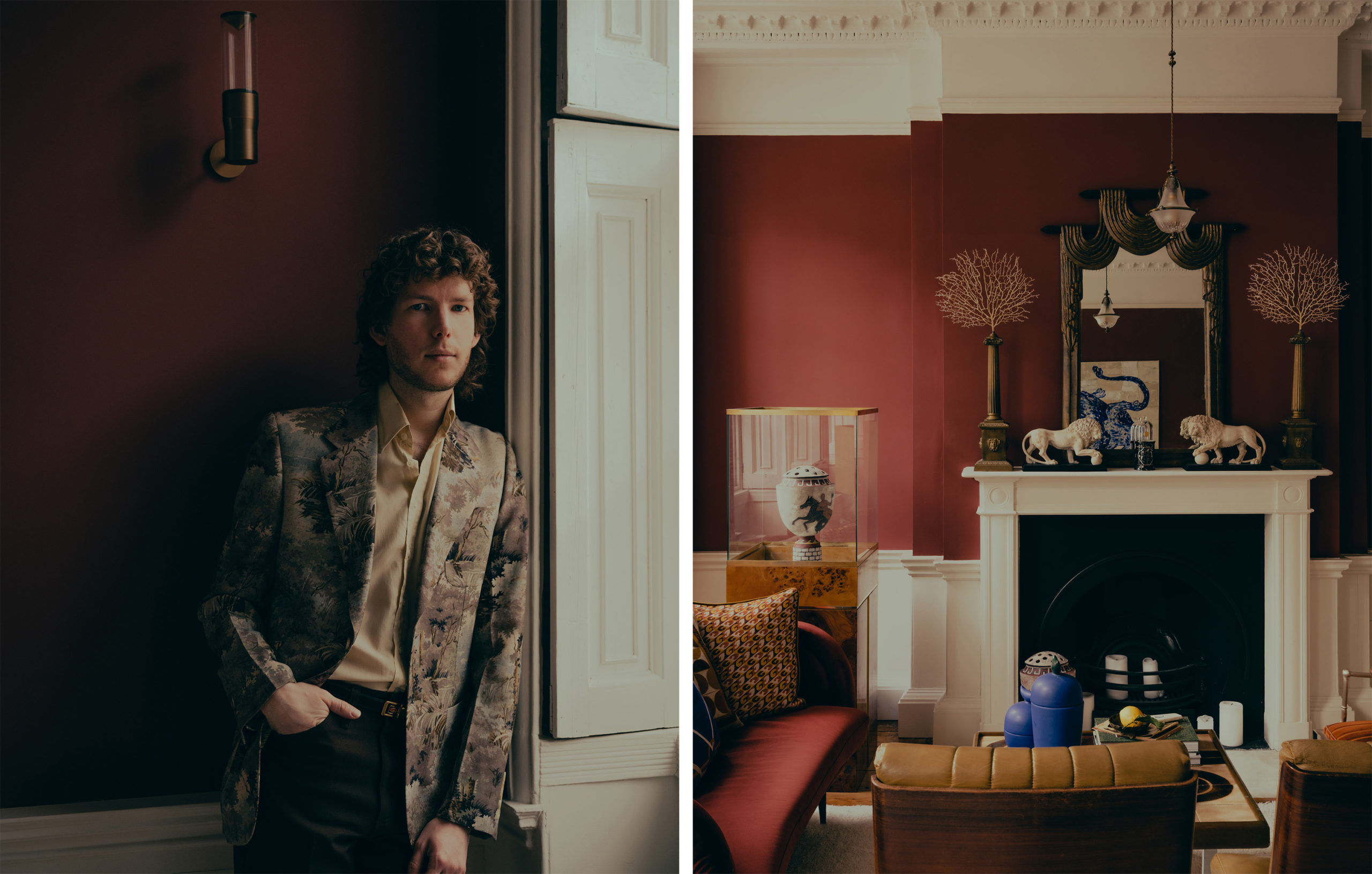
Another storyteller who has made his home here is Gergei Erdei, the former Gucci designer whose eponymous interiors brand was founded in 2019 and is now stocked by retailers including Matches and Selfridges. His wildly adorned homeware draws from an endlessly intriguing pool of references, from medieval creatures and Greek mythology to zodiacs and celestial patterns. One placemat features a Roman dog, lazily stretching within a border of bursting blue sunrays, while his cushions feature prints of marble floors from ancient Pompeii. His current collection was inspired by the bold geometric prints of designers like David Hicks and André Arbus. Like a good story you want to hear again and again, his work is warm, lived-in and more than a little eclectic. 

Erdei’s home fits the same description. The apartment is situated in exactly the kind of building he dreamed of living in when he was growing up in his native Hungary: an early 18th-century townhouse with enormous windows and high ceilings. Deep terra-cotta walls provide an unassuming backdrop for his unusual furnishings: an ’80s chair in polished nickel replete with horned ram motifs; an energetic painting of leopards brawling—painted by Erdei and inspired by a Roman mosaic; a vast antique display cabinet. But his apartment is not quite the overstuffed maximalist explosion you might expect as an extension of his products, which he explains was a conscious decision to keep the mood a bit calmer for the occasions that he works here. Having only moved in six months ago, he acknowledges that he’s “missing all those items that have memories connected to them. Bits that make a home a home, so that’s the next step.”

This reverence for the imagination is shared by several other young interior designers who have moved to the UK from overseas. There’s the colorful, entertaining aesthetic of Swedish decorator Beata Heuman, and the sumptuous, decorative patterns and prints of Milan-born Martina Mondadori Sartogo. If Britain is a nation known for its eccentricity, then it’s no surprise that it should be a home—both spiritually and literally—to like-minded designers, each with their own take on modern maximalism. And it can be no coincidence that the rise of this aesthetic has come during the sensory deprivation of the pandemic, when our homes became our whole worlds.

“I feel British people are curious and not scared to experiment, therefore British-based designers are also braver because they have an open-minded audience,” says Erdei, who first moved to London for his master’s in womenswear at the London College of Fashion before accepting the role at Gucci. “If we look back to the interiors of British stately homes we can see how eccentrically they are filled with mix-and-match objects—from Grand Tour souvenirs through to chinoiserie collectibles,” he says. “But we don’t even have to think about anything opulent. We can just think about the average British home in the ’50s when the crazy floral wallpapers were big and they sometimes paired them with patterned carpets. There was a lot going on.” 

The current trend for maximalism is sometimes dubbed “cluttercore,” although this is misleading given that—done “right”—it converges with minimalism at the point of careful curation. Detail is important to Erdei—right down to the literal cherry on top. “The photo shoot we did for [the most recent] collection, I wanted to go towards a jet-set lifestyle in Palm Beach in the ’60s and ’70s. . . . I was searching for this cocktail cherry that is a typical element of a ’60s motel buffet dinner,” he says. “Usually when I design, it’s almost like creating a film set. I’m listening to the right music that puts me in the mood; I’m trying to imagine a full interior but also the people who live there—what they are wearing, what kind of life they have. It’s nailing those references.”

This attention to the small details has always made all the difference to Erdei; for him, it’s essential to making a home. “Your home is there when you wake up and start your day, it obviously matters—like what sort of plates you’re eating from. When I was a student I couldn’t afford nice things. And it was such a pain for me to eat from plain horrible IKEA plates. I went to vintage markets and grabbed some £1 plates with big pink roses. What you surround yourself with is so important because it reflects on your mood.”

The storage boxes in Erdei's apartment are marbled, in keeping with the theme of antiquity.

Erdei hopes that his home will eventually become a shoppable showroom.

Erdei incorporates antiques into his own home—and often borrows objects to help style his collections.

( 1 ) Conran sold the contents of his six-bedroom apartment inside New Wardour Castle in 2021, explaining that he traveled too much to make good use of it.

The idea that your home should be deeply personal, as opposed to a white orderly cube, remains at the heart of Erdei’s brand. “It’s interesting to know the person behind the product, their visual development, everything that they’ve gone through. Now when there are so many brands without any story, or any designers behind them, just products, products, products, I think it’s really nice to have something a bit unique, and more personal.” 

Eventually, he would like to take the relationship with his customers even further with a new platform on his site that allows them to “shop” his home for curated pieces. Throughout our conversation, Erdei rattles off the names of the many vintage and antique markets at which he is a regular magpie, and it’s quite apparent he loves the hunt. There’s another advantage as well: “I don’t like to get bored by objects, so I like to have things going out and coming in.” He references designer Jasper Conran, who recently emptied his grand estate via auction.1 Bidders were able to see photos of some 430-plus objects in situ and take a virtual tour of Christie’s King Street gallery, styled by Conran himself. “You could see all these pieces that he had collected throughout his life and how the objects were styled in his home,” says Erdei. “It’s even more personal when it’s coming from a space that is closer to everyday life, or an actual home.” Beyond that, he’d like to open a boutique hotel: a whole lifestyle captured in one building. 

Erdei feels that as a designer you should “put yourself into every small part” of a project. “You should really tell a story with everything.” If his first home is anything to go by, his own unfurling story will be ambitious, unusual and never dull.  

( 1 ) Conran sold the contents of his six-bedroom apartment inside New Wardour Castle in 2021, explaining that he traveled too much to make good use of it.

FREE PREVIEW

Take a look inside Issue Sixty

You are reading a complimentary story from Issue 44

Want to enjoy full access? Subscribe Now

Subscribe Discover unlimited access to Kinfolk

  • Four print issues of Kinfolk magazine per year, delivered to your door, with twelve-months’ access to the entire Kinfolk.com archive and all web exclusives.

  • Receive twelve-months of all access to the entire Kinfolk.com archive and all web exclusives.

Learn More

Already a Subscriber? Login

Your cart is empty

Your Cart (0)