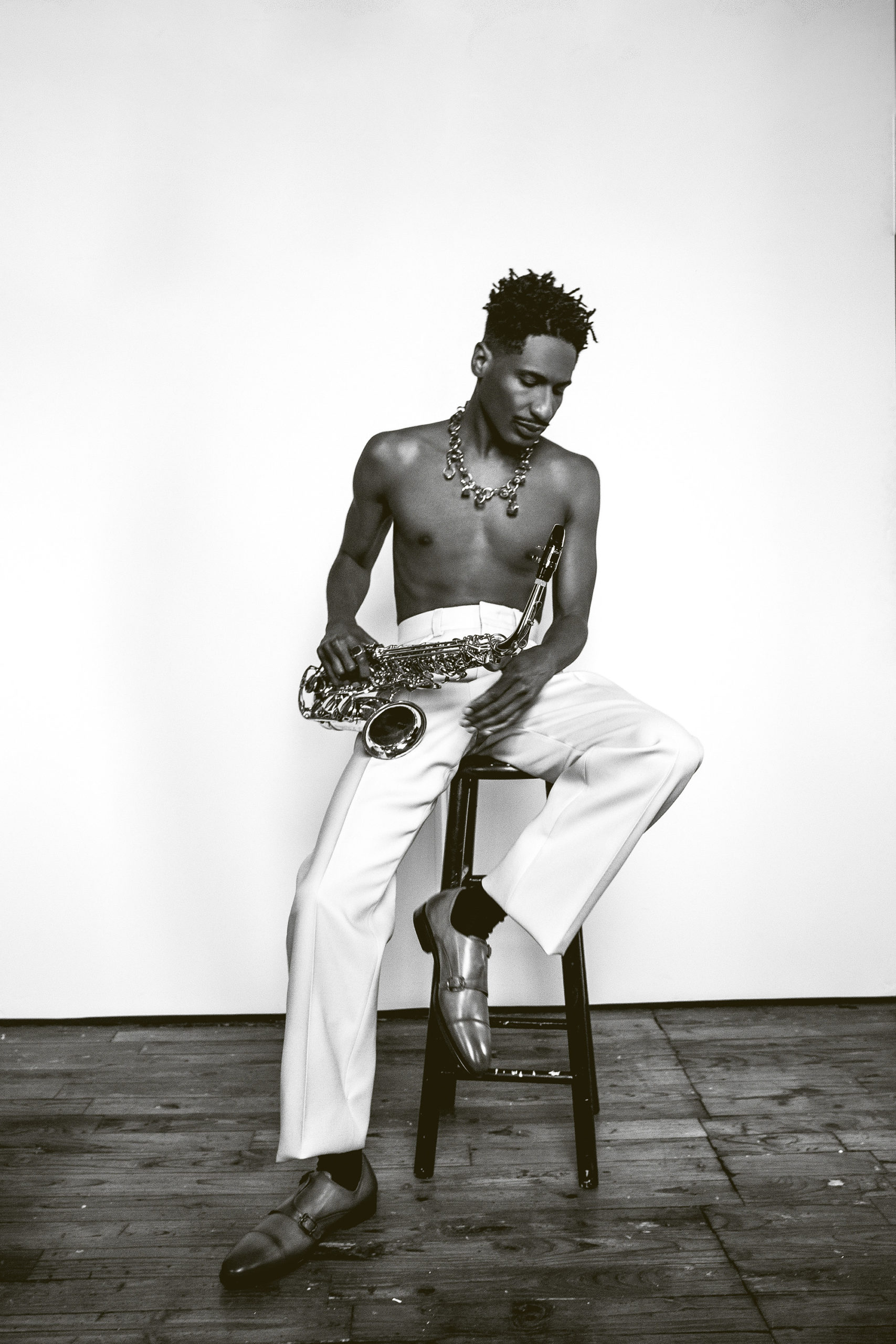
Alongside his many other pursuits, Batiste is co-artistic director of the National Jazz Museum in Harlem and has been actively involved in the museum’s programming since 2009.

Jon BatisteThe band leader on his genre-busting year.

Jon BatisteThe band leader on his genre-busting year.

  • Words Charles Shafaieh
  • Photography Justin French

( 1 ) Batiste comes from a New Orleans musical dynasty. His father, Michael, was a bassist who performed with Jackie Wilson and Isaac Hayes.

( 2 ) According to Pete Docter, who co-directed Soul, Batiste created his jazz compositions for the movie to be “user-friendly,” so that “people who aren’t jazz fans will still appreciate and be moved by the music.”

Jon Batiste’s fifth studio album, We Are, is by turns jubilant and tender. The same description applies to the musician himself, who speaks with strangers as if they were longtime friends and often breaks into song without prompting. The 34-year-old son of a storied New Orleans music family has many reasons for joy of late.1 Best known as the band leader for The Late Show with Stephen Colbert, he recently attracted a younger audience with Pixar’s animated hit Soul, whose jazz pianist protagonist’s fingers are modeled on his own. Just days before our interview, he, along with co-composers Trent Reznor and Atticus Ross, won an Academy Award for their score for the film. Batiste doesn’t restrict his talents to the screen, the studio or the concert hall however. Music, he believes, belongs in the street, which he demonstrates in “love riots”—at once public parades and spontaneous social interventions that occur as finales to his performances or whenever he and his friends feel compelled to meet and play. In June 2020, thousands followed him across New York City in marches supporting Black Lives Matter, as those with instruments created an ecstatic soundscape of spiritual and emancipatory anthems. 

CHARLES SHAFAIEH: We Are continues your established practice of breaking apart genres. Why is eliminating these market-imposed categories vital to you?

JON BATISTE: There are no different forms of music. There’s only music. For this album, the first thing we did in the studio with the band was record the Justin Bieber song “Let Me Love You.” I like the song, but it was also to get us outside the box of thinking about making music together, the way we’re used to and the way that people expect.As an artist, you always want to push yourself to find new territories. That’s why I’m against genres. They limit artistic expression, thus they limit human expression. And if you limit the expression of the artist, then it no longer becomes art. It becomes a form of virtue signaling for a lifestyle or a brand—something that eats itself.

CS: Does taking music out into the streets also redefine the concert experience?

JB: The rawest form of music was on display for centuries before it was a commodity. We need to get back to that because there’s a lot of wisdom, joy and truth in music exchange and in using music as something that connects people to the past as well as preserves history for the future. Playing in the street is one way to open people up to music in its rawest form and see it in action. I call that social music. New Orleans is one of the few places in the world where there is still social music. There’s music for when someone passes away, for almost every different occasion within a community. It’s not a thing that most people consider a normal part of life beyond entertainment value. It’s few and far between—in Cuba, Brazil and different parts of the [American] South.

CS: You’ve brought social music to New York City, beginning when, at Juilliard, you performed in the subway with your band, Stay Human. Are subway crowds a distinctive audience? 

JB: At college, I’ve had really varied performance experiences: playing with jazz greats Roy Hargrove, Abbey Lincoln and Wynton Marsalis, and with Lenny Kravitz and Prince; recording an album with Chad Smith and Bill Laswell; and these subway hits. Everything fed into everything else, and I noticed more what connects every aspect of performance, not the differences. At every performance, people at a certain point collectively decide whether to be open or closed to an experience. In the subway, they’re not expecting the experience. At an arena, there’s great anticipation. At a jazz venue, there’s a certain type of listening. The connectivity of all these things is that everybody gets on a wavelength—or they don’t. In the subway, what’s special is that you get people who are not expecting to be on the same wavelength to resonate on the same frequency. It feels like you’ve transmuted the energy in a space. A lot of the time New Yorkers dread being there, and then, all of a sudden, it’s a party, a jovial atmosphere, a space where there’s community and social engagement.

CS: Your work also collapses time and space. It’s a processional of sorts, in which you evoke composers and artists who have left us and call into the future to those not yet born.

JB: The greatest power of music is time travel. There’s not a way of doing that in many other art forms as immediately as in music. Imagine if you take Bach’s influence and bind it with someone who wasn’t around in his time, like Kendrick Lamar or Ali Farka Touré. What other art form can do that with such immediacy and impact? That’s what the greatest artists have done—channel people who came before them while doing something new in the present which will then inspire generations to come. That’s the definition of a musical icon. Music as an art form is endless and an opportunity to mine the collective human consciousness without losing your own unique perspective on it. 

CS: That interplay between the group and the individual seems like a jazz sensibility—respecting the group but celebrating the independent voice.

JB: Jazz is an example of how the individual voice can be just as important as the democratic group function, how co-creation can be just as important as individuality. Like what we struggle with in democracy, it’s about individual freedoms, freedom of speech, but also constant compromise and collective bargaining to coexist peacefully. It’s a paradox of objectives. Jazz is not really a form of music. It’s a philosophy tied to a sociocultural phenomenon. Jazz hands, finger snaps, cool clubs—that’s poor marketing of what jazz is. It has such deep roots in the Black experience and in slavery, the original sin of America. It takes different forms of culture from around the globe and incorporates them into the experience, which is the most quintessentially American anything can be. It’s an art form that, for the first time in history, is based in the past and the present, and it’s the most modern form of creating the future because it’s happening every second as you watch and listen to it, right in front of you. 

Listen to Duke Ellington’s “Diminuendo and Crescendo in Blue” and Paul Gonsalves on tenor saxophone playing a 27-chorus solo. You can hear in the recording that wasn’t set up to be 27 choruses long. It’s just that the audience kept shouting, and he kept going higher and higher. It became this feedback loop of energy. This is a piece that is very through-composed, but there’s this section that allows for this engagement with the audience. That’s one of the great innovations of jazz. You allow for the audience to be a part of the experience.2 

CS: The audience can propel you to unexpected places of discovery. What do you feel is pushing into your consciousness right now, about which you’re hungry to know more?

JB: I find it’s most illuminating to determine your course of study based on extremes. That will help you make connections to disparate things, which are, to me, the lifeblood of the artist. If you can find a way to connect being an auto mechanic with writing a song, or the hierarchy of the military to watercolors, that’s exciting. It opens up new ways of thinking about what it is that you do. I’m always inspired at the end of that process.

( 1 ) Batiste comes from a New Orleans musical dynasty. His father, Michael, was a bassist who performed with Jackie Wilson and Isaac Hayes.

( 2 ) According to Pete Docter, who co-directed Soul, Batiste created his jazz compositions for the movie to be “user-friendly,” so that “people who aren’t jazz fans will still appreciate and be moved by the music.”

FREE PREVIEW

Take a look inside Issue Sixty

You are reading a complimentary story from Issue 41

Want to enjoy full access? Subscribe Now

Subscribe Discover unlimited access to Kinfolk

  • Four print issues of Kinfolk magazine per year, delivered to your door, with twelve-months’ access to the entire Kinfolk.com archive and all web exclusives.

  • Receive twelve-months of all access to the entire Kinfolk.com archive and all web exclusives.

Learn More

Already a Subscriber? Login

Your cart is empty

Your Cart (0)