Katie Paterson The artist making work for other planets.
Katie Paterson The artist making work for other planets.
( 1 ) In her ongoing project The Dying Star Letters, Paterson receives notifications from astronomical institutes each time a star explodes and writes a condolence letter to mark its passing. She issues between three and 150 such letters every week.
( 2 ) Ocean Vuong told The Guardian that he wanted to participate because “so much of publishing is about seeing your name in the world, but this is the opposite, putting the future ghost of you forward.”
Katie Paterson’s garage contains moon dust. It’s stored alongside offcuts from a mammoth’s thighbone and a collection of wood samples from 10,000 different trees, each acquired in the name of art. In her work, Paterson poses searching existential questions in the form of poetic acts, whether that be setting up a live phone line to a melting glacier, sending a meteorite back into space or bouncing a recording of Beethoven’s Moonlight Sonata off the surface of the moon. These artworks bring the cosmos down to scale, cutting through the detritus of daily life to reawaken a wide-eyed wonder at the universe and our place within it.
Paterson’s work has been exhibited at London’s Tate Britain, New York’s Guggenheim Museum and the Scottish National Gallery of Modern Art. Her best-known project, Future Library, invites writers to submit original work that will remain unread until the year 2114, when a forest planted in 2014 in Norway will be fully grown to supply paper for the texts. So far she has solicited manuscripts from Margaret Atwood, Karl Ove Knausgård and Ocean Vuong. Paterson lives in a village outside Edinburgh, Scotland, with her partner and son.
TOM FABER: You don’t come from a scientific background, yet much of your work revolves around astrophysics and geology. Where did this interest come from?
KATIE PATERSON: It crept up on me later in life. After my first degree at art school, I took off to live in Iceland for eight months. I worked at a hotel in a remote hamlet with just a fish factory, a petrol station, and nothing for miles around. It was summer, so there were 24 hours of daylight, and I started to tune into the wider sky, the wider universe. For the first time I saw the moon properly. It was life-changing. A lot of my artwork has come from that short moment in time.
TF: How did you start working with scientists?
KP: When I was at university I was trying to make art from Icelandic glacier ice and I wandered into the physics lab where they let me use their walk-in freezers. At first I was terrified of how they would perceive me, some straggly arts student coming in with a mad experiment, but actually they were always really welcoming.
TF: Scientists often put a lot of time and experimentation into your work. What do you think they get out of the collaboration?
KP: We give them an opportunity to bring to life some of their research, to show it in a museum and give it a wider audience. Often I’ll ask a crazy question, like whether the European Space Agency can send a meteorite back into space, and they say: “Sure, why not?” This “why not” has kept me going. I think in the sciences there’s less apprehension of risk. In the arts, we have so many deadlines and specifications, but in astrophysics, they’re studying the edges of known space and time. It’s not such a big deal when somebody comes along asking for something unexpected.
TF: Your work has included burying a grain of sand in the Sahara desert and writing condolence letters for dead stars.1 Is the artwork the action itself, or is it communicating that action to an audience?
KP: It’s both. The artworks are like musical scores—they place something in front of the audience, who take it and translate it into something new. If they’re seeking to find out what the meaning is, that’s great. But if they’re just puzzled, or it’s given them a laugh, that’s fine, too.
TF: Often people expect contemporary art to be overly intellectual, or something you need to “get.”
KP: Exactly; that’s the problem. I don’t want people to feel they have to have a background in art history. The best artworks take you somewhere beyond, where there are no answers. In fact, they leave you with a kind of mystery, something you reach for with your intuition rather than your brain.
TF: One of your pieces was a black firework fired into the night sky at an undisclosed location. Another was a note of classical music being beamed under the ocean. These might be observed by nobody. What is art if there’s nobody to witness it?
KP: It’s almost like a Zen koan [riddle] approach to art. Ultimately, that’s what artists do. They put something out there and hope it will have a repercussion.
TF: A lot of your work involves music. How does this overlap with your astronomical interests?
KP: I grew up in a house with a big vinyl collection so there was always music on, and my dad is a musician. Music can shift your atmosphere, taking you to places beyond words. When I beamed a composition to the moon, the signal was reflected back to earth with gaps in it, and that was played by a piano in a gallery. I chose Moonlight Sonata because I wanted to send a song written about the moon, but also because it’s so familiar that people would instantly identify those gaps in the score—the moon’s alterations.
TF: Your work also delves into a sense of deep, geological time. Do these concerns change how you view your own life?
KP: I have a very bad sense of day-to-day time, which makes sense because my work shoots across billions of years. I’m always trying to reconcile with the 24-hour clock, to live with different ideas of time. And now I have a toddler so we have our everyday rituals and routines on top of that.
TF: Has having a child affected how you make art?
KP: Yeah, it’s been an immense journey. He’s three now, and it’s incredible how he responds to things with such immediacy, seeing things almost magically. I particularly love reading children’s stories to him because they use words as straightforwardly as possible. It’s like what I try to achieve in my work, to avoid being convoluted but still have layers. I feel that if I can communicate an artwork easily to children, I’ve done quite well. Having a son has also tuned me into time in a different way. My Future Library project, where writers submit texts which won’t be read for a hundred years, always confronts me with my own mortality.2 But before I was just thinking about my lifetime, and now it’s my son’s. He might be alive to read those texts, even though I’ll be gone.
TF: Is that sad to think about?
KP: It is. I used to take thinking about my death more lightly, but now I think about my son growing up, particularly the age he’ll be when the Future Library is over, probably retired and in his 90s. But considering the environmental crisis now, it’s important to underline that generational interaction. We need to take the focus off of our generation and start considering the generations to come.
TF: What do you think the world will look like in 2114, when the Future Library project ends?
KP: My deep down hope is that the forest itself is almost unchanged. But there’s the alternative version where it’s burned down, or there are insect infestations, or the land becomes flooded. We have to confront these apocalyptic visions in order to stop them from happening. My hope is that when the first reader opens the first page, they’ll be looking back a hundred years and say: Thank goodness, they really took heed and made the changes that needed to happen.
TF: Do you think your art is hopeful?
KP: I think so. My artwork is looking at such big expanses of time, from a hundred years to a billion. It’s trying to situate the human in a wider perspective, amongst other species, to allow us to jump outside of ourselves. Hopefully, it opens us up to the interconnectedness of things.
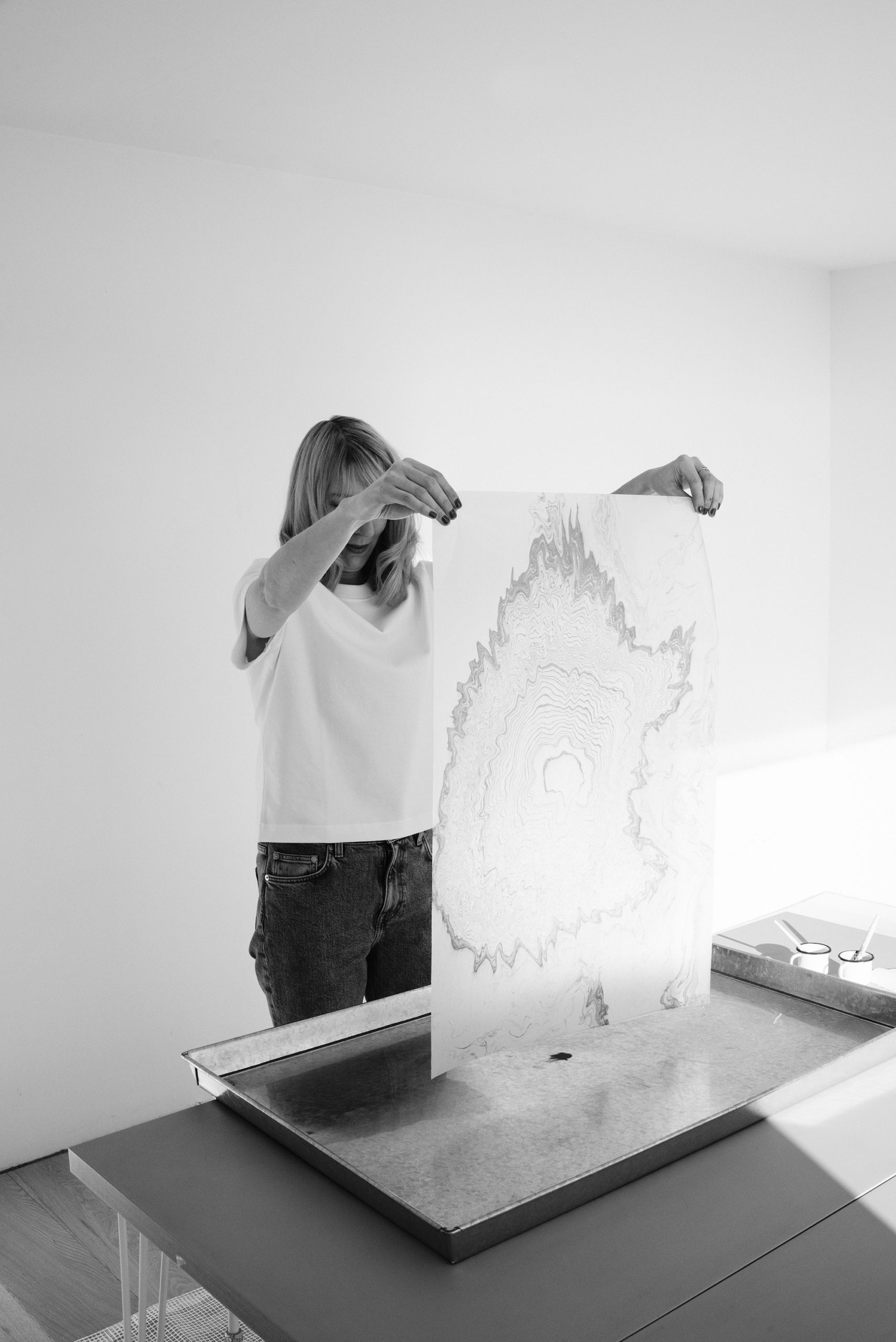
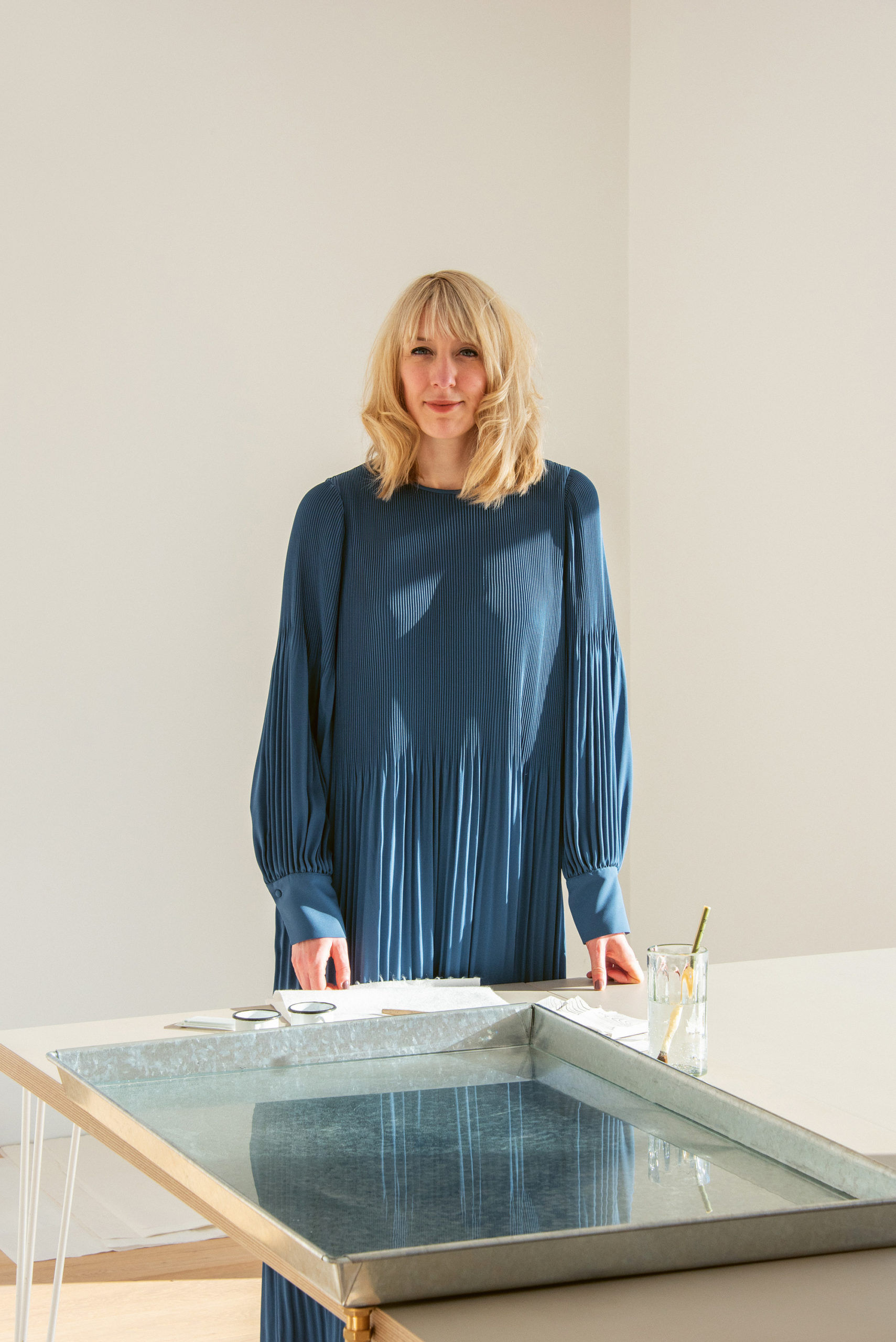
The technique Paterson is using in the image above is called suminagashi, a Japanese marbling technique that translates as “ink floating."
( 1 ) In her ongoing project The Dying Star Letters, Paterson receives notifications from astronomical institutes each time a star explodes and writes a condolence letter to mark its passing. She issues between three and 150 such letters every week.
( 2 ) Ocean Vuong told The Guardian that he wanted to participate because “so much of publishing is about seeing your name in the world, but this is the opposite, putting the future ghost of you forward.”