ORNA GURALNIK

  • Words Rachel Ellison
  • Photos Aaron Kirk

THE STAR OF COUPLES THERAPY ON WHAT BRINGS US TOGETHER AND KEEPS US APART.
Issue 57

, Friendship

,
  • Words Rachel Ellison
  • Photos Aaron Kirk

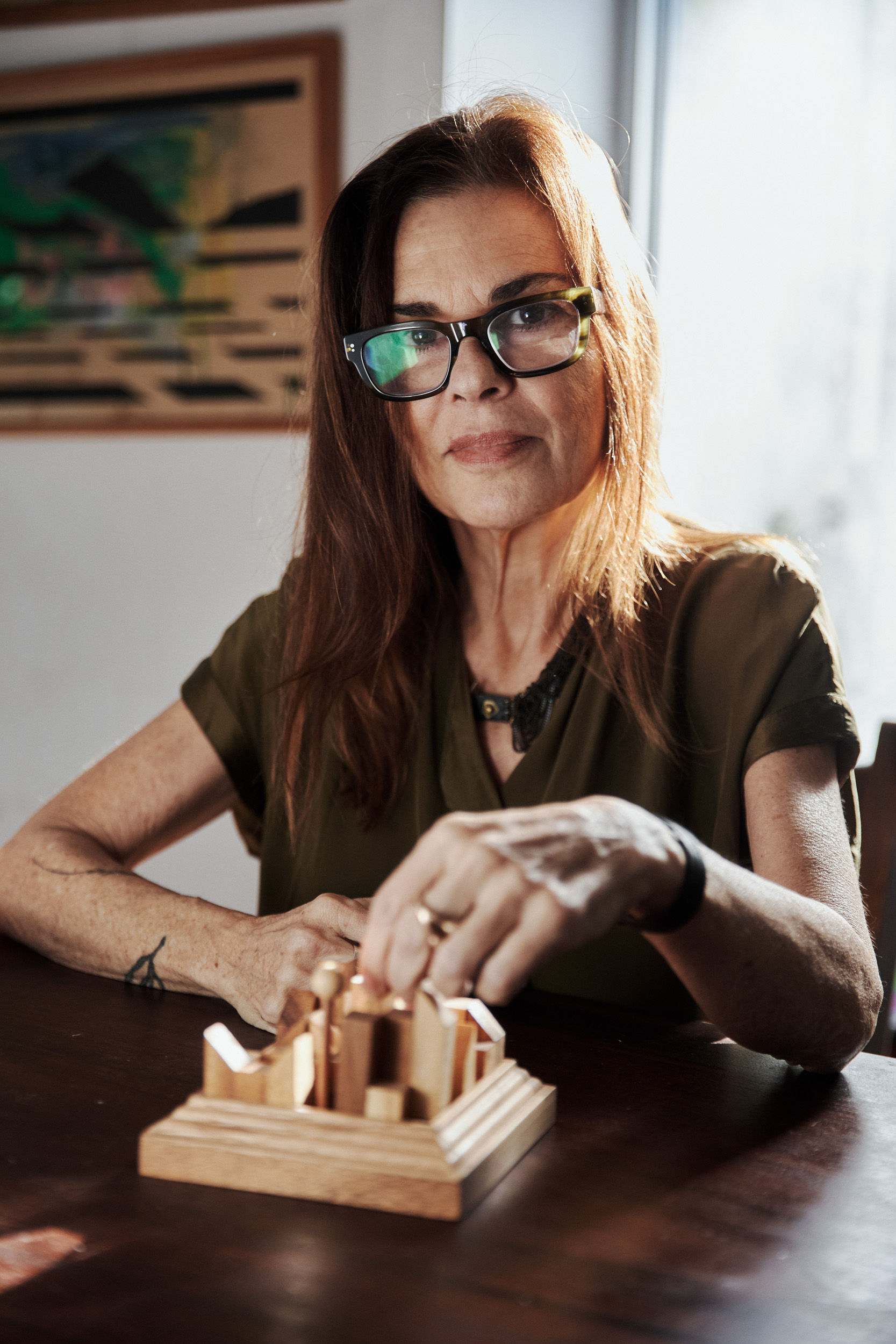
There is something unsettling about Orna Guralnik’s gaze, the way it probes and persists. As the star psychoanalyst of Showtime’s Couples Therapy, a show in which she administers therapy for the world to see, she faces couples on the brink—of divorce, a big decision, a new chapter—and helps them carve out a way forward. “Most couples therapies are around crises and helping unpack a certain pattern; it can become like a vortex,” she says in the season four finale. “I try to figure out what else is there. And that scares people.” 
We meet on a rainy morning in Brooklyn’s Park Slope neighborhood in a tiny café—the same one she goes to every day. Guralnik is trailed by her dog, Nico, and much as you would expect from the show: unbothered, with a gentle assertiveness. She’s friendly but doesn’t engage too deeply in pleasantries. Instead, she orders herself an espresso, asks a young man if she can use the chair beside him, and sits down to answer my questions. 

Guralnik is on the cusp of mainstream recognition and, thanks to Couples Therapy, coming for Esther Perel as the most famous psychoanalyst of our time. The show premiered in 2019 and the producers were smart: The pilot episode of the first season begins in session with Annie and her husband, Mau—a man with the winning combination of movie-star good looks and smug bravado that magnetizes a screen, and who, it was revealed, had canceled an elaborate birthday orgy Annie had arranged for him and flown to Italy by himself. The network had a hit on their hands.

Now in its fourth season, the show has maintained a familiar structure. The first season set expectations: one therapist, four couples, nine episodes. The second season was interrupted by the pandemic, and in-person therapy was replaced with Zoom meetings. By the fourth season, we had been introduced to our first polyamorous grouping, two women and one man. 

With every new cast of disenchanted lovers, Guralnik remains the bright light of the operation, often while uttering very little at all: say more, tell me, a gentle because? And then, with quiet force, she names what’s been circling the room. “One of the things that bonds you is that you’re intelligible to each other in a way you weren’t growing up,” she tells one couple, Boris and Jessica, in the latest season. It’s these epiphanies, laid bare on screen, that have kept viewers rapt.

Growing up, Guralnik did not see her future in psychology. Born in Washington, DC, she moved to Atlanta at two and Israel at seven, right before the Yom Kippur War, where she was thrown into a way of life that felt years behind her American experience (one TV channel, horse-drawn carts). As she got older, she pursued dance, painting and film in high school and college. During a rebellious phase she started seeing a therapist, which piqued her interest in the practice. “Analysis was both lifesaving, and also incredibly expansive in terms of understanding the world in a language that made sense to me,” she says. In her 20s she moved back to the US to get her graduate degree in clinical psychology and put her more artistic endeavors on the back burner. “I actually had quite a struggle with the profession early on,” she explains. “I was suspicious of dogmatic ways of thinking of psychoanalysis and the medical model. But something kept drawing me back.”

That something was her uncanny ability to cut through her patients’ defenses to unearth trauma and diagnose patterns. “Most of people’s psychic life is in their interpersonal world, so it’s interesting for me to see two subjects negotiate their views of reality.” This negotiation is key—she approaches each couple as a dynamic system, recognizing how each partner’s behavior is shaped by the roles they assume within the unit. 

There is, of course, the question of being on television, of turning this vulnerable, intimate practice into a spectacle of sorts. Around 2018, documentary filmmakers Josh Kriegman and Elyse Steinberg had conceptualized a show about couples therapy and set out to find their lead, interviewing hundreds of analysts. Guralnik was teaching at the NYU Postdoctoral Program in Psychotherapy and Psychoanalysis when the filmmakers reached out to the institute. She replied, and the connection between herself and the filmmakers was immediate.  

Since then, all three have played a part in helping the show skew more anthropological than spectacle. The cameras, for example, are unobtrusive, hidden behind one-way glass embedded in the walls of her “office” (a set built for the show). And she’s spent many conversations explaining to the filmmakers that the less information her patients can access about her, the better.

An analyst is taught to make room for their patients, “to not impinge with their own stuff,” she explains. But there is a lot of “stuff.” There is her dog and her kids and her political views and the profiles in magazines, like this one. It is an impossible task to remain a blank slate, and even more impossible when you’re in the public eye. “I’m still in the process of trying to understand what the workable boundaries are,” she explains. “I’m definitely impinging on my patients, which is a price they have to pay for this. But still, I try to maintain some boundaries.”

The latest season doesn’t pull back the curtain any further on her personal life, but we do see some new sides to Guralnik in the way she relates to and learns from her patients. Boris and Jessica are flailing, unable to benefit from the talking part of talk therapy and, in the sixth episode, decide to leave the show. We see Guralnik grapple with a perceived failure. When they come back for a final session, seemingly fixed and happy, she asks them for advice, if there’s anything she could have done differently to have helped them. 

The short answer is no, but Guralnik is rarely interested in choosing the simplest path and this seems to play out in her personal relationships. She owns a brownstone in Park Slope, where she lives on one floor and rents the others to friends and the children of friends. “I’m a communal person,” she says. “I’m half-Israeli. Israelis are generally oriented in that way.” It’s our second meeting and we’re taking an Uber from Manhattan to Brooklyn, Nico sitting between us. “I tend to build more experimental kinship structures,” she says, but then hesitates. “I think that’s going to be too much for people.” The boundaries are coming into play, the ones that are still in negotiation. “I mean, I have my own way of living, but I don’t think it’s a good idea to talk about it,” she concludes, as we cross the East River. She also remains steadfast in keeping her own relationship status private.

This much is clear: Guralnik’s interest in community extends beyond the confines of the traditional image of the home, a proclivity she thinks is net positive for the world. “You have a choice—how do you want to live? People create this invisible wall around their tiny little unit of a couple or a family and forget their communal belonging. And that’s a shame. It’s not good for the couple, it’s not good for the family, it’s not good for humanity.”

“I’m still in the process of trying to
understand what the workable boundaries are.”

“I think the best manifestation of humanity is in friendship.”

“In a way, I think the best manifestation of humanity is in friendship,” she continues. She explains how, in friendship, there are typically fewer entanglements. No financial strife, no shared children. Where romantic relationships can feel like labor, she says that people’s best selves show up in friendship. “What you’re required to do is to enjoy the other person, to think about their life from their perspective without thinking about what you need from them.” 

The couples we meet in the show are typically years into their relationships and at a crossroads. Boris and Jessica, for example, have been together for eight years and are unable to reconcile disparate yearnings for their own version of home (hers New York City, his a more rural community). “With romantic partners, in the beginning, there’s self-esteem, passion, the hunt.” And later, she tells me, dependencies develop, dynamics take over and unhealthy patterns crystallize. But that’s where the work begins, work that she often characterizes as enlightening. “Your partner always puts in front of you their difference, challenging you to consider another way to view the world. It’s scary and good.”

Guralnik doesn’t consider it her job to direct—good things lie at the end of each path. “If you stay together, things will shift and morph into something new and unpredictable. It might be terrific. And then you have the benefit of years of history together,” she explains. There is discovery to be had, even within the confines of committed relationships. But sometimes, as Couples Therapy illustrates, growth means walking away. “You can say, I actually want more adventure or more exploration and newness in my life, and the benefit of a long history is not worth it for me.” 

Before this long history is lived, there are the beginnings we never get to see on the show. What makes for a good couple? “I think you need a really strong spark to do this crazy thing of attaching to another person,” Guralnik says. “You have to give up so much of yourself in a way… it’s like some kind of strong binding mechanism.” What people call “that spark,” she explains can also be rationalized as lust or romance or pheromones, other times narcissism or ego—some combination of unconscious motivators. But the cornerstone of her practice is the recognition that relationships morph, either evolving or devolving as the spark wanes. “It turns into other things, and hopefully your unconscious told you this is a good person for me.”

 Another pillar to her specialized kind of psychoanalysis is the understanding that “the spark,” among other relationship building blocks, does not exist in a vacuum. Guralnik’s research and practice focus heavily on how cultural influences can affect the psyche—in sessions she often will name her whiteness—and she solicits advice from a diverse peer group that can point out her biases and direct her accordingly. She’s also taken the less trodden road by speaking publicly about some of her politics. “What’s happening in the world is so dangerous and as a citizen, as a teacher, I feel like to not talk about it is unethical.”

In season three, for example, Guralnik works with a couple—Christine, a Palestinian woman, and her Lebanese partner. Early in their sessions, they confront the elephant in the room: Guralnik is an Israeli Jew counseling a Palestinian woman through trauma inflicted by the Israeli state. And yet, empathy emerges. “Our dynamic made me a little bit anxious but I feel love in this space. I feel like there’s a real shared experience here, a communion,” Christine tells Guralnik in their final session. To which Guralnik replies, “It’s been important for me to work with the two of you, to create this kind of possibility.”

Their relationship continued off-screen. Following the Hamas-led attacks on Israel on October 7, 2023, Guralnik and Christine reunited for a monthslong exchange, using the tools of therapy to stay in dialogue through grief, conflict and difference. The result—a transcribed conversation published in The Guardian—offers a model of sustained, empathetic engagement. “Our conversations have required me to withstand a great deal of guilt, shame, tension and internal conflict,” Guralnik writes as closing thoughts. “And yet, I would much rather suffer that than lose hope in the human capacity to choose the right and ethical path.”

And while those conversations unfold in the background, Guralnik continues forward. The show is casting for its fifth season, a process that happens without Guralnik’s oversight or control, but she trusts the producers implicitly. She is writing a book (the working title is Couples) as well as her first screenplay, based on a past case, with screenwriter Daniel Goldfarb. Is there a future in which she might say, I’m done with this show? She can imagine it, but not today.

When Boris and Jessica stopped therapy, Guralnik vocalized her doubts on the show: “In hindsight, I would have gone slower and maybe not bring up too much.” But most of the time, she explains, she sees the series not as a learning lesson but as a sort of artifact with conviction. Just before the Uber pulls up to her home, where she hopes her son has finished his homework, she turns and smiles. A confession: “I do sometimes wish I washed my hair more frequently.”

You are reading a complimentary story from Issue 57

Want to enjoy full access? Subscribe Now

Subscribe Discover unlimited access to Kinfolk

  • Four print issues of Kinfolk magazine per year, delivered to your door, with twelve-months’ access to the entire Kinfolk.com archive and all web exclusives.

  • Receive twelve-months of all access to the entire Kinfolk.com archive and all web exclusives.

Learn More

Already a Subscriber? Login

Your cart is empty

Your Cart (0)