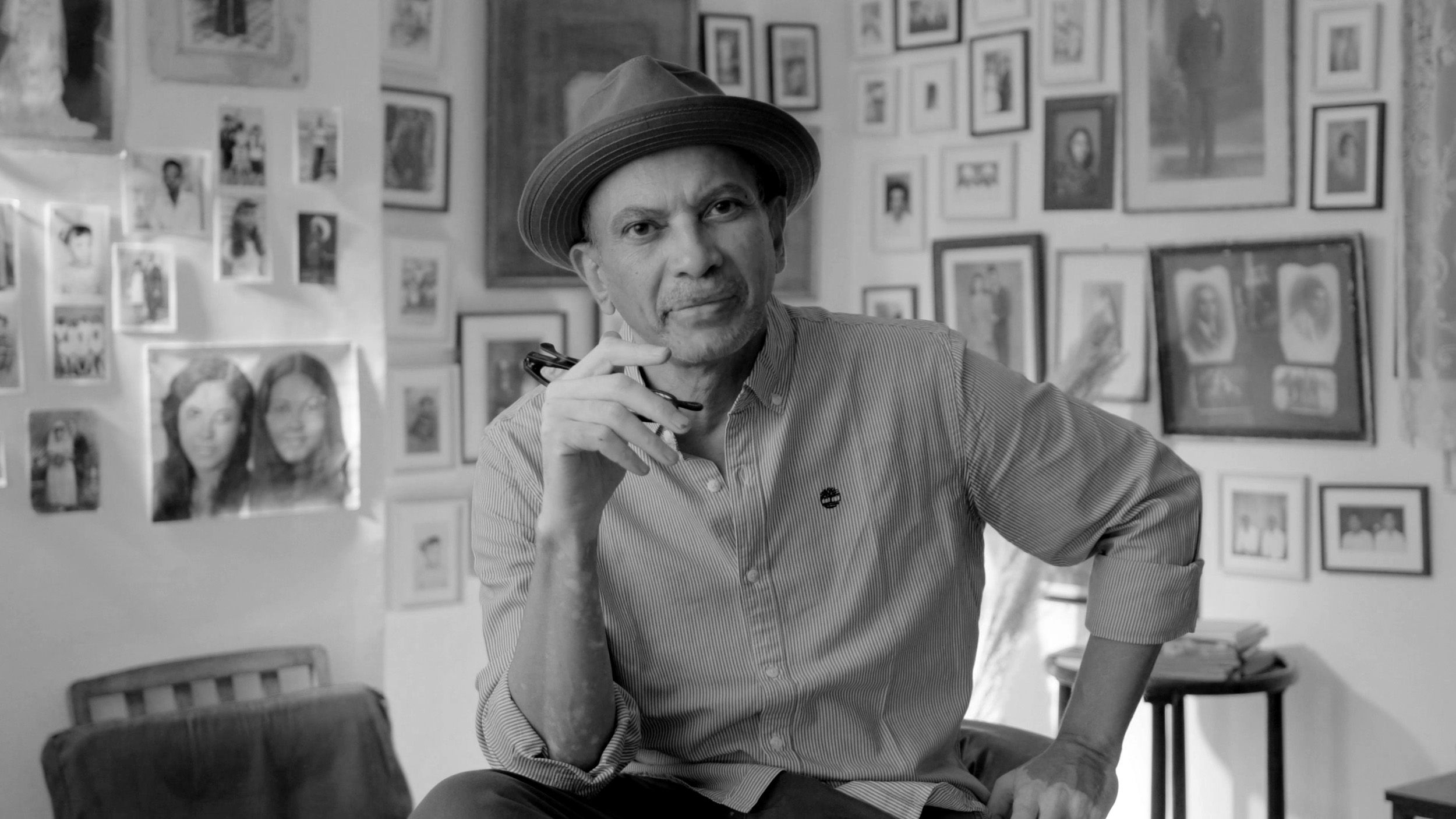
Point of ViewArtist Salah Elmur reflects on a corner of his Cairo studio.
Point of ViewArtist Salah Elmur reflects on a corner of his Cairo studio.
I like sitting in cafés and museums, but my favorite spot is in my studio in Cairo, in a space I’ve made for relaxation. I will work for hours without stopping, then I sit here, drink tea or coffee, look at the photographs on the walls, and I immediately feel at ease.
I wanted this corner to feel homey, to be a place where I could rest. My studio is full of different collections: I have maquettes of rabbits, antique pots women once used to store eyeliner, various rubber stamps. Here, however, there are only photographs—a small selection from a collection of more than 20,000 black-and-white photos from Sudan, Egypt, Ghana, Kenya, Mexico and beyond. I especially love those from the ’50s, ’60s and ’70s—before digital cameras—because they feel like a miracle to me. They fix a moment in time, recording life as it was.
When I’m on a break, I sit and look through them one by one, studying people’s features, imagining their stories. Two girls, a man, children sitting and playing—each photo sparks something in me. I even have a photo of my father and mother on their wedding day, but I keep family photos in an album.
My father had a photo studio before I was born, and when I was young, I found boxes full of negatives and pictures in our home. Even though his studio was only open for a year in 1964, that discovery changed my life. At the time, my father was a university student, and the Sudanese government required everyone to have an ID card. That meant every Sudanese person needed a photograph. My father was already a member of the university’s photography society and had a camera, and he saw the opportunity to open a small studio to earn money. Seeing the images transported me to another world. I didn’t know who the people were, but I imagined their lives and why they had gone to the studio at that time.