Simone Bodmer-TurnerMeet the artist throwing clay a curveball.
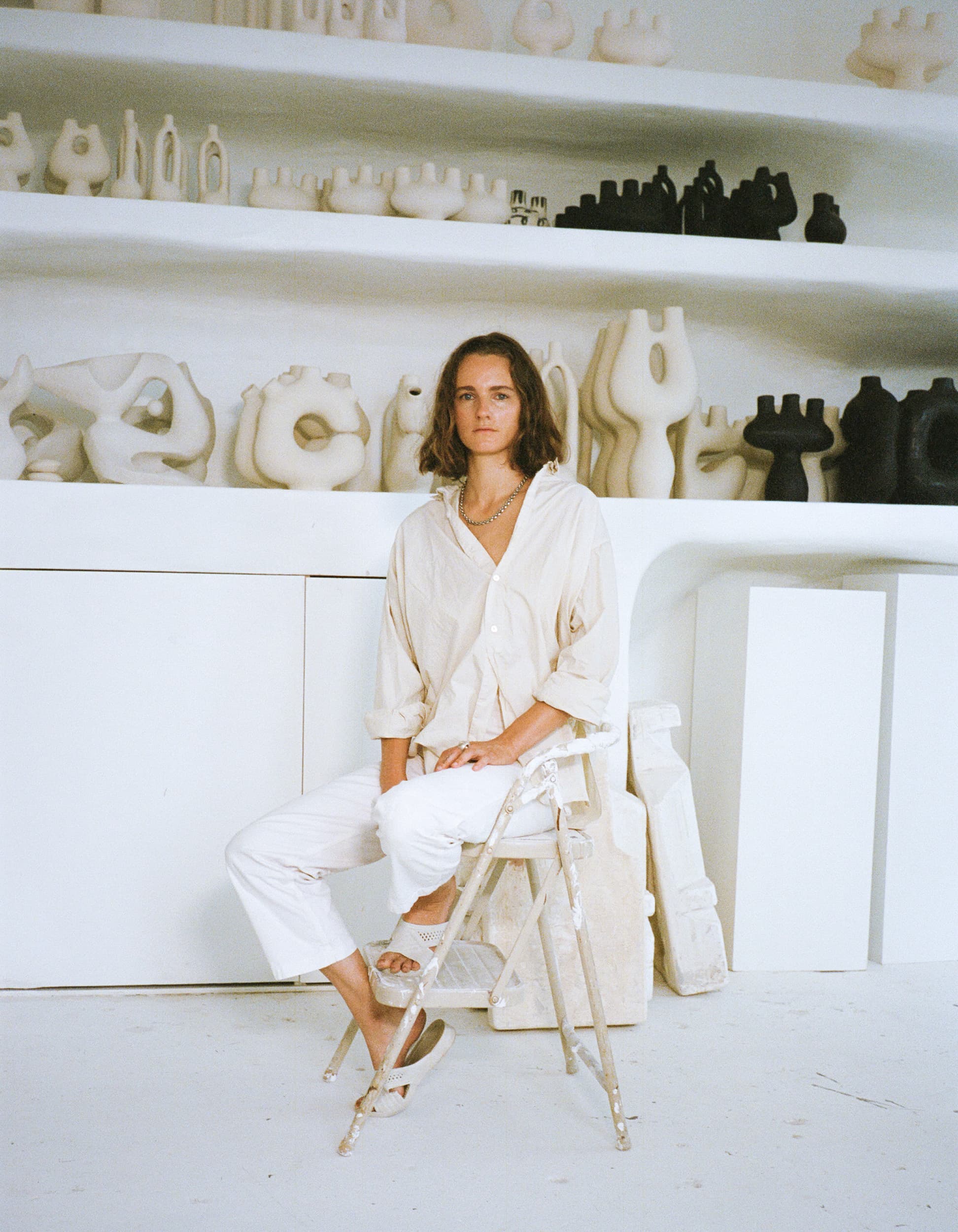
Since California-born sculptor and ceramist Simone Bodmer-Turner opened her studio in Brooklyn in 2018, her distinctively shaped pieces have pushed the boundaries of form, material and practicality. For Bodmer-Turner, creating functional objects out of clay—not just vases, but also chairs, fireplaces and shelving—has been a satisfying challenge. “I don’t use it in the way that most people do,” she says. “Everybody perceives ceramics as being super fragile, but the clay I use has so much sand in it that it’s more like a stone.”
In the fall of 2021, Bodmer-Turner relocated from New York to western Massachusetts, allowing her to rekindle her love of ceramics as a natural art form. She’s also settled into a smaller scale, making one-off sculptures rather than fashioning vast units. Clay is “one of the most pleasant and calming materials to work with,” she says. “But when you’re living in the city and ordering premixed clay from a factory, it becomes disjointed.”
Precious Adesina: A lot of your work is about pushing the boundaries of clay. How do you approach this?
Simone Bodmer-Turner: Most people who work with clay think of themselves as potters, but I don’t identify with any of the terminology usually applied to people who work with the medium. I use it as if it is some other material, and often people don’t realize it’s clay. Right now, I’m doing a lot more puzzle piece–like sculptures—multiple parts that fit into each other almost seamlessly.
PA: Shape is a big part of your work, but color seems to be intentionally lacking. Why?
SBT: When I first started moving away from more functional work, I made vases for a long time. I wanted to explore shape, push myself to find my voice and challenge myself to create interesting things, so I stayed away from not necessarily color but glaze. Using glaze in ceramics is a science; there are many ways it can go wrong. I also don’t like traditional glaze as it doesn’t serve the kind of work that I make. You don’t get those sharp lines or shadows in the same way, but with being in Massachusetts and working with more experimental firings, I’m looking forward to exploring surface again. I haven’t done that since I worked with wood kilns in Japan.
PA: Why did you shift from design to art?
SBT: I still have the design practice, but I have scaled that back, so it’s less business and more art. It’s now just one assistant and me working directly with clients. Most of my work is now sculpture or smaller pieces, as requested. Producing at scale was not the right path for me. I was mainly managing the studio, and there wasn’t that much time for making my own work.
PA: How has moving from the city to the countryside changed your approach to your work?
SBT: I’m currently splitting my time [between Brooklyn and Massachusetts], but I’ll be giving up my studio in New York soon. It’s one of the hardest decisions I’ve ever made, but the barn has more space, it is in the middle of a beautiful field and I can build a wood kiln. So there’s just a lot more possibility to go in the direction that I want to go in, which is being more in touch with nature and using the natural elements more directly. People are drawn to ceramics because there’s this romanticism about working with the earth and having a grounding element to your practice.