Studio Visit: FRANÇOIS STAHLY
- Words Annick Weber
- Photos Yosigo
Inside the abandoned home-atelier of the late postwar sculptor.
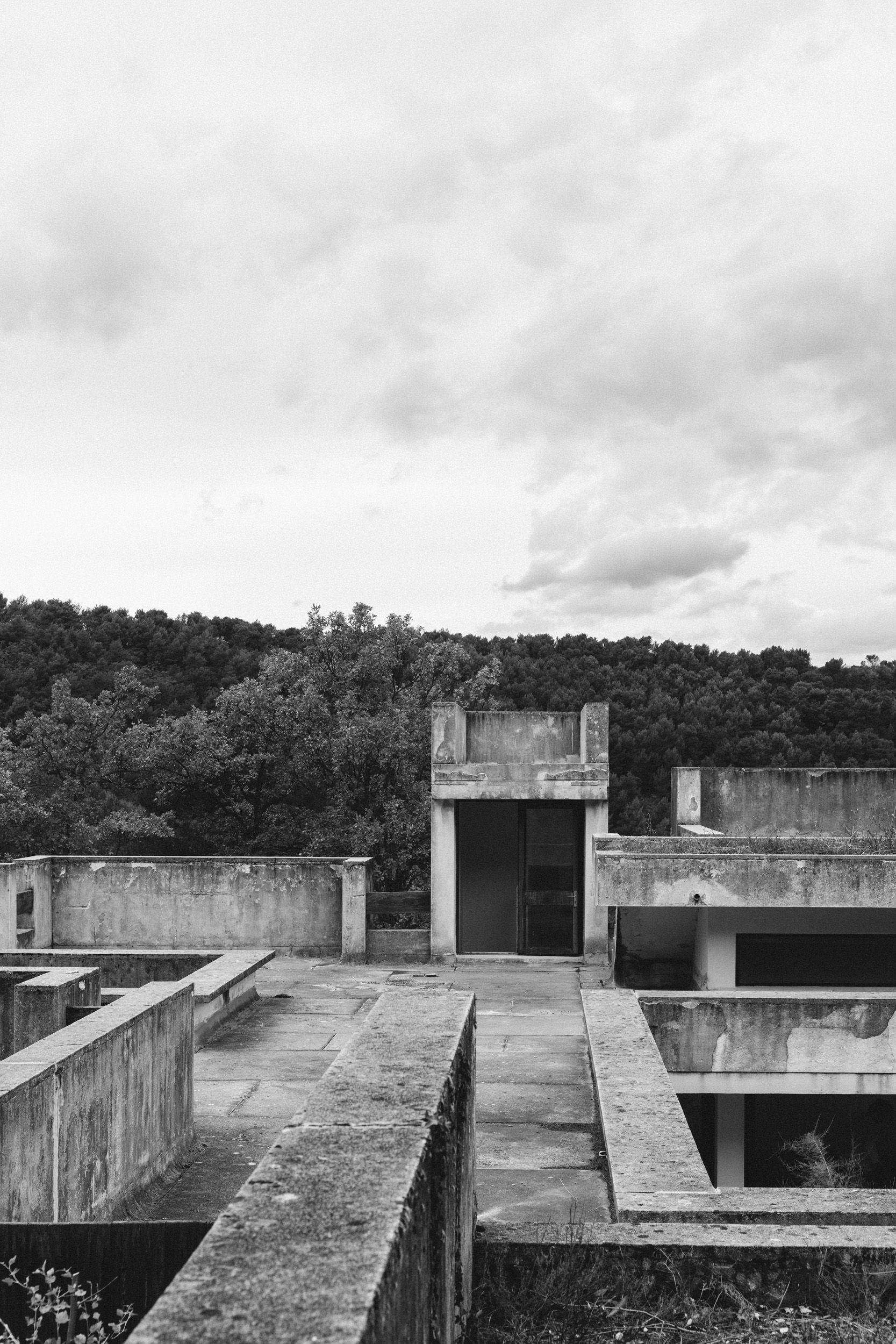
Different levels were designed to flow into one another around two patios. Terraces function as external passageways, and each floor is linked by a series of staircases, creating a continuous circulation between the spaces.
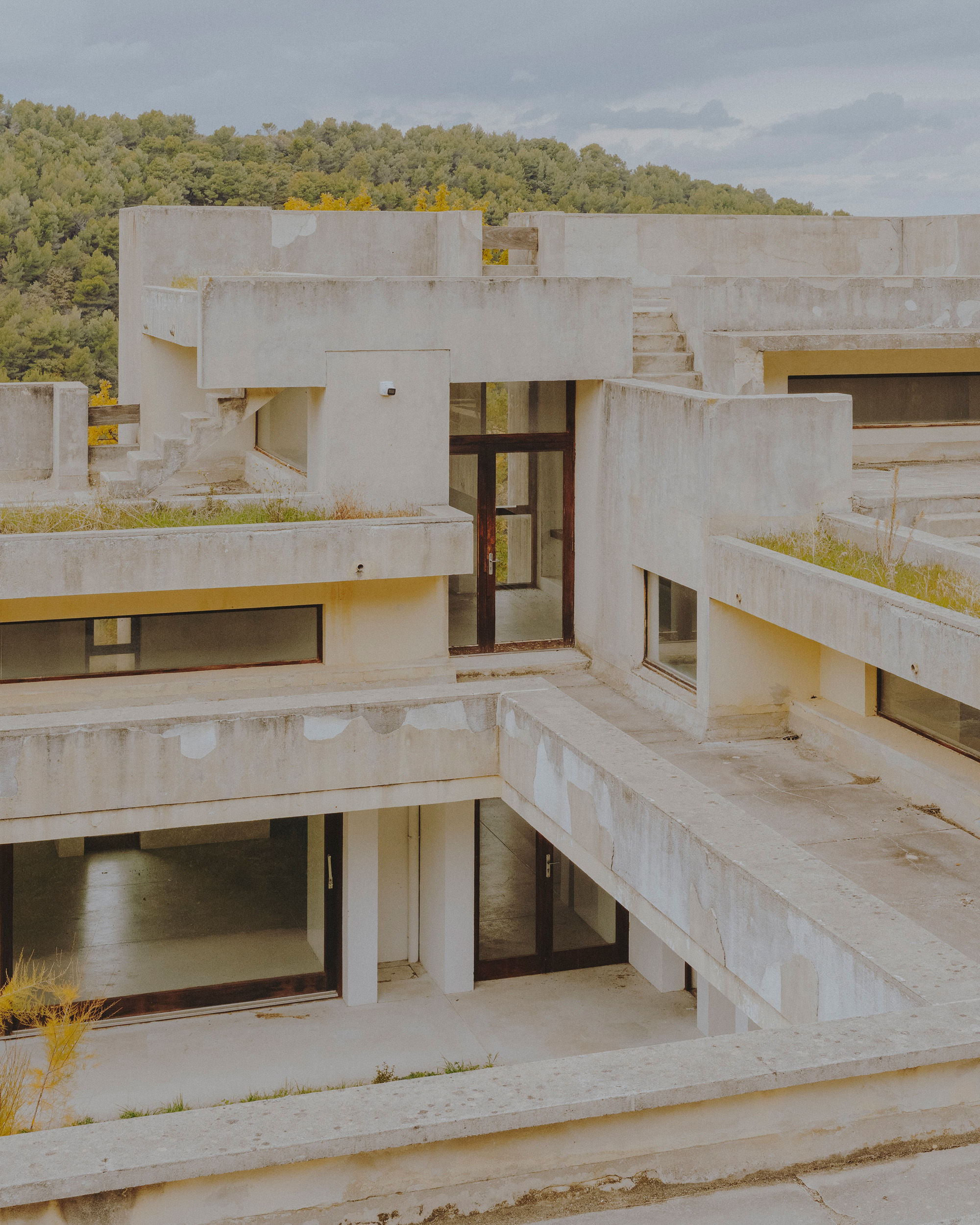
The road to the former home and atelier of French sculptor François Stahly winds up through dense pine forests from the picturesque village of Crestet in the south of France. Pulling up at the house, you are greeted by a series of gray-beige concrete blocks that cascade down the sloped terrain—architecture that feels a world away from the traditional stone and terra-cotta roofs just a mile back down the road. A maze of terraces, stairways and patios, the building sits in the rolling countryside west of Mont Ventoux like a child’s construction set abandoned mid-play.
The foundations for the house were laid in 1966, after Stahly and his family returned to France following five years in the United States. Stahly had taught at the University of California, Berkeley, led a collaborative workshop at the Aspen School of Contemporary Art and completed several large-scale public commissions. “He and my mother [tapestry artist Claude Stahly] came back with a taste for the great outdoors and the collective work they experienced in America,” explains Catherine Stahly Mougin, the youngest of Stahly’s three children and the editor of a forthcoming catalogue raisonné on her father. “The idea that led my parents to establish their atelier here was to work in the middle of nature and invite young artists to join them in the adventure.”
The couple bought the woodland site from Claude’s sister and enlisted their middle son, Bruno—who was studying architecture under Marcel Lods at the École des Beaux-Arts in Paris—to help them develop the plans. While the design was a collaborative effort between father and son, it shows the influence of Bruno’s own experience in the United States: his apprenticeship with Ludwig Mies van der Rohe in Chicago, an acquaintance with the architect Bruce Goff and visits to some of Frank Lloyd Wright’s key works. Bruno had also assisted his father on a fountain for the 1962 Seattle World’s Fair and its cantilevered basins foreshadow the long, floating terraces he designed for his parents’ home.


Inside, narrow windows frame views of the Provençal forest rising above the village of Crestet.
“There were always a dozen people or so around the table.”
More than an attempt to bring American modernism to the French countryside, however, the atelier was a practical necessity. Stahly had just won the commission to create a monumental sculpture for the New York State Capitol Plaza in Albany and needed space to work on the series of stacked wooden towers and arches that would comprise the piece. Completed in 1972, it would be one of his major installations, encapsulating the totemic, nature-inspired forms that earned him recognition in the United States.
“My father wanted Crestet to be a place where people could learn the art of wood and stone carving, and the commission gave him the financial means of doing so,” explains Stahly Mougin. The house was still unfinished when the family moved in in 1968, but the atelier’s high ceilings, horizontal openings and generously proportioned spaces allowed Stahly to make progress on the Albany installation. And in any case, as Stahly Mougin remembers, her parents “were always busy adding to the house.”
Stahly had invited young artists to help him in his previous atelier in the Parisian suburb of Meudon, where the family had lived before leaving for America, but at Crestet the scale was more ambitious, with Stahly sourcing large pieces of iroko wood from a timber supplier down in the valley. Stahly Mougin recalls her childhood and early adulthood in this environment as “one filled with curiosity, where there was always someone new to meet. We had people from everywhere: Swiss, Belgians, Germans, Canadians—so many nationalities passed through our home. During meals, we would all come together and talk; there were always a dozen people or so around the table.”
The living quarters were secondary to the studio spaces. Stahly and his wife lived in a small space with a kitchen and bathroom on one side of the central courtyard, while the children and visiting artists were housed in outbuildings. To get some peace away from the hustle of studio life, Stahly constructed a tiny room for himself on one of the terraces, where he penned his articles on the contemporary art scene for publications including Werk and Die Kunst. He also kept hundreds of books in the atelier, where everyone could consult them, much like in the libraries of the colleges where he taught.
“My mother would always say, ‘Let Papa work, don’t disturb him,’” says Stahly Mougin. “When we wanted to ask him something, we would have to wait until he came out of his atelier or his study. My parents’ life was inseparable from their work.” It was for this reason that the atelier-home was arranged around two patios—the only way to flood the working spaces with light, since the outer walls had to be kept windowless as a shield against the harsh mistral wind. The region is also prone to wildfires, and the family kept the gardens cleared of branches—save for a few cypress trees in the courtyards—to prevent a blaze that could have destroyed their dream of a haven for collaboration and creativity, rooted in the natural landscape.
It was a dream, in any case, that would last only a few short years. In 1973, Claude died suddenly of cancer and, after falling into a depression, Stahly abandoned the project, spending the following decades seeking new inspiration at sacred sites across Central America, India and North Africa with the young French Iranian sculptor Parvine Curie.
The home was bought by the French state in 1985 and turned into a center for contemporary art, with exhibition spaces and residencies for artists exploring the relationship between their practice and nature, as well as a sculpture garden featuring works by Stahly, Curie and Frans Krajcberg, among others. The project would never achieve the dynamism it aspired to, however. The local town hall objected to the influx of traffic into their village, and gradually momentum stalled as the Ministry of Culture shifted its focus to more urban projects.
When the center finally closed to the public in 2003, the sculptures were relocated to public spaces across France, and the home and atelier fell into disrepair. For a while, a resident caretaker ensured a minimum of maintenance and security, but after he retired, it was left empty.
Today, the house has been uninhabited, and unheated, for so long that the facade is showing signs of damp, and nature has taken its course, with moss and shrubs growing on the walls and roofs. In 2022 the building was classified as a monument historique, for its artistic and architectural significance, but the cost of meeting the conservation requirements tied to its new status led the state to put it on the market. After a thorough selection process, the site was bought by Michel Gilbert, a Belgian property investor who has experience with protected architecture, having purchased and restored several Victor Horta structures in Brussels.
Gilbert plans to turn the building into his vacation home once the construction permits are issued, but it wasn’t the prospect of holidaying in the south of France that piqued his interest. “I am passionate about architecture,” he says. “When I first saw the photos, I was almost certain I would buy it. It’s very surrealist: the large volumes, the shifting levels with staircases leading up and down, the mezzanines. I haven’t shown it to anyone yet who didn’t say ‘Wow.’”
While Gilbert intends to restore the exterior to its former glory, he envisions small adaptations inside to create additional bedrooms in the former atelier. He also aims to plant Japanese-style gardens in the patios and, most importantly, reintroduce sculptures by Stahly and Curie across the grounds.
Just as he has done with his Horta buildings, Gilbert would like to open the house to the public for occasional guided visits—an effort, he hopes, that will help ensure that Stahly (who is still better known in the United States) is recognized in Europe as one of the great postwar sculptors. If a home is a mirror of its maker, this one speaks volumes, and there would be no better way to get to know Stahly than at Crestet.