STUDIO VISIT: HAIDEE BECKER

  • Words Precious Adesina
  • Photos Alixe Lay

Inside the London studio—and home—designed to provide all the inspiration one painter needs.
Issue 53

, Features

,
  • Words Precious Adesina
  • Photos Alixe Lay

( 1 ) In Rome, Becker’s parents hosted glamorous parties during which they staged marionette theaters. The pair made a strong impression on the film director Federico Fellini, who, according to Becker, offered her mother (and the puppets) a role in his 1960 movie La Dolce Vita. Campbell declined, but Fellini based two intellectual characters—the Steiners—on Becker’s parents and replicated their apartment (even using their paintings) in the film.

( 2 ) Becker’s son is chef and restaurateur Jacob Kenedy, who opened Bocca di Lupo in London’s Soho neighborhood in 2008. Off the back of its success, he has since opened a gelateria, Gelupo, and Plaquemine Lock—a gastropub on the Regent’s Canal that has received Michelin’s Bib Gourmand award three years running. He is also the author of three cookbooks, including The Geometry of Pasta.
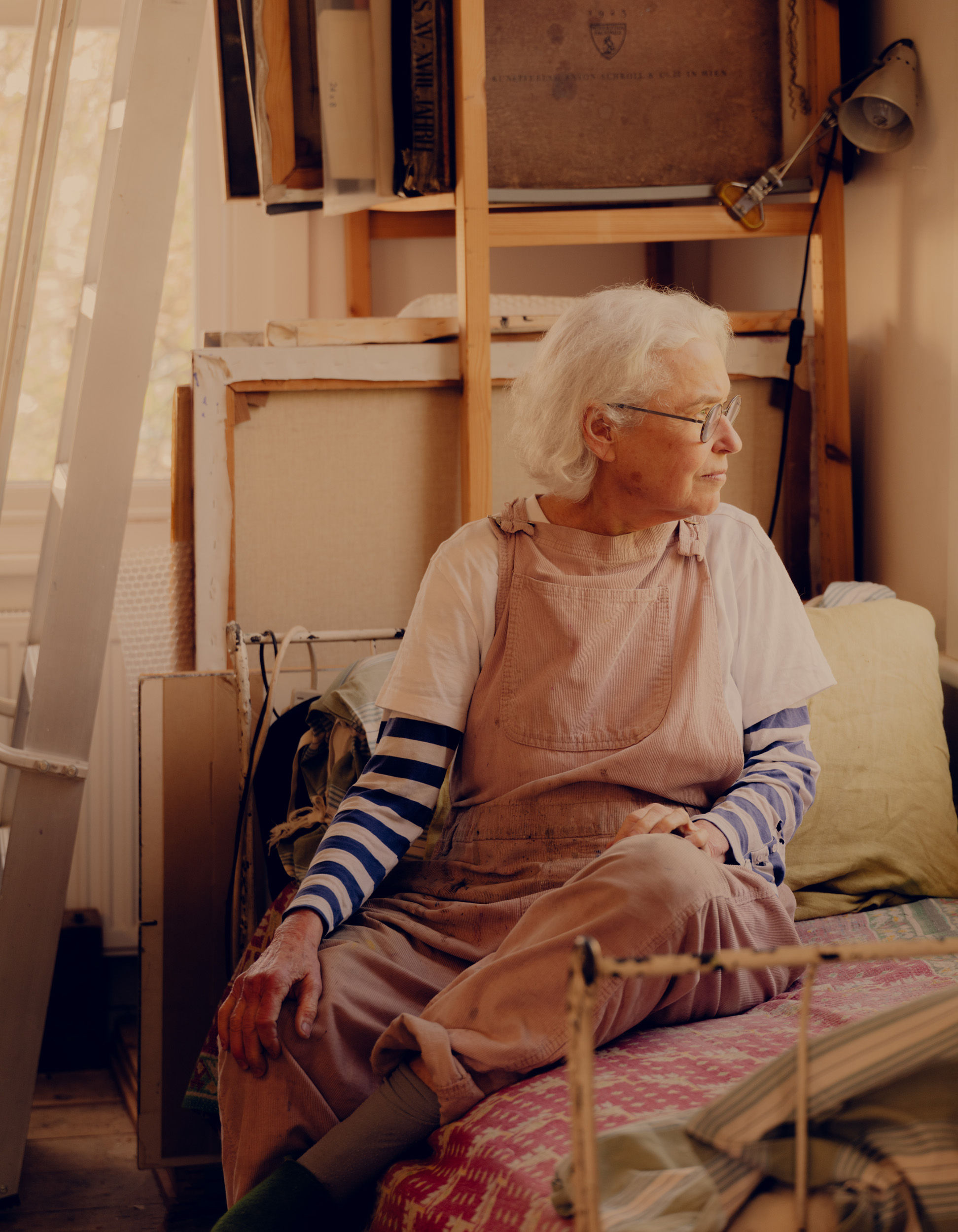
The first thing you notice as you enter Haidee Becker’s quaint north London home-cum-studio is the large folding screen standing next to the stairs in the hall, painted with bold abstract shapes. “Don’t you think that’s amazing?” says the 74-year-old artist, noting that the work has stopped visiting art dealers in their tracks. “They would say, ‘Oh, that’s really good. Do you have anything more like that?’”

The work, as it turns out, was made not by the celebrated painter, in what would have been a departure from her carefully observed still lifes and portraits, but by her son, Jacob, when he was eight years old. “I learned to close it up and put it away when [the dealers] came,” Becker jokes. Yet the screen sets a welcoming tone for the Victorian home that Becker now shares with Lobos, her dog. Her light-flooded studio, which occupies most of the second floor, is filled with Becker’s paintings: contemplative works that cover the walls, rest against workbenches and are stacked on shelves. In the rest of the house, wherever the walls are not lined with books, she has hung art by friends and family, including other pieces by her now adult children—offering a chance, she explains, “to get away” from her own work.

Becker was born in Los Angeles and raised in Rome by her parents, the writer and gallerist John Becker and the Hollywood actress Virginia Campbell, before the family settled in London.1 She began painting in the summer after her final year of high school when, as she says, she had little else to preoccupy her. “I started to do watercolors and I just got hooked.” In place of a formal education, she copied paintings at the National Gallery. (“I went one day to an art school and I hated it so much”). The portraits and still lifes she has produced in the five decades since capture the beauty of the everyday, turning slabs of meat and fresh vegetables into searching meditations on life and death. The late poet Ted Hughes once wrote that her paintings have an “essential quality…. The revelation of a passionate inwardness.” 

Becker moved to her current home in 2019 after her partner, the British author Clive Sinclair, passed away, but she already had been looking for a new place prior. The previous home—a Georgian house—was impractical. “It was on four floors with one room on each,” she says, explaining that there was never enough space for both of them to work and that she found herself bouncing from studio to studio. “I moved 10 times in 10 years because the studios didn’t have the right light or were too small. It was just a nightmare.” 

( 1 ) In Rome, Becker’s parents hosted glamorous parties during which they staged marionette theaters. The pair made a strong impression on the film director Federico Fellini, who, according to Becker, offered her mother (and the puppets) a role in his 1960 movie La Dolce Vita. Campbell declined, but Fellini based two intellectual characters—the Steiners—on Becker’s parents and replicated their apartment (even using their paintings) in the film.

( 2 ) Becker’s son is chef and restaurateur Jacob Kenedy, who opened Bocca di Lupo in London’s Soho neighborhood in 2008. Off the back of its success, he has since opened a gelateria, Gelupo, and Plaquemine Lock—a gastropub on the Regent’s Canal that has received Michelin’s Bib Gourmand award three years running. He is also the author of three cookbooks, including The Geometry of Pasta.
Becker frequently uses flowers as still-life subjects. The British poet Ted Hughes once wrote that her works possessed an “essential quality” that revealed “a passionate inwardness” which he attributed to “a psychological depth of great sweetness, gently and powerfully focused.”

Here, however, she has been able to design the space around her work as an artist. Little needed to change on the ground floor, which has an airy, high-ceilinged living room and study, and a kitchen with a dining area in a modern extension that leads out to the leafy garden. Upstairs, however, Becker enlisted the help of architect friends Johan Hybschmann and Margaret Bursa to create a spacious studio that, along with a small bedroom and bathroom, occupies the second floor. Even so, despite having “so much” space in this new studio, she still feels as if she could do with more. “There’s not much room to hang paintings,” Becker says, looking around at her work.

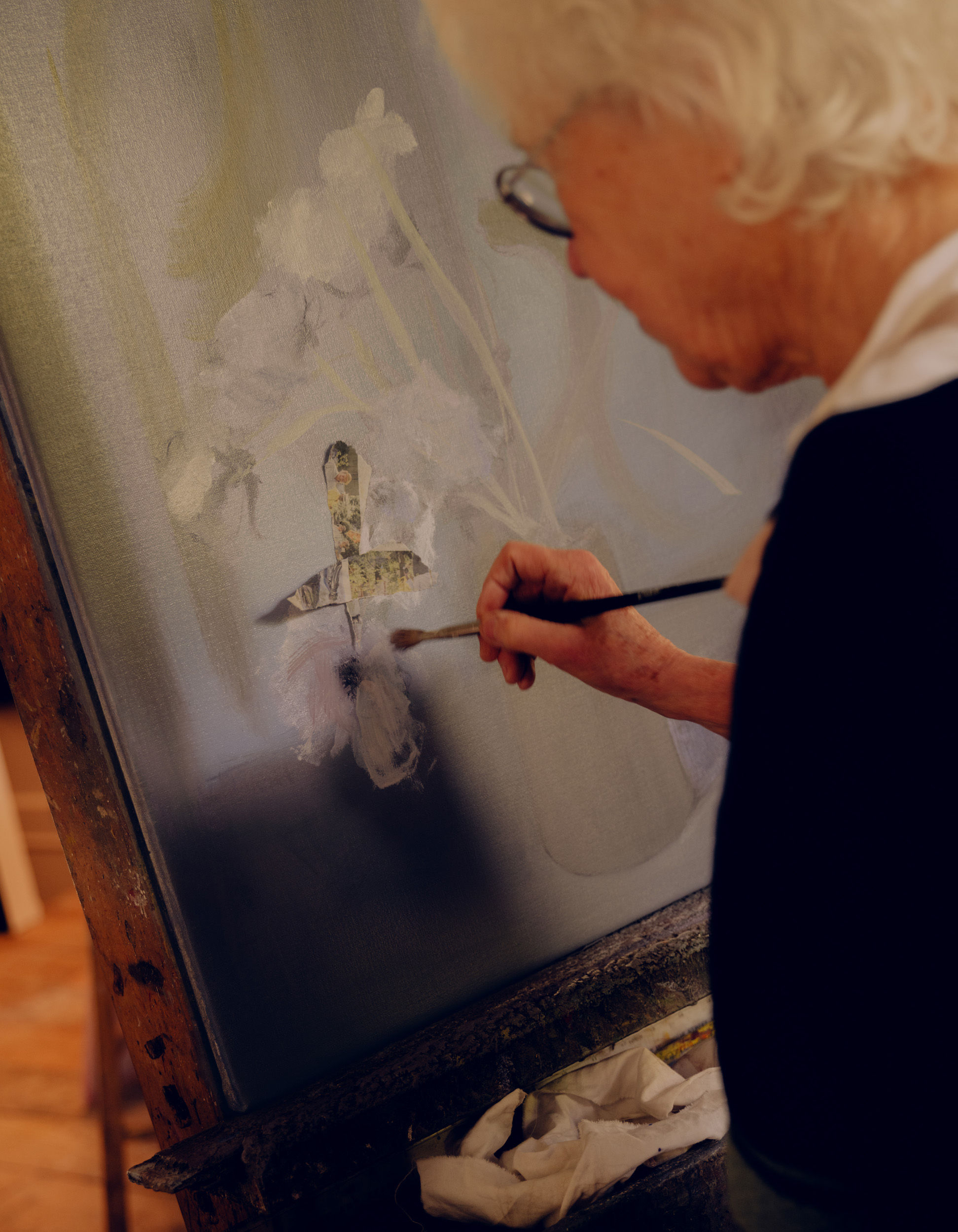
Two paintings made two decades apart do hang in the studio, however. stewart 1 (1985) is a closely cropped portrait of friend and fellow artist Stewart Helm, who is depicted sitting in front of one of his own paintings and gazing into the distance. The brushstrokes are loose, the varied colors and shapes that compose his face made with quick precision. “When I was younger, I had a lot of anger and energy,” she says. “It was much more passionate and explosive.” It forms a contrast with rachel (2008). The subject, Becker’s daughter, is sitting in a corner of the canvas, grinning at the viewer while slicing an artichoke, with vegetables and flowers scattered across the table in front of her. The painting appears to have been more strategically composed and the artist’s hand is less apparent. “Now [my paintings are] much more contemplative and passive,” she says. “I let the world in, which is, for me, a small world. It’s the flowers or the plants or the meat, and people speak to me rather than me trying to dominate them.” 

“I let the world in, which is, for me, a small world.”

The flowers and the other objects that litter the various worktops in her studio—plant pots, seashells, pieces of fabric—are echoed in more recent works. hellebores in jug (2023), is reminiscent of Van Gogh’s still lifes, the muted greens and purples of the wilting flowers painted with bold and expressive gestures. “I usually go to Columbia Road [Flower Market] once every three weeks and get a shitload of flowers,” she says, explaining that she’d been the day before, which is why the flowers were particularly fresh. “I paint a lot of flowers as [those works] sell best, but I go on painting them [after they begin to wilt], and they become very interesting to me in a different way.” She relates the dying flowers to her own experiences of aging. “It’s very strange getting old because you look at your body, and you don’t recognize it, and it happens quite rapidly,” she says. “Luckily, I like it. It is a strange, interesting process of disintegrating and changing.”

Becker at her current home in Stoke Newington, where she has lived and worked since 2019. “I work best in places that have been used and are old,” she told Inigo’s Almanac last year. “A lot of the things I have in my studio I’ve had all my life.”

The artist says she tends not to place too much meaning on her work: “I read a lot, but I’m not a cerebral person, so I don’t put anything into words—I find that if I try, it belittles it.” But that hasn’t stopped others offering their own interpretations. “People have said that they’re not really about flowers. They’re a story, and some of them are very dark.” She pauses to think and adds, “I’ve been to very dark places, so I suppose I do express it in my paintings.” Becker highlights the potential references to death. “You see the duck,” she says, pointing to meat and bay from 2022, a large painting—it’s almost six feet wide—depicting a table holding birds, eggs and a large slab of meat. “It’s dead.” She moves to another still life of meat from Bocca di Lupo, her son Jacob’s restaurant.2 “There’s a lot of meat [in my work],” she says. “It has life and death.” 

Despite how some might interpret her paintings, Becker has carved out a space in her home and studio that’s filled with joy and gives her essential time for contemplation. “One of the main problems of being a painter—and writers have written about it, too—is that in order to work, you have to turn your back on life outside, though what makes you want to work is the life outside,” she says. “So you’re constantly stuck in this conflict of inside or outside, or being engaged or solitary.” Her friend encourages her to leave the house more, saying that what keeps one alive and young is meeting and talking to people. “It’s not good for you to be on your own,” she tells Becker.

Becker points to Lobos, who has spent the past hour and a half following her every move. “But, you know, everybody’s different. And I’m not on my own. I live with him.”

“I’ve been to very dark places, so I suppose I do express it in my paintings.”

FREE PREVIEW

Take a look inside Issue Sixty

You are reading a complimentary story from Issue 53

Want to enjoy full access? Subscribe Now

Subscribe Discover unlimited access to Kinfolk

  • Four print issues of Kinfolk magazine per year, delivered to your door, with twelve-months’ access to the entire Kinfolk.com archive and all web exclusives.

  • Receive twelve-months of all access to the entire Kinfolk.com archive and all web exclusives.

Learn More

Already a Subscriber? Login

Your cart is empty

Your Cart (0)