Theresa Traore DahlbergWhen Theresa Traore Dahlberg realized that she couldn’t relate to narratives about women in West African films, she decided to make her own.
Theresa Traore DahlbergWhen Theresa Traore Dahlberg realized that she couldn’t relate to narratives about women in West African films, she decided to make her own.
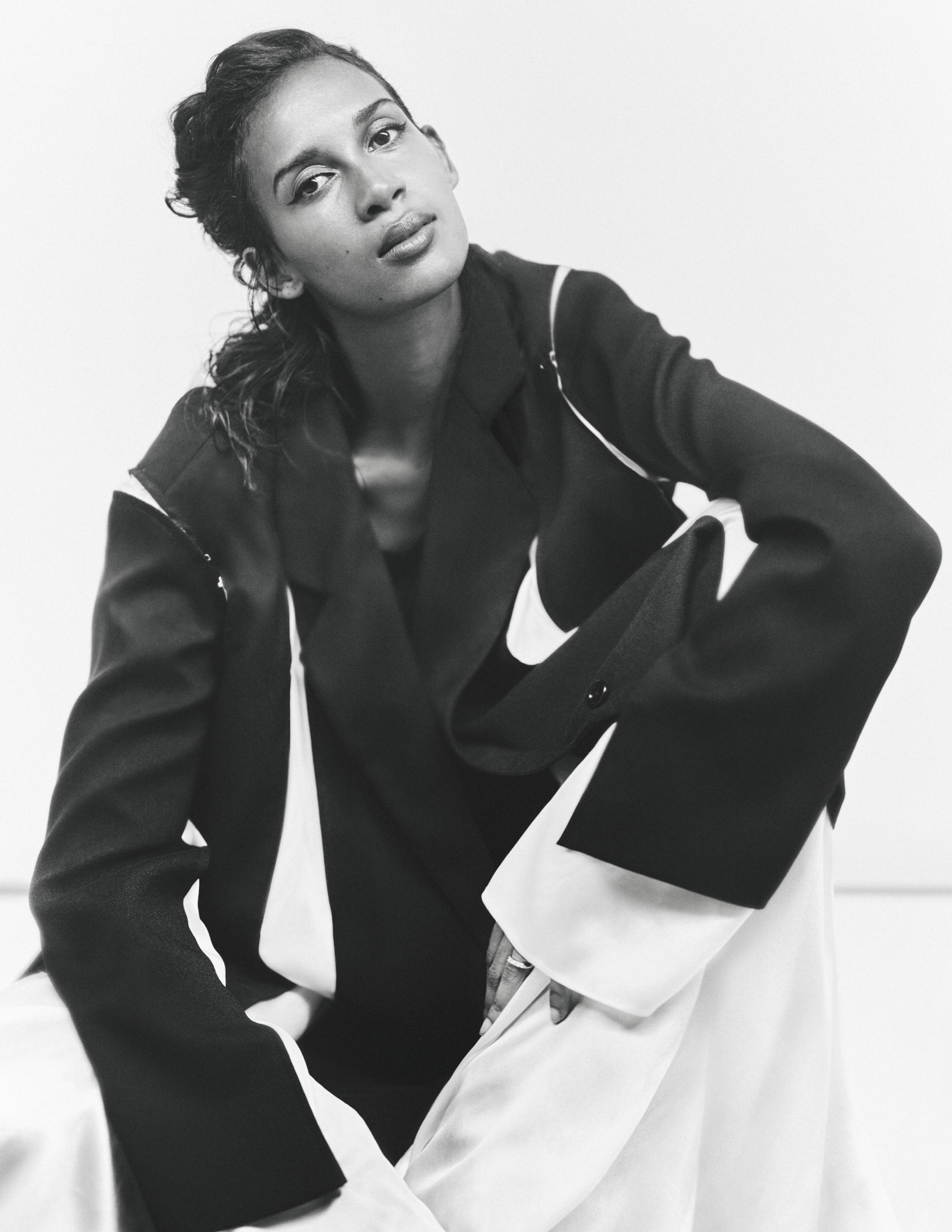
Theresa wears a coat by Acne Studios.
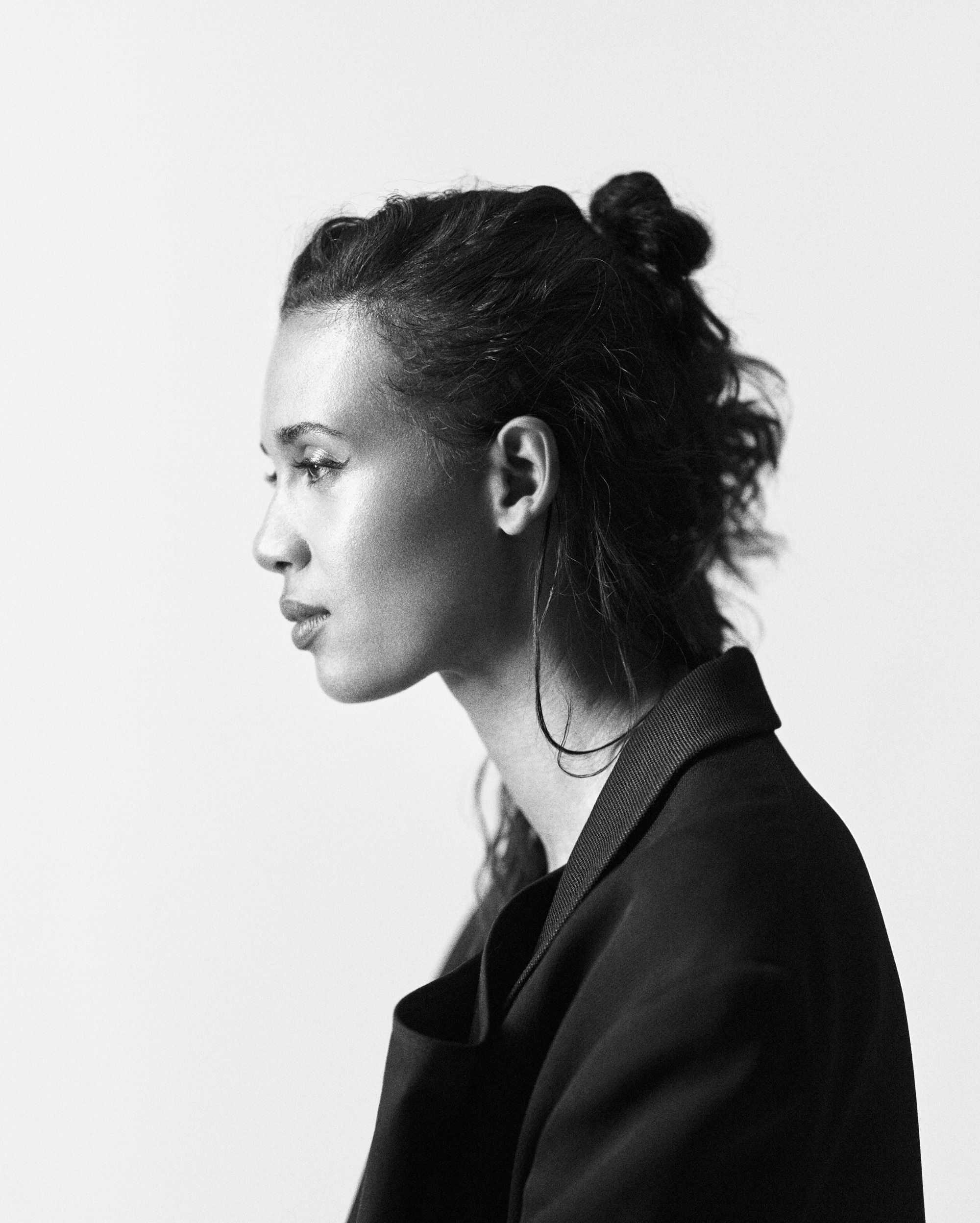
Theresa wears a top by Yohji Yamamoto and a jacket by Acne Studios.
“Fame itself is not something I strive for, but I would like my films to be seen.”
Theresa Traore Dahlberg is currently editing her first feature-length documentary, Du Courage, a bildungsroman shot in Burkina Faso. Her whole life, Theresa has split her time between the Sahelian nation and Sweden. It’s an arrangement she says has broadened her perspective and instilled a versatility at her core—a valuable set of attributes for a documentary filmmaker. Knee-deep in more than 170 hours of footage, Theresa discusses her drive to persist, challenge stereotypes and deliver the West Africa she loves to a bigger screen and audience.
What are your working days currently like?
I’m finishing my first feature documentary that was filmed in an all-girls school for car mechanics in Burkina Faso. It’s a film about making choices, friendship, lost mothers and pretty much the everyday life of a teenage girl—a coming-of-age story in Ouagadougou. I’m also in my last year of studying fine arts at the Royal Academy of Fine Arts in Stockholm where I’m working on painting, sculpture and installation projects.
How do you decide what to document in your films?
It completely depends on the project I’m working on. I decided that I wanted to do my last film, Taxi Sister, after being in film school and having not seen even one inspiring film from the continent of Africa. Every time I saw an African film at school, I walked out feeling half as tall. The subjects were always war, poverty and disease. Of course, these stories should be told but if that’s the only thing that you see then there’s no balance. I felt like inspiring stories of women in West Africa were lacking. I also wanted to see more everyday stories that I could relate to. In general, what makes me want to document something is when I’m moved by a person or a place or if I’m passionate about a particular subject. It always starts with an initial gut feeling.
You spent a lot of time in West Africa yourself as a girl.
I grew up in between Ouagadougou and the island of Öland in the southeastern part of Sweden. It’s actually called the “Swedish savannah.” I grew up there and I also grew up in Burkina Faso—back and forth.
How do you think that’s shaped you?
First of all, it gave me language. I’ve always spoken French, Swedish and English. It definitely gave me a wider perspective and also flexibility—the ability to adapt and pretty much feel at home in a new place. It was very important for my parents that we played with kids from different backgrounds from a young age. For me, the understanding that people are the same wherever you go has always been in my core.
Where else have you had to adapt?
After high school, I lived in Barcelona for a little bit and came back to Sweden to study economics. It turned out to be completely wrong for me, so I took my savings and went to New York and started assisting different directors and photographers among other jobs.
When did you realize that economics wasn’t the right path?
When I moved to New York, I lived in a small apartment with other girls my age that had aspirations and ambitions within the arts and music. I realized that it was okay to try and work for your dream, even if it’s outside of a normal everyday job. We encouraged each other a lot and are still good friends today. I started assisting directors, and after a few years I studied experimental film and 16mm film at The New School before applying to Swedish film school.
Why film?
For me, filmmaking is a way of communicating, understanding and seeing. I feel very present when I’m filming, like I’m 100 percent there. I also like the whole process of filming and then, afterward, sitting and editing. There are so many layers with film—the sound, the music, picture, editing, characters and locations. The possibilities are endless.
Do you prefer to work alone or collaborate?
I used to do everything on my own. I still do on smaller projects, but in this current one with more than 170 hours of material, it’s been great to have a small crew to work with. It’s been good to work with a photographer and editor that I really, really trust.
Do you work better at night or in the morning?
I get more done at the beginning of the day.
Do you remember the moment, person or film that inspired you to become a filmmaker?
My mother was a teacher and would borrow a VHS camera from her school over the weekend. That was the first time I saw a camera. When I look at those tapes now, I can hear myself in the background pleading to hold it. I’ve always had an urge to document, to film and take pictures. I guess I feel like I can freeze a moment and take it with me forever—it’s like collecting moments. But making a film is so different from just documenting everyday life. I remember watching Fassbinder, Maya Deren or Wiseman films and old documentaries like Grey Gardens for the first time. There are so many stories to tell and so many ways to touch magic with film.
What’s the worst job you’ve ever had?
I’ve been working since I was 13 years old, doing all kinds of extra jobs—at a candy shop, restaurant, real estate agency, as a janitor, gardener, guide, kindergarten teacher, TV host. The list is long. The worst job was working at an amusement park and not being allowed to talk to the other workers. Whether I like a job or not comes down to the people I work with and the work environment.
Are there any small, boring tasks that you secretly enjoy doing?
I enjoy setting the table and peeling potatoes.
What do you admit to being bad at?
Remembering names.
Your last documentary, ‘Taxi Sister’, also featured women working with cars. Is there a theme in your work?
With Taxi Sister, the protagonist made a really major choice to become a taxi driver and go against the grain of what was expected of her as a woman. At the mechanic school in the movie I’m currently working on, they didn’t get to make that choice. I found it really interesting just to follow the girls in those different worlds. There are so many questions—about becoming a woman, boyfriends and relationships. There are so many things happening and then, on top, there is a layer of doing something that a lot of people have issues with. They go through layers of truths and expectations of how a woman really should be at school, at home and in public.
What do you think about the representation of women in film more generally?
I want to see more of it.
Would you ever like to be famous?
Fame in itself is not something that I strive for, but I would like for my films to be shown and my exhibitions to be seen.
What are some of the things you miss about Burkina Faso when you’re in Sweden, and vice versa?
When I’m in Sweden, I miss the red dust, mangoes, the way everyone talks to each other wherever they go, the sounds at night and, of course, my family. When I’m in Burkina Faso, I miss coffee, the four seasons—or all seasons but winter—and, of course, my family and friends.
–
Hair and makeup Ignacio Alonso
Photography Assistant Dominick Hedgecock
Photography Assistant Rasmus Staahl
Photography Assistant Ellen Nykvist